

1963 State Papers (page 2)
January 03 1994
Publication Date
Cosgrave Plea to Release De Valera from Prison in Belfast, Early Contacts Focus on Issue of Prisoners, Civil Rights Concerns Ignored by Parliament, Stormont Said No to Address by De Valera, Prisoners’ Release Always Contentious, Whitehall Non-plussed by Talk of IRA Activity
State Paper Snippet
Record Office Opens Cabinet Door to Public
This week, the Public Record Office of Northern Ireland released to the public under the 30-year rule some 2,000 previously confidential Cabinet files mainly relating to 1963.
The files include some dating from earlier periods – the 1920s, 1930s, and 1940s. For the first time, the Record Office has adopted a standard 10-year closure period for those files still considered sensitive (i.e. 30 years plus 10).
Few Stormont Cabinet files were embargoed this year though the census records for 1937‒61 are, in line with policy in Britain, closed indefinitely. Among those files closed for 10 years is a Ministry of Agriculture file for 1953‒63 entitled General Enquiries and Customs Returns regarding Transit of Flax from Northern Ireland to Southern Ireland and the Smuggling of Flax.
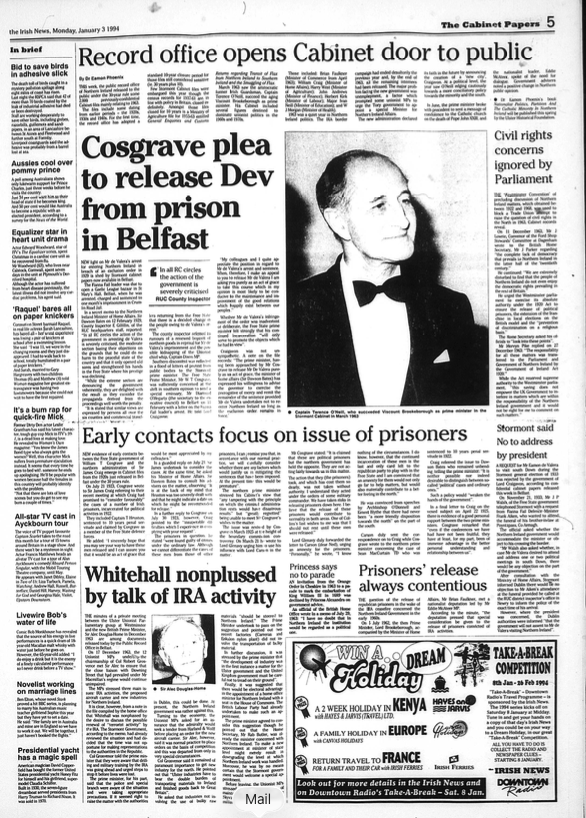
March 1963 saw the aristocratic former Irish Guardsman, Captain Terence O’Neill, succeed the ageing Viscount Brookeborough as Prime Minister. His Cabinet included several figures destined to dominate Unionist politics in the 1960s and 1970s.
Those included Brian Faulkner (Minister of Commerce from April 1963); William Craig (Minister of Home Affairs); Harry West (Minister of Agriculture); John Andrews (Minister of Finance); Herbert Kirk (Minister of Labour); Major Ivan Neill (Minister of Education); and WJ. Morgan (Minister of Health).
1963 was a quiet year in Northern Ireland politics. The IRA border campaign had ended desultorily the previous year and, by the end of 1963, all the remaining internees had been released. The major problem facing the new government was unemployment, a factor which prompted some Unionist MPs to urge the Tory government to appoint a special Minister for Northern Ireland Affairs.
The new administration declared its faith in the future by announcing the creation of a ‘new city Craigavon. At a political level, the year saw O’Neill edging cautiously towards a more conciliatory policy towards the minority and the South.
In June, the Prime Minister broke with precedent to send a message of condolence to the Catholic Church on the death of Pope John XXIII, and the Nationalist leader, Eddie McAteer, spoke of the need for dialogue. Government advisers noted a positive change in Northern public opinion.
– Dr. Éamon Phoenix’s book Nationalist Politics, Partition and the Catholic Minority in Northern Ireland will be published this spring by the Ulster Historical Foundation.
Cosgrave Plea to Release Dev from Prison in Belfast
New light on Mr. de Valera’s arrest for entering Northern Ireland in breach of an exclusion order in 1929 is shed by Stormont Cabinet papers now available in Belfast.
The Fianna Fail leader was due to open a Gaelic League bazaar in St Mary’s Hall, Belfast, when he was arrested, charged, and sentenced to one month’s imprisonment in Crumlin Road Jail
In a secret memo to the Northern Ireland Minister of Home Affairs, Sir Dawson Bates, on 12 February 1929, County Inspector E. Gilfillin, of the RUC headquarters staff, reported:
“In all RC circles the action of the government in arresting de Valera is severely criticised, the moderate section basing their objections on the grounds that he could do no harm to the peaceful state of the country and that it only opened old sores and strengthened his hands in the Free State where his prestige was declining.
“While the extreme section are denouncing the government vehemently, they are delighted with the result as they consider the propaganda derived from the proceedings well worth the penalty.
“It is stated that similar views are expressed by persons all over the six counties, and commercial travellers returning from the Free State that there is a decided change in the people owing to de Valera’s arrest.”
The County Inspector referred to rumours of a renewed boycott of Northern goods in reprisal for Mr. de Valera’s imprisonment and the possible kidnapping of the Unionist Chief Whip, Captain Dixon MP.
Southern discontent was reflected in a flood of letters of protest from public bodies to the Stormont Prime Minister. The Free State Prime Minister, Mr. W. T. Cosgrave, was sufficiently concerned at the shift in Southern opinion to send a special emissary, Mr. Diarmuid O’Hegarty (secretary to the executive council), to Belfast on 11 February with a letter regarding the Fianna Fail leader’s arrest. He told Lord Craigavon:
“My colleagues and I quite appreciate the position in regard to Mr. de Valera’s arrest and sentence. When, therefore, I make an appeal to you to release Mr. de Valera, I am asking you purely as an act of grace to take this course which, in my opinion, is most likely to be conducive to the maintenance and improvement of the good relations which happily exist between our peoples.”
Whether Mr. de Valera’s infringement of the order was inadvertent or deliberate, the Free State Prime Minister felt strongly that his continued incarceration “will only serve to promote the objects which he had in view.”
Craigavon was not unsympathetic. A note on the file records: “The Prime Minister, having been approached by Mr. Cosgrave to release Mr. De Valera purely as an act of grace, The Minister of Home Affairs (Sir Dawson Bates) has expressed his willingness to advise the Governor to exercise the prerogative of mercy and remit the remainder of the sentence, provided Mr. de Valera undertakes not to re-enter Northern Ireland so long as the exclusion order remains in force.
Early Contacts Focus on Issue of Prisoners
NEW evidence of early contacts between the Free State government of William T. Cosgrave and the Northern Administration of Sir James Craig emerge in Cabinet files from the 1920s just released in Belfast under the 30 years rule.
On July 21, 1923, Cosgrave wrote to Sir James Craig referring to their recent meeting at which Craig had promised to ‘consider favourably’ the cases of a number of Irish prisoners, incarcerated for political activities in 1922.
They included Captain T. Heuston, sentenced to 10 years penal servitude and claimed by Cosgrave as a member of the Free State defence forces.
He added: ‘I sincerely hope that you may see your way to have these men released and I can assure you that it would be an act of grace that would be most appreciated.’’
In a guarded reply on July 21, James undertook to consider the cases. At the same time, he asked his Minister of Home Affairs, Sir Dawson Bates, to consult advisers on the matter, observing ‘it is at the back of my mind that Heuston was too severely dealt with and that he might indicate a date on which he might be recommended for release.’’
In a further reply to Cosgrave on July 30, 1921, however, Craig pointed to the “insuperable difficulties I experienced in complying with the request.’’
The prisoners in question, he stated, ‘were found guilty of crimes under the ordinary law. Although we cannot differentiate the cases of these men from those of other prisoners, I can promise you that, in accordance with our normal practice, we will carefully consider whether there are any factors which would justify us in mitigating the sentences that have been imposed. At the present time this would be premature.’’
The Northern Prime Minister stressed his Cabinet’s view that “any tampering with the principle on which the criminal administration rests would have disastrous results’’ but “greatly regretted’ being unable to meet Mr. Cosgrave’s wishes in the matter.
The issue was revived by Cosgrave in March 1925 at the height of the boundary commission controversy. On March 21 he wrote to Lord Glenavy urging him to use his influence with Lord Carson in the matter.
Mr. Cosgrave stated: ‘It is claimed that these are political prisoners, but the Northern Government has held the opposite. They are not acting fairly towards us in this matter.
The action that they (the prisoners) took, and which has cost them so dearly, was not taken without authority. I understand they acted under the orders of some military commander. We have taken risks in releasing prisoners down here. I believe that the release of these prisoners would contribute to normality in both areas. One of Collins’s last wishes to me was that I should not rest until these men were released.’
Lord Glenavy duly forwarded the letter to Carson (dear Ned), urging an amnesty for the prisoners. ‘Personally,’ he wrote, ‘I know nothing of the circumstances. I do know, however, that the continued incarceration of these men is the last and only card left to the republican party to play with in the Free State and I am convinced that an amnesty for them would not only go far to help matters, but would also materially contribute to a better feeling in the North.’
He was convinced from speeches by Archbishop O’Donnell and Ernest Blythe that ‘there had never been a more friendly disposition towards the North on the part of the South.’
Carson duly sent the correspondence on to Craig while Cosgrave wrote to the Northern Prime Minister concerning the case of Sean MacCurtain TD, who was sentenced to 10 years penal servitude in 1922.
Craig referred the issue to Dawson Bates who remained unbending, telling the Prime Minister: ‘It is neither possible nor indeed desirable to distinguish between so called political cases and ordinary ones.’
Such a policy, he said, would ‘weaken the hands of the government.’
In a final letter to Craig on April 22, 1925, there is evidence of a good personal rapport between the two Prime Ministers. Cosgrave remarked that ‘even if the conferences we have had have not been fruitful, they have at least, for my part, been of immense advantage in the better personal understanding and relationship between us.’
Civil Rights Concerns Ignored by Parliament
THE “Westminster Convention” of precluding discussion of Northern Ireland matters, which obtained between 1922 and 1968, was used to block a Trade Union attempt to raise the question of civil rights in the North in 1963, Cabinet records reveal.
On 11 December 1963, Mr. J. Lowrie, Convenor of the Ford Shop Stewards Committee at Dagenham, wrote to the British Home Secretary, Mr. J. Parker, regarding “the complete lack of democracy that prevails in Northern Ireland in the latter half of the twentieth century.”
He continued: “We are extremely disturbed to find that the people of Northern Ireland do not even enjoy the democratic rights prevailing in the rest of Britain.”
He urged the Westminster Parliament to exercise its absolute authority under the 1920 Act to ensure the release of political prisoners, the extension of the franchise in local elections on the British model and the “prevention of discrimination on a religious basis.”
The Home Secretary asked his officials to “look into these points.”
Mr. Mervyn Pike replied on 27 December 1963: “The responsibility for all these matters was transferred to the Parliament and Government of Northern Ireland by the Government of Ireland Act 1920.”
While the Act reserved supreme authority to the Westminster Parliament, “this saving does not empower the UK Government to interfere in matters which are within the responsibility of the Northern Ireland Government and it would not be right for me to comment on such matters.”
Stormont Said No to Address by President
A REQUEST for Mr. Eamon de Valera to visit South Down during the Stormont general election of 1933 was rejected by the government of Lord Craigavon, according to confidential Cabinet papers released this week in Belfast.
On November 21, 1933, Mr. J. P. Walsh, of the Free State government, telephoned Stormont with a request from Fianna Fail Defence Minister Frank Aiken, who wanted to attend the funeral of his brother-in-law at Poyntzpass, Co. Armagh.
The official asked whether the Northern Ireland government would accommodate the Minister or Object to his crossing the border.
‘Mr. Walsh also asked whether, in case Mr. de Valera desired to attend and address one or two political meetings in South Down, there would be any objection on the part of the Government.’
After consultation with the Ministry of Home Affairs, Stormont informed Dublin there would be no objection to Mr. Aiken’s attendance at the funeral provided he called at the RUC district inspector’s office in Newry to inform the police of the exact time of his arrival.
However, where the president was concerned, the Dublin authorities were informed ‘that the government will not assent to Mr. de Valera visiting Northern Ireland.
Princess Says No to Parade
An invitation from the Orange Order in Cheshire in 1963 to a parade to mark the embarkation of King William III in 1689 was declined by Princess Alexandra on government advice.
An official of the British Home Office wrote in a memo of July 29, 1963: “I have no doubt that in Northern Ireland the institution would be regarded as a political act.”
Prisoners’ Release Always Contentious
The question of the release of republican prisoners in the wake of the IRA ceasefire concerned the Northern Ireland Government in the early 1960s.
On 5 July 1962, the then Prime Minister, Lord Brookeborough, accompanied by the Minister of Home Affairs, Mr Brian Faulkner, met a nationalist deputation led by Mr. Eddie McAteer MP.
According to the minute, “the deputation pressed that special consideration be given to the release of prisoners convicted of IRA activities.”
Whitehall Nonplussed by Talk of IRA Activity
THE minutes of a private meeting between the Ulster Unionist Parliamentary group at Westminster and the new British Prime Minister, Sir Alec Douglas-Home, in December 1963 are among documents released today by the Public Record Office in Belfast.
On 17 December 1963, the 12 Unionist MPs, under the chairmanship of Col. Robert Grosvenor, met Sir Alec to ensure that the close liaison with Downing Street that had prevailed under Mr Macmillan’s regime would continue unimpaired.
The MPs stressed three main issues: IRA activities, the proposed aircraft carrier, and new industries for Northern Ireland.
It is clear, however, from a note in the file compiled by the Home Office, that Whitehall was nonplussed by the desire to discuss the possible renewal of “terrorist activity” by the IRA. The Stormont Government, according to the memo, had already reviewed the situation and had decided that the time was not opportune for making representations to the authorities in the Republic.
Col. Grosvenor told the Prime Minister that they were aware that drilling and military training by the IRA was going ahead and urged steps to stop it before lives were lost.
The Prime Minister, for his part, said that the police and Special Branch were aware of the situation and were taking appropriate precautions. If it seemed right to raise the matter with the authorities in Dublin, this could be done. At present, the Northern Ireland Government was rather against this.
Turning to the economy, the Unionist MPs asked for an assurance that the Admiralty would seek a tender from Harland & Wolff before placing an order for the new aircraft carrier. Sir Alec, however, said it was normal practice to place orders on the basis of competition and that this was departed from only in very special circumstances.
Col. Grosvenor said it remained of paramount importance to get new industry for the North. He pointed out that “Ulster industries have to bear the double burden of transporting materials to Ireland and finished goods back to Great Britain.”
He asked that industries not involving the use of bulky raw materials “should be steered to Northern Ireland.” The Prime Minister undertook to pass on the suggestion and pointed out that two recent factories (Carreras and Enkalon nylon plant) did not involve the transportation of bulky material.
In further discussion, it was stressed by the Prime Minister that the development of industry was, in the first instance, a matter for the Ulster Government and that the United Kingdom Government must be careful not to tread on their ground.
Finally, it was suggested that there would be electoral advantage in the appointment of a Home Office Minister for Northern Ireland with a seat in the House of Commons. The British Labour Party had already undertaken to make such an appointment.
The Prime Minister agreed to consider this suggestion, though he pointed out that the Home Secretary, Mr. Rab Butler, was already the Minister concerned with Northern Ireland. To make a new appointment at Minister of State level might merely result in downgrading the level at which Northern Ireland work was handled. Moreover, he was by no means certain that the Stormont Government would welcome a special appointment.
Before leaving, the Unionist MPs stressed the importance of maintaining the production of the Skyvan, which might cost another £2 million.