

1969 State Papers (page 1)
January 03 2000
Publication Date
Stormont gears up for security solution to north’s political problems, Too little, too late: O’Neill, Barricade radio stations discussed by ministers, Specials’ Mass Resignation, O’Neill’s Final Cabinet Meeting, Use of B Specials
State Paper Snippet
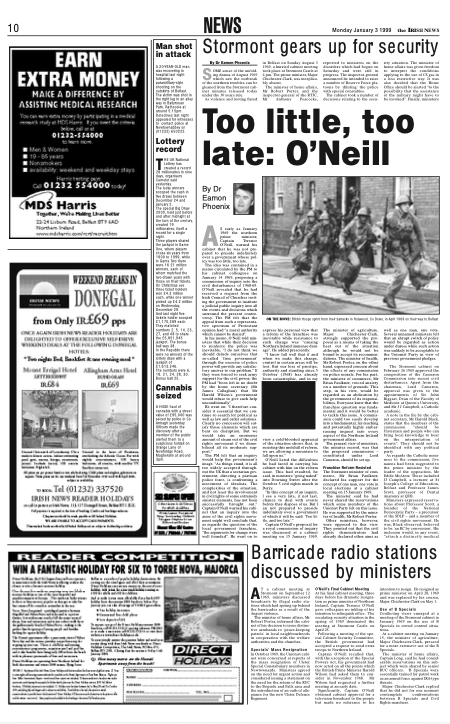
Stormont gears up for security solution to north’s political problems
SOME sense of the unfolding drama of August 1969, which saw the outbreak of the Northern troubles, can be gleaned from the Stormont cabinet minutes released today under the 30-year rule.
As violence and looting flared in Belfast on Sunday August 3 1969, a hurried cabinet meeting took place at Stormont Castle at 4 pm. The prime minister, Major Chichester-Clark, was inexplicably absent.
The minister of home affairs, Mr Robert Porter, and the inspector-general of the RTJC, Mr Anthony Peacocke, reported to ministers on the disorders which had begun on Saturday and were still in progress.
The inspector-general announced he intended to raise a number of Reserve Force platoons by ‘diluting’ the police with special constables.
The cabinet took a number of decisions relating to the security situation. The Minister of Home Affairs was given freedom to interpret the conditions applying to the use of CS gas in a less restrictive way.
It was also decided that the Home Office should be alerted “to the possibility that the assistance of the military might have to be invoked”.
Finally, ministers agreed they would support a proposal by the army to move one of three companies on stand-by to Musgrave Street barracks in central Belfast on a ‘readiness’ basis.
Consideration was given to banning all marches for a while, but it was decided that organisers of traditional parades on both sides should be sounded out first.
An approved statement from the government warned the public: “The present disorder in Belfast threatens the livelihood and prejudices the future of all our citizens. The government will not shrink from any measure, however firm or exceptional, which may be necessary to bring it to an end.”
Following further clashes in the city, the cabinet reconvened on August 4. Ministers felt that more stringent penalties could have a salutary deterrent effect. The attorney-general and minister of home affairs agreed to consider ways of ensuring that magistrates were aware of the need to impose more severe punishments for looting and other offences.
The cabinet agreed that, given the deteriorating situation in Belfast, police manpower would be extremely stretched by the Apprentice Boys demonstration in Derry on August 12. It was decided that the prime minister should discuss difficulties with the leaders of that organisation with a view to securing their voluntary co-operation in order to reduce the burden on the police.
The secretary to the cabinet, Mr Harold Black revealed that a contingent request for army assistance had been withdrawn.
Too little, too late: O’Neill
AS early as January 1969, the Northern Prime Minister, Captain Terence O’Neill, warned his cabinet that he was not prepared to preside indefinitely over a government whose policy was too little, too late.
The idea was contained in a memo circulated by the PM to his cabinet colleagues on January 14 1969, proposing a commission of inquiry into the civil disturbances of 1968-69. O’Neill revealed that he had received a request from the Irish Council of Churches inviting the government to institute a judicial public inquiry into all the events and decisions which surround the present controversy.
The PM felt that the appeal from such a representative spectrum of Protestant opinion had “a moral authority which cannot be denied”.
In his memo, O’Neill told ministers that while their decision to reinforce the police was inevitable, “I do not think we should delude ourselves that so-called ‘firm government’ through the exercise of police power will provide any satisfactory answer to our problem.”
If they were forced to seek army support for the civil power, the PM had “been left in no doubt by the home secretary (Mr James Callaghan) that Mr Harold Wilson’s government would refuse to give such help unconditionally”.
He went on: “I therefore consider it essential that we continue to search for political as well as law and order solutions. Clearly, no concession will satisfy those elements which are bent on disruption. But we would take an enormous amount of steam out of the civil rights movement if we demo-bilised all its moderate support.”
The PM felt that an inquiry would help the government’s image. “As things stand, it is all too widely accepted throughout the UK that a sectarian government, directing a partisan police force, is confronting a movement of idealists. The complexities of the situation, and not least the involvement in civil rights of some extremely sinister elements, has not been successfully brought out.”
Captain O’Neill warned his cabinet that an inquiry into the aims of the civil rights movement might well conclude that, as regards the question of the local government franchise, “the arguments for change were well founded”.
He went on to express his personal view that a reform of the franchise was inevitable while resistance to such change was “causing Northern Ireland immense damage”. He added presciently:
“I know full well that if and when we make this change, control in certain areas will be lost. But our loss of prestige, authority and standing since 5 October (1968) has already been catastrophic, and in my view a cold-blooded appraisal of the situation shows that, in resisting this molehill of reform, we are allowing a mountain to fall upon us.”
O’Neill listed the difficulties he had faced in carrying his cabinet with him on the reform issue. This had resulted, he said, in ministers “going naked” into Downing Street after the October 5 civil rights march in Derry.
‘Tn this concept of an inquiry, I see a very late, if not last, chance to deal with events before they dispose of us. But I an not prepared to preside indefinitely over a government of which it will be said: Too lit-tle, and too late’.”
Captain O’Neill’s proposal for a royal commission of inquiry was discussed at a cabinet meeting on 15 January 1969.
The minister of agriculture, Major Chichester-Clark, strongly supported the proposal as a means of taking the heat out of the situation, although he would not be bound to accept its recommendations. The minister of health, Mr Robert Porter, on the other hand, expressed concern about the effects of any commission on police morale.
For his part, the minister of commerce, Mr Brian Faulkner, voiced anxiety on a number of grounds.
This step, in his view, would be regarded as an abdication by the government of its responsibilities. Everyone knew that the franchise question was fundamental and it would be better to tackle this issue. A commission could too easily develop into a fundamental, far-reaching and potentially highly embarrassing inquest into every aspect of the Northern Ireland government affairs.
The general view of ministers, the minutes record, was that the proposed commission, constituted under Lord Cameron, should be set up.
Barricade radio stations discussed by ministers
AT a cabinet meeting at Stormont on September 12 1969, ministers discussed broadcasts by illegal radio stations which had sprung up behind the barricades as a result of the August violence.
The minister of home affairs, Mr Robert Porter, informed the cabinet of his decision to issue distinctive armbands to ‘peace-keeping patrols’ in local neighbourhoods in cooperation with the welfare authorities and the churches.
Specials’ Mass Resignation
In October 1969, the Unionist cabinet were concerned at reports of the mass resignation of Ulster Special Constabulary members in Newtownards. Ministers agreed on the need for urgent action and considered issuing a statement on the need for the return of the RUC to the Bogside and Falls area and the introduction of an oath of allegiance for the new Ulster Defence Regiment.
O’Neill’s Final Cabinet Meeting
At his final cabinet meeting, three days before his dramatic resignation as prime minister of Northern Ireland, Captain Terence O’Neill gave colleagues no inkling of his intention to relinquish office. The escalating security situation in the spring of 1969 dominated the meeting at Stormont Castle on April 25.
Following a meeting of the special Cabinet Security Committee, the British government had accepted a request to send extra troops to Northern Ireland.
Captain O’Neill recalled that, with the exception of the Special Powers Act, his government had now acted on all the points which the British Prime Minister Harold Wilson had asked them to consider in November 1968. Mr Wilson had requested a further meeting at an early date.
Significantly, Captain O’Neill obtained cabinet approval for a television broadcast to the people but made no reference to his intention to resign. He resigned as prime minister on April 28, 1969 and was replaced by his cousin, Major Chichester-Clark on May 1.
Use of B Specials
Conflicting views emerged at a meeting of the Stormont cabinet in January 1969 on the use of B Specials in crowd control situations.
At a cabinet meeting on January 15, the minister of agriculture, Major Chichester-Clark, pressed for a more extensive use of the B Specials.
The minister of home affairs, Captain Long, said he had considerable reservations on this subject which were shared by senior RUC officers. B Specials were essentially trained for patrol work as an armed force against IRA-type threats.
Major Chichester-Clark replied that he did not for one moment contemplate confrontations between B Specials and Civil Rights marchers.