

1989 State Papers (page 3)
August 25 2016
Publication Date
MacBride success forced fair employment change, Brooke: Radical act crucial to policies, Damning report of QUB practices
State Paper Snippet
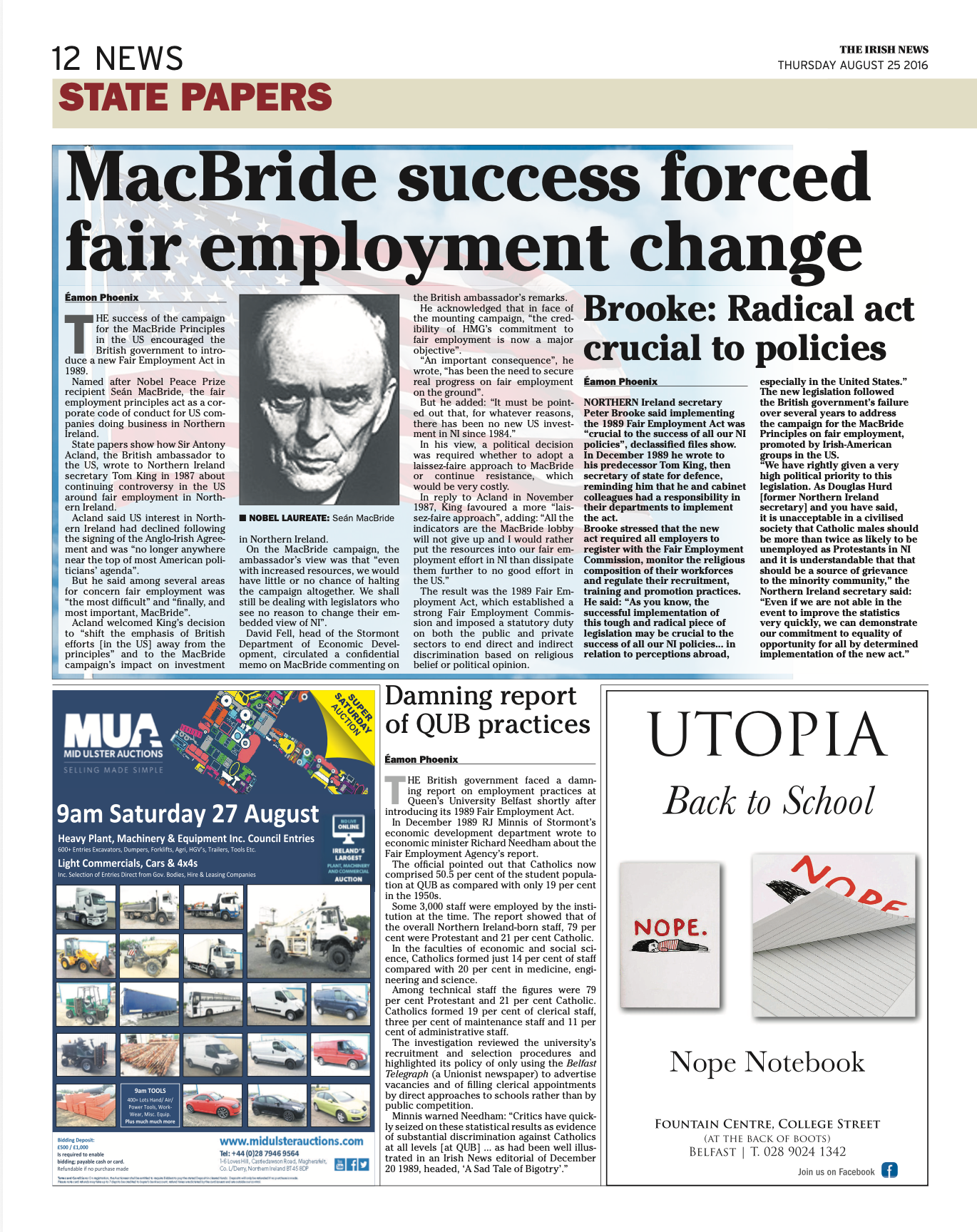
MacBride success forced fair employment change
THE success of the campaign for the MacBride Principles in the US encouraged the British government to introduce a new Fair Employment Act in 1989.
Named after Nobel Peace Prize recipient Sean MacBride, the fair employment principles act as a corporate code of conduct for US companies doing business in Northern Ireland.
State papers show how Sir Antony Acland, the British ambassador to the US, wrote to Northern Ireland secretary Tom King in 1987 about continuing controversy in the US around fair employment in Northern Ireland.
Acland said US interest in Northern Ireland had declined following the signing of the Anglo-Irish Agreement and was “no longer anywhere near the top of most American politicians’ agenda”.
But he said among several areas for concern fair employment was “the most difficult” and “finally, and most important, MacBride”.
Acland welcomed King’s decision to “shift the emphasis of British efforts [in the US] away from the principles” and to the MacBride campaign’s impact on investment in Northern Ireland.
On the MacBride campaign, the ambassador’s view was that “even with increased resources, we would have little or no chance of halting the campaign altogether. We shall still be dealing with legislators who see no reason to change their embedded view of NI”.
David Fell, head of the Stormont Department of Economic Development, circulated a confidential memo on MacBride commenting on the British ambassador’s remarks.
He acknowledged that in face of the mounting campaign, “the credibility of HMD’s commitment to fair employment is now a major objective”.
“An important consequence”, he wrote, “has been the need to secure real progress on fair employment on the ground”.
But he added: “It must be pointed out that, for whatever reasons, there has been no new US investment in NI since 1984.”
In his view, a political decision was required whether to adopt a laissez-faire approach to MacBride or continue resistance, which would be very costly.
In reply to Acland in November 1987, King favoured a more “laissez-faire approach”, adding: “All the indicators are the MacBride lobby will not give up and I would rather put the resources into our fair employment effort in NI than dissipate them further to no good effort in the US.”
The result was the 1989 Fair Employment Act, which established a strong Fair Employment Commission and imposed a statutory duty on both the public and private sectors to end direct and indirect discrimination based on religious belief or political opinion.
Brooke: Radical act crucial to policies
NORTHERN Ireland secretary Peter Brooke said implementing the 1989 Fair Employment Act was “crucial to the success of all our NI policies”, declassified files show.
In December 1989 he wrote to his predecessor Tom King, then secretary of state for defence, reminding him that he and cabinet colleagues had a responsibility in their departments to implement the act
Brooke stressed that the new act required all employers to register with the Fair Employment Commission, monitor the religious composition of their workforces and regulate their recruitment, training and promotion practices.
He said: “As you know, the successful implementation of this tough and radical piece of legislation may be crucial to the success of all our NI policies… in relation to perceptions abroad, especially in the United States.”
The new legislation followed the British government’s failure over several years to address the campaign for the MacBride Principles on fair employment, promoted by Irish-American groups in the US.
“We have rightly given a very high political priority to this legislation. As Douglas Hurd [former Northern Ireland secretary] and you have said, it is unacceptable in a civilised society that Catholic males should be more than twice as likely to be unemployed as Protestants in NI and it is understandable that that should be a source of grievance to the minority community,” the Northern Ireland secretary said: “Even if we are not able in the event to improve the statistics very quickly, we can demonstrate our commitment to equality of opportunity for all by determined implementation of the new act”
Damning report of QUB practices
THE British government faced a damning report on employment practices at Queen’s University Belfast shortly after introducing its 1989 Fair Employment Act.
In December 1989 RJ Minnis of Stormont’s economic development department wrote to economic minister Richard Needham about the Fair Employment Agency’s report.
The official pointed out that Catholics now comprised 50.5 per cent of the student population at QUB as compared with only 19 per cent in the 1950s.
Some 3,000 staff were employed by the institution at the time. The report showed that of the overall Northern Ireland-born staff, 79 per cent were Protestant and 21 per cent Catholic.
In the faculties of economic and social science, Catholics formed just 14 per cent of staff compared with 20 per cent in medicine, engineering and science.
Among technical staff the figures were 79 per cent Protestant and 21 per cent Catholic. Catholics formed 19 per cent of clerical staff, three per cent of maintenance staff and 11 per cent of administrative staff.
The investigation reviewed the university’s recruitment and selection procedures and highlighted its policy of only using the Belfast Telegraph (a Unionist newspaper) to advertise vacancies and of filling clerical appointments by direct approaches to schools rather than by public competition.
Minnis warned Needham: “Critics have quickly seized on these statistical results as evidence of substantial discrimination against Catholics at all levels [at QUB] … as had been well illustrated in an Irish News editorial of December 20 1989, headed, ‘A Sad Tale of Bigotry’.