

1989 State Papers (page 2)
August 25 2016
Publication Date
Dublin’s attachment to unity blocked progress, Britain depended in unionists to run north
State Paper Snippet
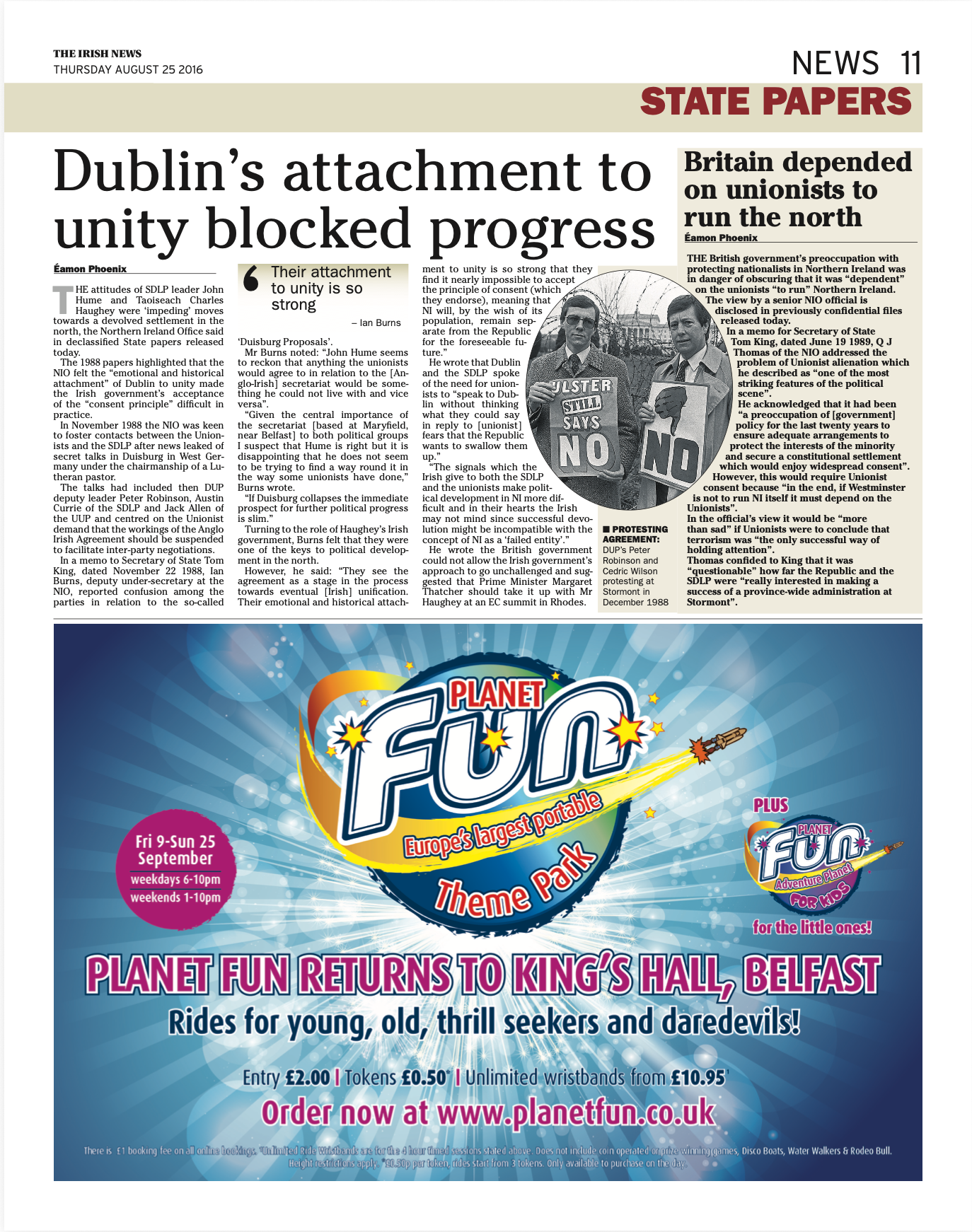
Dublin’s attachment to unity blocked progress
THE attitudes of SDLP leader John Hume and Taoiseach Charles Haughey were ‘impeding’ moves towards a devolved settlement in the north, the Northern Ireland Office said in declassified State papers released today.
The 1988 papers highlighted that the NIO felt the “emotional and historical attachment” of Dublin to unity made the Irish government’s acceptance of the “consent principle” difficult in practice.
In November 1988 the NIO was keen to foster contacts between the Unionists and the SDLP after news leaked of secret talks in Duisburg in West Germany under the chairmanship of a Lutheran pastor.
The talks had included then DUP deputy leader Peter Robinson, Austin Currie of the SDLP and Jack Allen of the UUP and centred on the Unionist demand that the workings of the Anglo Irish Agreement should be suspended to facilitate inter-party negotiations.
In a memo to Secretary of State Tom King, dated November 22 1988, Ian Burns, deputy under-secretary at the NIO, reported confusion among the parties in relation to the so-called ‘Duisburg Proposals’.
Mr Burns noted: “John Hume seems to reckon that anything the unionists would agree to in relation to the [Anglo-Irish] secretariat would be something he could not live with and vice versa”.
“Given the central importance of the secretariat [based at Maryfield, near Belfast] to both political groups I suspect that Hume is right but it is disappointing that he does not seem to be trying to find a way round it in the way some unionists have done,” Burns wrote.
“If Duisburg collapses the immediate prospect for further political progress is slim.”
Turning to the role of Haughey’s Irish government, Burns felt that they were one of the keys to political development in the north.
However, he said: “They see the agreement as a stage in the process towards eventual [Irish] unification. Their emotional and historical attachment to unity is so strong that they find it nearly impossible to accept the principle of consent (which they endorse), meaning that NI will, by the wish of its population, remain separate from the Republic for the foreseeable future.”
He wrote that Dublin and the SDLP spoke of the need for unionists to “speak to Dublin without thinking what they could say I in reply to [unionist] fears that the Republic wants to swallow them up.”
“The signals which the Irish give to both the SDLP and the unionists make political development in NI more difficult and in their hearts the Irish may not mind since successful devolution might be incompatible with the concept of NI as a ‘failed entity’.”
He wrote the British government could not allow the Irish government’s approach to go unchallenged and suggested that Prime Minister Margaret Thatcher should take it up with Mr Haughey at an EC summit in Rhodes.
Britain depended in unionists to run north
THE British government’s preoccupation with protecting nationalists in Northern Ireland was in danger of obscuring that it was “dependent” on the unionists “to run” Northern Ireland.
The view by a senior NIO official is disclosed in previously confidential files released today.
In a memo for Secretary of State Tom King, dated June 19 1989, Q J Thomas of the NIO addressed the problem of Unionist alienation which he described as “one of the most striking features of the political scene”.
He acknowledged that it had been “a preoccupation of [government] policy for the last twenty years to ensure adequate arrangements to protect the interests of the minority and secure a constitutional settlement which would enjoy widespread consent”.
However, this would require Unionist consent because “in the end, if Westminster is not to run NI itself it must depend on the Unionists”.
In the official’s view it would be “more than sad” if Unionists were to conclude that terrorism was “the only successful way of holding attention”.
Thomas confided to King that it was “questionable” how far the Republic and the SDLP were “really interested in making a success of a province-wide administration at Stormont”.