

1979 State Papers (page 9)
December 31 2009
Publication Date
Viability of DeLorean’s car project questioned, RUC was reluctant to remove monument, Election ‘a blow to consensus’
State Paper Snippet
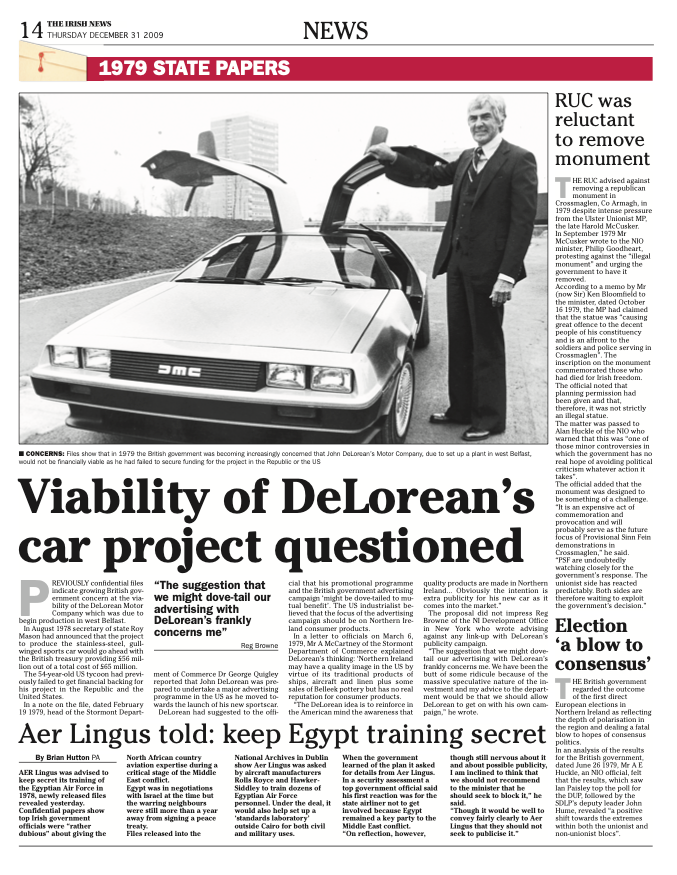
Viability of DeLorean’s car project questioned
PREVIOUSLY confidential files indicate growing British government concern at the viability of the DeLorean Motor Company which was due to begin production in west Belfast.
In August 1978 secretary of state Roy Mason had announced that the project to produce the stainless-steel, gullwinged sports car would go ahead with the British treasury providing £56 million out of a total cost of £65 million.
The 54-year-old US tycoon had previously failed to get financial backing for his project in the Republic and the United States.
In a note on the file, dated February 19 1979, head of the Stormont Department of Commerce Dr George Quigley reported that John DeLorean was prepared to undertake a major advertising programme in the US as he moved towards the launch of his new sportscar.
DeLorean had suggested to the official that his promotional programme and the British government advertising campaign ‘might be dove-tailed to mutual benefit’. The US industrialist believed that the focus of the advertising campaign should be on Northern Ireland consumer products.
In a letter to officials on March 6, 1979, Mr A McCartney of the Stormont Department of Commerce explained DeLorean’s thinking: ‘Northern Ireland may have a quality image in the US by virtue of its traditional products of ships, aircraft and linen plus some sales of Belleek pottery but has no real reputation for consumer products.
“The DeLorean idea is to reinforce in the American mind the awareness that quality products are made in Northern Ireland… Obviously the intention is extra publicity for his new car as it comes into the market.”
The proposal did not impress Reg Browne of the NI Development Office in New York who wrote advising against any link-up with DeLorean’s publicity campaign.
“The suggestion that we might dovetail our advertising with DeLorean’s frankly concerns me. We have been the butt of some ridicule because of the massive speculative nature of the investment and my advice to the department would be that we should allow DeLorean to get on with his own campaign,” he wrote.
RUC was reluctant to remove monument
THE RUC advised against removing a republican monument in Crossmaglen, Co Armagh, in 1979 despite intense pressure from the Ulster Unionist MP, the late Harold McCusker. In September 1979 Mr McCusker wrote to the NIO minister, Philip Goodheart, protesting against the “illegal monument” and urging the government to have it removed.
According to a memo by Mr (now Sir) Ken Bloomfield to the minister, dated October 16 1979, the MP had claimed that the statue was “causing great offence to the decent people of his constituency and is an affront to the soldiers and police serving in Crossmaglen”.
The inscription on the monument commemorated those who had died for Irish freedom. The official noted that planning permission had been given and that, therefore, it was not strictly an illegal statue.
The matter was passed to Alan Huckle of the NIO who warned that this was “one of those minor controversies in which the government has no real hope of avoiding political criticism whatever action it takes”.
The official added that the monument was designed to be something of a challenge. “It is an expensive act of commemoration and provocation and will probably serve as the future focus of Provisional Sinn Fein demonstrations in Crossmaglen,” he said.
“PSF are undoubtedly watching closely for the government’s response. The unionist side has reacted predictably. Both sides are therefore waiting to exploit the government’s decision.”
Election ‘a blow to consensus’
THE British government regarded the outcome of the first direct European elections in Northern Ireland as reflecting the depth of polarisation in the region and dealing a fatal blow to hopes of consensus politics.
In an analysis of the results for the British government, dated June 26 1979, Mr A E Huckle, an NIO official, felt that the results, which saw Ian Paisley top the poll for the DUP, followed by the SDLP’s deputy leader John Hume, revealed “a positive shift towards the extremes within both the unionist and non-unionist blocs”.