

1979 State Papers (page 7)
December 31 2009
Publication Date
Protestant population drift caused concern, ‘Violence endemic to life in north’
State Paper Snippet
Protestant population drift caused concern
As secret state files are released for public viewing under the 30-year rule, Dr Eamon Phoenix continues his look at what was preoccupying government figures in Northern Ireland 1979
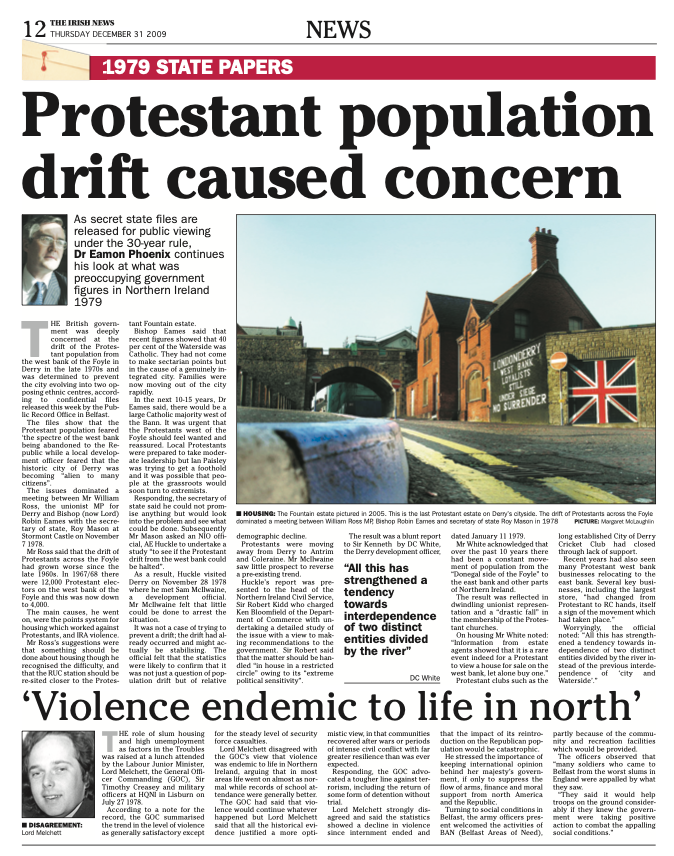
THE British government was deeply concerned at the drift of the Protestant population from the west bank of the Foyle in Derry in the late 1970s and was determined to prevent the city evolving into two opposing ethnic centres, according to confidential files released this week by the Public Record Office in Belfast.
The files show that the Protestant population feared ‘the spectre of the west bank being abandoned to the Republic while a local development officer feared that the historic city of Derry was becoming “alien to many citizens”.
The issues dominated a meeting between Mr William Ross, the unionist MP for Derry and Bishop (now Lord) Robin Eames with the secretary of state, Roy Mason at Stormont Castle on November 7 1978.
Mr Ross said that the drift of Protestants across the Foyle had grown worse since the late 1960s. In 1967/68 there were 12,000 Protestant electors on the west bank of the Foyle and this was now down to 4,000.
The main causes, he went on, were the points system for housing which worked against Protestants, and IRA violence. Mr Ross’s suggestions were that something should be done about housing though he recognised the difficulty, and that the RUC station should be re-sited closer to the Protestant Fountain estate.
Bishop Eames said that recent figures showed that 40 per cent of the Waterside was Catholic. They had not come to make sectarian points but in the cause of a genuinely integrated city. Families were now moving out of the city rapidly.
In the next 10-15 years, Dr Eames said, there would be a large Catholic majority west of the Bann. It was urgent that the Protestants west of the Foyle should feel wanted and reassured. Local Protestants were prepared to take moderate leadership but Ian Paisley was trying to get a foothold and it was possible that people at the grassroots would soon turn to extremists.
Responding, the secretary of state said he could not promise anything but would look into the problem and see what could be done. Subsequently Mr Mason asked an NIO official, AE Huckle to undertake a study “to see if the Protestant drift from the west bank could be halted”.
As a result, Huckle visited Derry on November 28 1978 where he met Sam Mcllwaine, a development official. Mr Mcllwaine felt that little could be done to arrest the situation.
It was not a case of trying to prevent a drift; the drift had already occurred and might actually be stabilising. The official felt that the statistics were likely to confirm that it was not just a question of population drift but of relative demographic decline.
Protestants were moving away from Derry to Antrim and Coleraine. Mr Mcllwaine saw little prospect to reverse a pre-existing trend.
Huckle’s report was presented to the head of the Northern Ireland Civil Service, Sir Robert Kidd who charged Ken Bloomfield of the Department of Commerce with undertaking a detailed study of the issue with a view to making recommendations to the government. Sir Robert said that the matter should be handled “in house in a restricted circle” owing to its “extreme political sensitivity”.
The result was a blunt report to Sir Kenneth by DC White, the Derry development officer, dated January 11, 1979.
Mr White acknowledged that over the past 10 years there had been a constant movement of population from the “Donegal side of the Foyle” to the east bank and other parts of Northern Ireland.
The result was reflected in dwindling unionist representation and a “drastic fall” in the membership of the Protestant churches.
On housing Mr White noted: “Information from estate agents showed that it is a rare event indeed for a Protestant to view a house for sale on the west bank, let alone buy one.” Protestant clubs such as the long -established City of Derry Cricket Club had closed through lack of support.
Recent years had also seen many Protestant west bank businesses relocating to the east bank. Several key businesses, including the largest store, “had changed from Protestant to RC hands, itself a sign of the movement which had taken place.”
Worryingly, the official noted: “All this has strengthened a tendency towards independence of two distinct entities divided by the river instead of the previous interdependence of ‘city and Waterside’.”
‘Violence endemic to life in north’
THE role of slum housing and high unemployment as factors in the Troubles was raised at a lunch attended by the Labour Junior Minister, Lord Melchett, the General Officer Commanding (GOC), Sir Timothy Creasey and military officers at HQNI in Lisburn on July 27 1978.
According to a note for the record, the GOC summarised the trend in the level of violence as generally satisfactory except for the steady level of security force casualties.
Lord Melchett disagreed with the GOC’s view that violence was endemic to life in Northern Ireland, arguing that in most areas life went on almost as normal while records of school attendance were generally better.
The GOC had said that violence would continue whatever happened but Lord Melchett said that all the historical evidence justified a more optimistic view, in that communities recovered after wars or periods of intense civil conflict with far greater resilience than was ever expected.
Responding, the GOC advocated a tougher line against terrorism, including the return of some form of detention without trial.
Lord Melchett strongly disagreed and said the statistics showed a decline in violence since internment ended and that the impact of its reintroduction on the Republican population would be catastrophic.
He stressed the importance of keeping international opinion behind her majesty’s government, if only to suppress the flow of arms, finance and moral support from north America and the Republic.
Turning to social conditions in Belfast, the army officers present welcomed the activities of BAN (Belfast Areas of Need), partly because of the community and recreation facilities which would be provided.
The officers observed that “many soldiers who came to Belfast from the worst slums in England were appalled by what they saw.
“They said it would help troops on the ground considerably if they knew the government were taking positive action to combat the appalling social conditions.”