

1979 State Papers (page 5)
December 30 2009
Publication Date
Irish government paid expenses to the SDLP, Hume ‘wanted internment brought back to tackle IRA’
State Paper Snippet
Irish government paid expenses to the SDLP
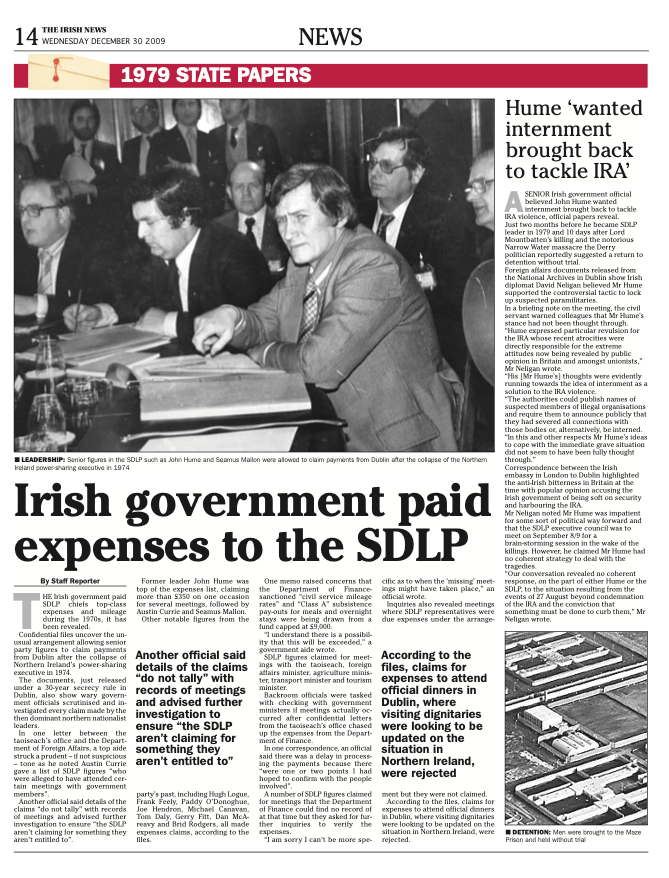
The Irish government paid expenses and mileage during the 1970s, it has been revealed. Confidential files uncover the unusual arrangement allowing senior party figures to claim payments from Dublin after the collapse of Northern Ireland’s power-sharing executive in 1974.
The documents, just released under a 30-year secrecy rule in Dublin, also show wary government officials scrutinised and investigated every claim made by the then dominant northern nationalist leaders.
In one letter between the taoiseach’s office and the Department of Foreign Affairs, a top aide struck a prudent – if not suspicious – tone as he noted Austin Currie gave a list of SDLP figures “who were alleged to have attended certain meetings with government members”.
Another official said details of the claims “do not tally” with records of meetings and advised further investigation to ensure “the SDLP aren’t claiming for something they aren’t entitled to”.
Former leader John Hume was top of the expenses list, claiming more than £350 on one occasion for several meetings, followed by Austin Currie and Seamus Mallon.
Other notable figures from the party’s past, including Hugh Logue, Frank Feely, Paddy O’Donoghue, Joe Hendron, Michael Canavan, Tom Daly, Gerry Fitt, Dan McAreavy and Brid Rodgers, all made expenses claims, according to the files.
One memo raised concerns that the Department of Finance-sanctioned “civil service mileage rates” and “Class A” subsistence pay-outs for meals and overnight stays were being drawn from a fund capped at £9,000.
“I understand there is a possibility that this will be exceeded,” a government aide wrote.
SDLP figures claimed for meetings with the taoiseach, foreign affairs minister, agriculture minister, transport minister and tourism minister.
Backroom officials were tasked with checking with government ministers if meetings actually occurred after confidential letters from the taoiseach’s office chased up the expenses from the Department of Finance.
In one correspondence, an official said there was a delay in processing the payments because there “were one or two points I had hoped to confirm with the people involved”.
A number of SDLP figures claimed for meetings that the Department of Finance could find no record of at that time but they asked for further inquiries to verify the expenses.
“I am sorry I can’t be more specific as to when the ‘missing’ meetings might have taken place,” an official wrote.
Inquiries also revealed meetings where SDLP representatives were due expenses under the arrangement but they were not claimed.
According to the files, claims for expenses to attend official dinners in Dublin, where visiting dignitaries were looking to be updated on the situation in Northern Ireland, were rejected.
Hume ‘wanted internment brought back to tackle IRA’
A senior Irish government official believed John Hume wanted internment brought back to tackle IRA violence, official papers reveal.
Just two months before he became SDLP leader in 1979 and 10 days after Lord Mountbatten’s killing and the notorious Narrow Water massacre the Derry politician reportedly suggested a return to detention without trial.
Foreign affairs documents released from the National Archives in Dublin show Irish diplomat David Neligan believed Mr Hume supported the controversial tactic to lock up suspected paramilitaries.
In a briefing note on the meeting, the civil servant warned colleagues that Mr Hume’s stance had not been thought through.
“Hume expressed particular revulsion for the IRA whose recent atrocities were directly responsible for the extreme attitudes now being revealed by public opinion in Britain and amongst unionists,” Mr Neligan wrote.
“His [Mr Hume’s] thoughts were evidently running towards the idea of internment as a solution to the IRA violence.
“The authorities could publish names of suspected members of illegal organisations and require them to announce publicly that they had severed all connections with those bodies or, alternatively, be interned.
“In this and other respects Mr Hume’s ideas to cope with the immediate grave situation did not seem to have been fully thought through.”
Correspondence between the Irish embassy in London to Dublin highlighted the anti-Irish bitterness in Britain at the time with popular opinion accusing the Irish government of being soft on security and harbouring the IRA.
Mr Neligan noted Mr Hume was impatient for some sort of political way forward and that the SDLP executive council was to meet on September 8/9 for a brain-storming session in the wake of the killings.
However, he claimed Mr Hume had no coherent strategy to deal with the tragedies. “Our conversation revealed no coherent response, on the part of either Hume or the SDLP, to the situation resulting from the events of 27 August beyond condemnation of the IRA and the conviction that something must be done to curb them,” Mr Neligan wrote.