

1979 State Papers (page 4)
December 30 2009
Publication Date
Hostility shown to priest’s efforts on behalf of inmates
State Paper Snippet
Hostility shown to priest’s efforts on behalf of inmates
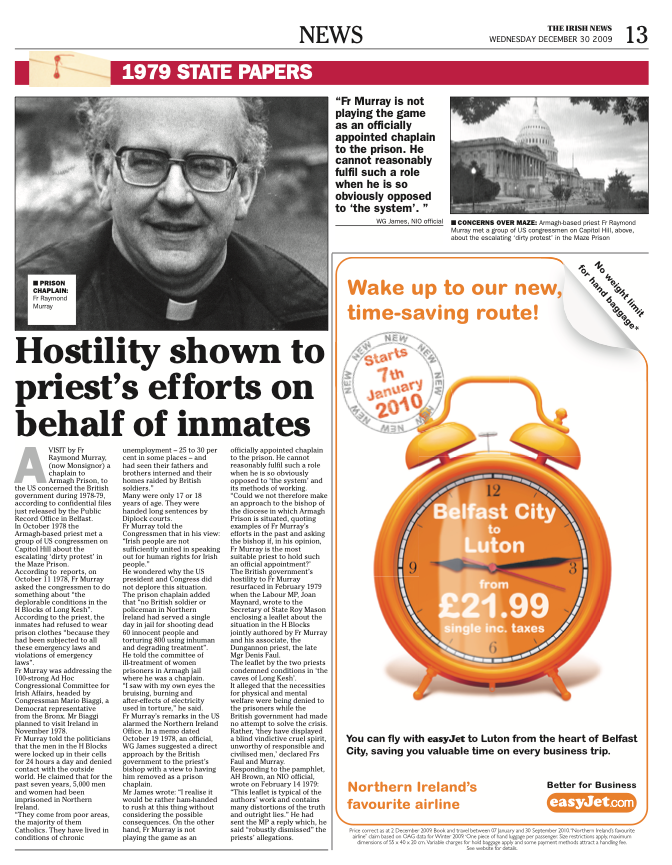
A visit by Fr Raymond Murray, (now Monsignor) a chaplain to Armagh Prison, to the US concerned the British government during 1978-79, according to confidential files just released by the Public Record Office in Belfast.
In October 1978 the Armagh-based priest met a group of US congressmen on Capitol Hill about the escalating ‘dirty protest’ in the Maze Prison.
According to reports, on October 11 1978, Fr Murray asked the congressmen to do something about “the deplorable conditions in the H Blocks of Long Kesh”.
According to the priest, the inmates had refused to wear prison clothes “because they had been subjected to all these emergency laws and violations of emergency laws”.
Fr Murray was addressing the 100-strong Ad Hoc Congressional Committee for Irish Affairs, headed by Congressman Mario Biaggi, a Democrat representative from the Bronx. Mr Biaggi planned to visit Ireland in November 1978.
Fr Murray told the politicians that the men in the H Blocks were locked up in their cells for 24 hours a day and denied contact with the outside world. He claimed that for the past seven years, 5,000 men and women had been imprisoned in Northern Ireland.
“They come from poor areas, the majority of them Catholics. They have lived in conditions of chronic unemployment – 25 to 30 per cent in some places – and had seen their fathers and brothers interned and their homes raided by British soldiers.”
Many were only 17 or 18 years of age. They were handed long sentences by Diplock courts.
Fr Murray told the Congressmen that in his view: “Irish people are not sufficiently united in speaking out for human rights for Irish people.”
He wondered why the US president and Congress did not deplore this situation. The prison chaplain added that “no British soldier or policeman in Northern Ireland had served a single day in jail for shooting dead 60 innocent people and torturing 800 using inhuman and degrading treatment”.
He told the committee of ill-treatment of women prisoners in Armagh jail where he was a chaplain. “I saw with my own eyes the bruising, burning and after-effects of electricity used in torture,” he said.
Fr Murray’s remarks in the US alarmed the Northern Ireland Office. In a memo dated October 19 1978, an official, WG James suggested a direct approach by the British government to the priest’s bishop with a view to having him removed as a prison chaplain.
Mr James wrote: “I realise it would be rather ham-handed to rush at this thing without considering the possible consequences. On the other hand, Fr Murray is not playing the game as an officially appointed chaplain to the prison.
“He cannot reasonably fulfil such a role when he is so obviously opposed to ‘the system’ and its methods of working.
“Could we not therefore make an approach to the bishop of the diocese in which Armagh Prison is situated, quoting examples of Fr Murray’s efforts in the past and asking the bishop if, in his opinion, Fr Murray is the most suitable priest to hold such an official appointment?”
The British government’s hostility to Fr Murray resurfaced in February 1979 when the Labour MP, Joan Maynard, wrote to the Secretary of State Roy Mason enclosing a leaflet about the situation in the H Blocks jointly authored by Fr Murray and his associate, the Dungannon priest, the late Mgr Denis Faul.
The leaflet by the two priests condemned conditions in ‘the caves of Long Kesh’. It alleged that the necessities for physical and mental welfare were being denied to the prisoners while the British government had made no attempt to solve the crisis.
Rather, ‘they have displayed a blind vindictive cruel spirit, unworthy of responsible and civilised men,’ declared Frs Faul and Murray.
Responding to the pamphlet, AH Brown, an NIO official, wrote on February 14 1979: “This leaflet is typical of the authors’ work and contains many distortions of the truth and outright lies.” He had sent the MP a reply which, he said “robustly dismissed” the priests’ allegations.