

1979 State Papers (page 1)
December 30 2009
Publication Date
Election of Tories met by surge in political violence
State Paper Snippet
Election of Tories met by surge in political violence
A papal visit, the election of Margaret Thatcher and an upsurge in violence all dominated headlines in 1979, writes historian Dr Eamon Phoenix.
The year 1979 was marked in the north by the election of a Tory government at Westminster and an escalation of violence.
The IRA assassinated Queen Elizabeth’s cousin, Lord Louis Mountbatten, in August.
In February the loyalist murder gang known as the ‘Shankill Butchers’, responsible for many sectarian murders, were convicted and sentenced.
In March the Bennett Report confirmed allegations of ill treatment in RUC interrogation centres.
A leading police surgeon, Dr Robert Irwin, claimed that up to 150 people he had seen at Castlereagh interrogation centre had shown evidence of ill treatment by RUC detectives.
In the same month the Provisional IRA admitted killing two 16-year-old boys and wounding three others at Keady, Co Armagh.
Apologising to their families, the IRA said that one of their units had mistaken the youths for British soldiers.
On March 22 the IRA assassinated the British ambassador to Holland, Sir Richard Sykes, in the Hague.
On March 31 Airey Neave, the Tory spokesman on Northern Ireland and a close ally of his party leader, Margaret Thatcher, was killed when his car was blown up at Westminster in an attack claimed by the INLA.
June saw the election at Westminster of the Conservatives under Margaret Thatcher. The political unknown, Humphrey Atkins, was appointed Secretary of State succeeding the Labour party’s Roy Mason.
In the first direct elections to the European Parliament held under proportional representation, Ian Paisley topped the poll with almost 30 per cent of the vote with John Hume winning the second seat for the SDLP with 25 per cent.
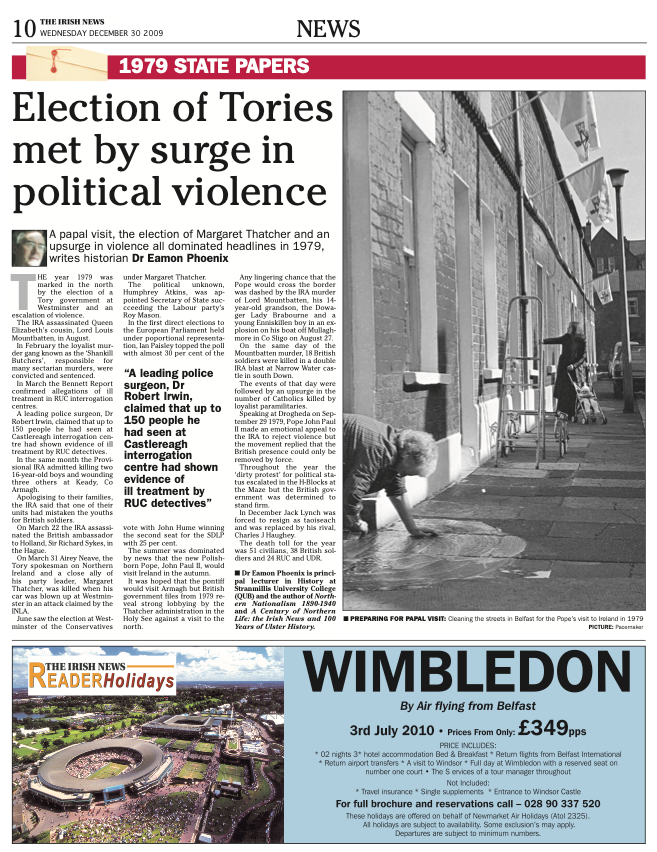
The summer was dominated by news that the new Polish-born Pope, John Paul II, would visit Ireland in the autumn.
It was hoped that the pontiff would visit Armagh but British government files from 1979 reveal strong lobbying by the Thatcher administration in the Holy See against a visit to the north.
Any lingering chance that the Pope would cross the border was dashed by the IRA murder of Lord Mountbatten, his 14-year-old grandson, the Dowager Lady Brabourne and a young Enniskillen boy in an explosion on his boat off Mullaghmore in Co Sligo on August 27.
On the same day of the prmurder, 18 British soldiers were killed in a double IRA blast at Narrow Water castle in south Down.
The events of that day were followed by an upsurge in the number of Catholics killed by loyalist paramilitaries.
Speaking at Drogheda on September 29 1979, Pope John Paul II made an emotional appeal to the IRA to reject violence but the movement replied that the British presence could only be removed by force.
Throughout the year the ‘dirty protest’ for political status escalated in the H-Blocks at the Maze but the British government was determined to stand firm.
In December Jack Lynch was forced to resign as taoiseach and was replaced by his rival, Charles J Haughey.
The death toll for the year was 51 civilians, 38 British soldiers and 24 RUC and UDR.