

1978 State Papers (page 8)
December 31 2008
Publication Date
All aspects of life were hit hard in ‘ailing city’, Ill-fated DeLorean was seen as great investment magnet, Political void led to public apathy
State Paper Snippet
All aspects of life were hit hard in ‘ailing city’
Belfast was “an ailing city” in 1978, beset with sectarian violence, poverty, unemployment and a declining population which was most marked in Protestant areas. This government view of Belfast as a rapidly declining industrial city is expressed in confidential Stormont files.
On December 28 1977, Ken Bloomfield of the Department of the Environment defined the “problem of Belfast” thus: “Belfast is ailing. Much of the violence of the last eight years had taken place within its boundaries. There is an entrenched and bitter sectarianism which poisons many aspects of its life. Some of its established industries are in an unstable position. The state of much of its housing stock is deplorable. Large areas of the city are characterised by multiple social need.”
Ironically, Mr Bloomfield noted that Sir Robert Matthew in the early 1960s had predicted a continuation of dynamic growth in the city but the economic downturn and impact of the Troubles had shattered this optimistic assumption.
The problems of the city dominated a meeting of the Policy Coordinating Committee at Stormont on January 11 1978. Mr Bloomfield said recent surveys had highlighted the poor state of housing stock and this, together with unemployment, were unanimously accepted as the major problem. The “continuing decline of population over the past five years” confirmed the fact that Belfast was ailing and all indications showed that the trend would continue.
The inner city wards had lost almost 50,000 people during this period. Population in Protestant areas had fallen fastest and movement out of the inner city had tended to be imbalanced with the young families resettling elsewhere (eg Craigavon) with the old and the unskilled being left behind.
Dr George Quigley (Department of Commerce) referred to unemployment in particularly Catholic areas of the city where immobility of labour presented one of many difficulties.
The meeting considered a report from the Department of the Environment on the changing sectarian demographics in the city. This noted that the population in Protestant areas such as the Shankill, east Belfast, Sandy Row and Donegall Pass had fallen fastest.
“The Shankill area for example has lost almost 10,000 people over five years. The loss of population has been reflected in a crude housing surplus in these areas resulting in bricked-up dwellings, abandoned modern flats and vacant land.”
“In the Protestant areas, age structures generally tend to be heavily biased towards the older age groups and therefore passage of time will tend to reduce the population of these areas further. The revival of some areas (eg Memil Street, Donegall Pass) must be in jeopardy on current trends,” the report continued.
Conversely, the Catholic population was increasing: “Because fewer Catholics have left the city and because of higher birth rates, population structures in Catholic areas tend to be much more balanced and indeed some inner city communities such as Short Strand and Lower Ormeau seem likely on present trends to grow rather than contract.”
Ill-fated DeLorean was seen as great investment magnet
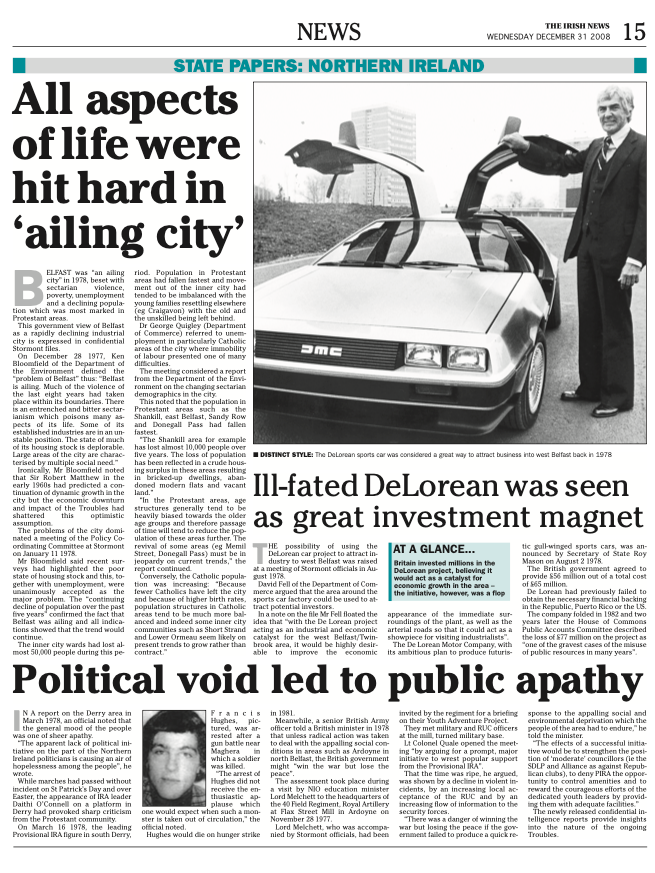
The possibility of using the DeLorean car project to attract industry to west Belfast was raised at a meeting of Stormont officials in August 1978.
David Fell of the Department of Commerce argued that the area around the sports car factory could be used to attract potential investors.
In a note on the file Mr Fell floated the idea that “with the De Lorean project acting as an industrial and economic catalyst for the west Belfast/Twinbrook area, it would be highly desirable to improve the economic appearance of the immediate surroundings of the plant, as well as the arterial roads so that it could act as a showpiece for visiting industrialists”.
The De Lorean Motor Company, with its ambitious plan to produce futuristic gull-winged sports cars, was announced by Secretary of State Roy Mason on August 2 1978. The British government agreed to provide £56 million out of a total cost of £65 million. De Lorean had previously failed to obtain the necessary financial backing in the Republic, Puerto Rico or the US.
The company folded in 1982 and two years later the House of Commons Public Accounts Committee described the loss of £77 million on the project as “one of the gravest cases of the misuse of public resources in many years”.
Political void led to public apathy
In a report on the Derry area in March 1978, an official noted that the general mood of the people was one of sheer apathy.
“The apparent lack of political initiative on the part of the Northern Ireland politicians is causing an air of hopelessness among the people”, he wrote.
While marches had passed without incident on St Patrick’s Day and over Easter, the appearance of IRA leader Daithi O’Connell on a platform in Derry had provoked sharp criticism from the Protestant community.
On March 16 1978, the leading Provisional IRA figure in south Derry, Francis Hughes, was arrested after a gun battle near Maghera in which a soldier was killed.
“The arrest of Hughes did not receive the enthusiastic applause which one would expect when such a monster is taken out of circulation,” the official noted. Hughes would die on hunger strike in 1981.
Meanwhile, a senior British Army officer told a British minister in 1978 that unless radical action was taken to deal with the appalling social conditions in areas such as Ardoyne in north Belfast, the British government might “win the war but lose the peace”.
The assessment took place during a visit by NIO education minister Lord Melchett to the headquarters of the 40 Field Regiment, Royal Artillery at Flax Street Mill in Ardoyne on November 28 1977. Lord Melchett, who was accompanied by Stormont officials, had been invited by the regiment for a briefing on their Youth Adventure Project.
They met military and RUC officers at the mill, turned military base. Lt Colonel Quale opened the meeting “by arguing for a prompt, major initiative to wrest popular support from the Provisional IRA”.
That the time was ripe, he argued, was shown by a decline in violent incidents, by an increasing local acceptance of the RUC and by an increasing flow of information to the security forces.
“There was a danger of winning the war but losing the peace if the government failed to produce a quick response to the appalling social and environmental deprivation which the people of the area had to endure,” he told the minister.
“The effects of a successful initiative would be to strengthen the position of ‘moderate’ councillors (ie the SDLP and Alliance as against Republican clubs), to deny PIRA the opportunity to control amenities and to reward the courageous efforts of the dedicated youth leaders by providing them with adequate facilities.”
The newly released confidential intelligence reports provide insights into the nature of the ongoing Troubles.