

1978 State Papers (page 7)
December 31 2008
Publication Date
‘Prisoner of war’ status for republican prisoners feared, Gelignite found in butter, Officials impressed by SDLP vitality and quality of debate
State Paper Snippet
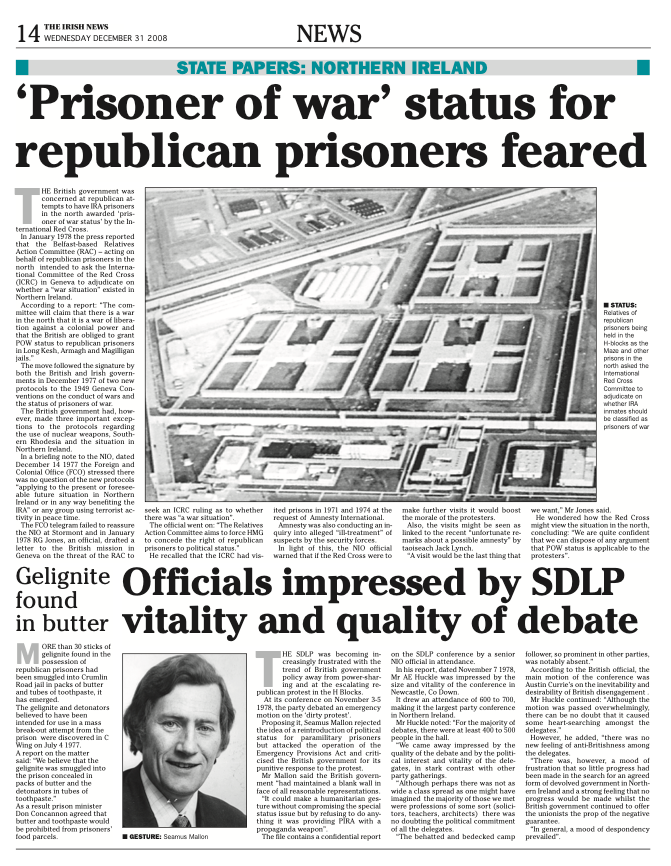
‘Prisoner of war’ status for republican prisoners feared
The British government was concerned at republican attempts to have IRA prisoners in the north awarded ‘prisoner of war status’ by the International Red Cross.
In January 1978 the press reported that the Belfast-based Relatives Action Committee (RAC) – acting on behalf of republican prisoners in the north – intended to ask the International Committee of the Red Cross (ICRC) in Geneva to adjudicate on whether a “war situation” existed in Northern Ireland.
According to a report: “The committee will claim that there is a war in the north that it is a war of liberation against a colonial power and that the British are obliged to grant POW status to republican prisoners in Long Kesh, Armagh and Magilligan jails.”
The move followed the signature by both the British and Irish governments in December 1977 of two new protocols to the 1949 Geneva Conventions on the conduct of wars and the status of prisoners of war. The British government had, however, made three important exceptions to the protocols regarding the use of nuclear weapons, Southern Rhodesia and the situation in Northern Ireland.
In a briefing note to the NIO, dated December 14 1977 the Foreign and Colonial Office (FCO) stressed there was no question of the new protocols “applying to the present or foreseeable future situation in Northern Ireland or in any way benefiting the IRA” or any group using terrorist activity in peace time.
The FCO telegram failed to reassure the NIO at Stormont and in January 1978 RG Jones, an official, drafted a letter to the British mission in Geneva on the threat of the RAC to seek an ICRC ruling as to whether there was “a war situation”.
The official went on: “The Relatives Action Committee aims to force HMG to concede the right of republican prisoners to political status.”
He recalled that the ICRC had visited prisons in 1971 and 1974 at the request of Amnesty International. Amnesty was also conducting an inquiry into alleged “ill-treatment” of suspects by the security forces.
In light of this, the NIO official warned that if the Red Cross were to make further visits it would boost the morale of the protesters. Also, the visits might be seen as linked to the recent “unfortunate remarks about a possible amnesty” by taoiseach Jack Lynch.
“A visit would be the last thing that we want,” Mr Jones said. He wondered how the Red Cross might view the situation in the north, concluding: “We are quite confident that we can dispose of any argument that POW status is applicable to the protesters.”
Gelignite found in butter
More than 30 sticks of gelignite found in the possession of republican prisoners had been smuggled into Crumlin Road jail in packs of butter and tubes of toothpaste, it has emerged.
The gelignite and detonators believed to have been intended for use in a mass break-out attempt from the prison were discovered in C Wing on July 4 1977.
A report on the matter said: “We believe that the gelignite was smuggled into the prison concealed in packs of butter and the detonators in tubes of toothpaste.”
As a result prison minister Don Concannon agreed that butter and toothpaste would be prohibited from prisoners’ food parcels.
Officials impressed by SDLP vitality and quality of debate
The SDLP was becoming increasingly frustrated with the trend of British government policy away from power-sharing and at the escalating republican protest in the H Blocks.
At its conference on November 3-5 1978, the party debated an emergency motion on the ‘dirty protest’. Proposing it, Seamus Mallon rejected the idea of a reintroduction of political status for paramilitary prisoners but attacked the operation of the Emergency Provisions Act and criticised the British government for its punitive response to the protest.
Mr Mallon said the British government “had maintained a blank wall in face of all reasonable representations. It could make a humanitarian gesture without compromising the special status issue but by refusing to do anything it was providing PIRA with a propaganda weapon”.
The file contains a confidential report on the SDLP conference by a senior NIO official in attendance.
In his report, dated November 7 1978, Mr AE Huckle was impressed by the size and vitality of the conference in Newcastle, Co Down. It drew an attendance of 600 to 700, making it the largest party conference in Northern Ireland.
Mr Huckle noted: “For the majority of debates, there were at least 400 to 500 people in the hall. We came away impressed by the quality of the debate and by the political interest and vitality of the delegates, in stark contrast with other party gatherings. Although perhaps there was not as wide a class spread as one might have imagined the majority of those we met were professions of some sort (solicitors, teachers, architects) there was no doubting the political commitment of all the delegates. The behatted and bedecked camp follower, so prominent in other parties, was notably absent.”
According to the British official, the main motion of the conference was Austin Currie’s on the inevitability and desirability of British disengagement.
Mr Huckle continued: “Although the motion was passed overwhelmingly, there can be no doubt that it caused some heart-searching amongst the delegates.”
However, he added, “there was no new feeling of anti-Britishness among the delegates. There was, however, a mood of frustration that so little progress had been made in the search for an agreed form of devolved government in Northern Ireland and a strong feeling that no progress would be made whilst the British government continued to offer the unionists the prop of the negative guarantee. In general, a mood of despondency prevailed”.