

1978 State Papers (page 5)
December 31 2008
Publication Date
British tried to assess Provo influence in nationalist area, Paramilitary fundraising, Loyalist backlash feared in wake of La Mon, Power-sharing deal predicted
State Paper Snippet
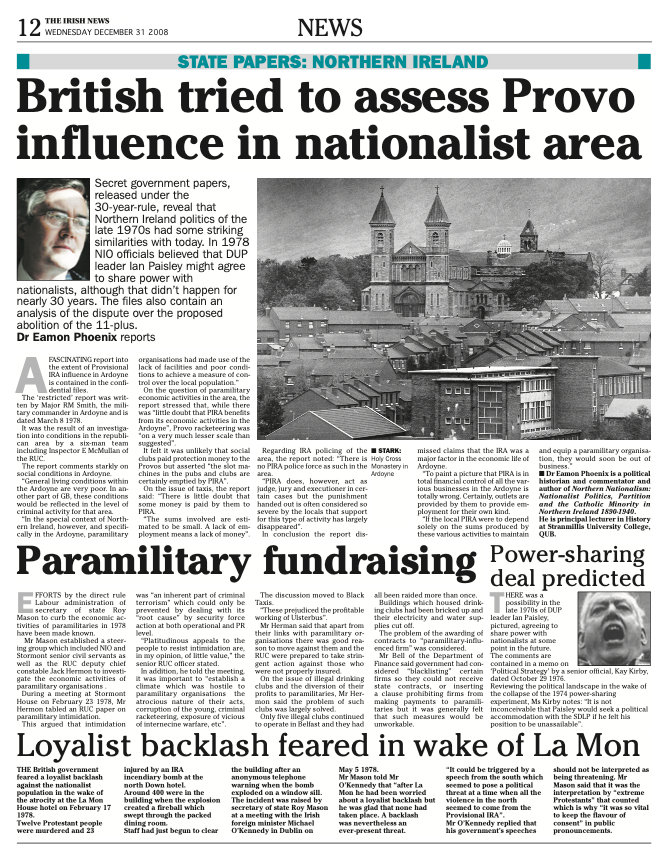
British tried to assess Provo influence in nationalist area
A fascinating report into IRA influence in Ardoyne is contained in the confidential files. The ‘restricted’ report was written by Major RM Smith, the military commander in Ardoyne and is dated March 8 1978.
It was the result of an investigation into conditions in the republican area by a six-man team including Inspector E McMullan of the RUC.
The report comments starkly on social conditions in Ardoyne. “General living conditions within the Ardoyne are very poor. In another part of GB, these conditions would be reflected in the level of criminal activity for that area. In the special context of Northern Ireland, however, and specifically in the Ardoyne, paramilitary organisations had made use of the lack of facilities and poor conditions to achieve a measure of control over the local population.”
On the question of paramilitary economic activities in the area, the report stressed that, while there was “little doubt that PIRA benefits from its economic activities in the Ardoyne”, Provo racketeering was “on a very much lesser scale than suggested”. It felt it was unlikely that social clubs paid protection money to the Provos but asserted “the slot machines in the pubs and clubs are certainly emptied by PIRA”.
On the issue of taxis, the report said: “There is little doubt that some money is paid by them to PIRA. The sums involved are estimated to be small. A lack of employment means a lack of money.”
Regarding IRA policing of the area, the report noted: “There is no PIRA police force as such in the area. PIRA does, however, act as judge, jury and executioner in certain cases but the punishment handed out is often considered so severe by the locals that support for this type of activity has largely disappeared.”
In conclusion the report dismissed claims that the IRA was a major factor in the economic life of Ardoyne. “To paint a picture that PIRA is in total financial control of all the various businesses in the Ardoyne is totally wrong. Certainly, outlets are provided by them to provide employment for their own kind. If the local PIRA were to depend solely on the sums produced by these various activities to maintain and equip a paramilitary organisation, they would soon be out of business.”
Paramilitary fundraising
Efforts by the direct rule Labour administration of secretary of state Roy Mason to curb the economic activities of paramilitaries in 1978 have been made known. Mr Mason established a steering group which included NIO and Stormont senior civil servants as well as the RUC deputy chief constable Jack Hermon to investigate the economic activities of paramilitary organisations.
During a meeting at Stormont House on February 23 1978, Mr Hermon tabled an RUC paper on paramilitary intimidation. This argued that intimidation was “an inherent part of criminal terrorism” which could only be prevented by dealing with its “root cause” by security force action at both operational and PR level.
“Platitudinous appeals to the people to resist intimidation are, in my opinion, of little value,” the senior RUC officer stated. In addition, he told the meeting, it was important to “establish a climate which was hostile to paramilitary organisations the atrocious nature of their acts, corruption of the young, criminal racketeering, exposure of vicious of internecine warfare, etc”.
The discussion moved to Black Taxis. “These prejudiced the profitable working of Ulsterbus”. Mr Hermon said that apart from their links with paramilitary organisations there was good reason to move against them and the RUC were prepared to take stringent action against those who were not properly insured.
On the issue of illegal drinking clubs and the diversion of their profits to paramilitaries, Mr Hermon said the problem of such clubs was largely solved. Only five illegal clubs continued to operate in Belfast and they had all been raided more than once. Buildings which housed drinking clubs had been bricked up and their electricity and water supplies cut off.
The problem of the awarding of contracts to “paramilitary-influenced firm” was considered. Mr Bell of the Department of Finance said government had considered “blacklisting” certain firms so they could not receive state contracts, or inserting a clause prohibiting firms from making payments to paramilitaries but it was generally felt that such measures would be unworkable.
Loyalist backlash feared in wake of La Mon
The British government feared a loyalist backlash against the nationalist population in the wake of the atrocity at the La Mon House hotel on February 17 1978. Twelve Protestant people were murdered and 23 injured by an IRA incendiary bomb at the north Down hotel.
Around 400 were in the building when the explosion created a fireball which swept through the packed dining room. Staff had just begun to clear the building after an anonymous telephone warning when the bomb exploded on a window sill.
The incident was raised by secretary of state Roy Mason at a meeting with the Irish foreign minister Michael O’Kennedy in Dublin on May 5 1978. Mr Mason told Mr O’Kennedy that “after La Mon he had been worried about a loyalist backlash but he was glad that none had taken place.
“A backlash was nevertheless an ever-present threat. It could be triggered by a speech from the south which seemed to pose a political threat at a time when all the violence in the north seemed to come from the Provisional IRA”.
Mr O’Kennedy replied that his government’s speeches should not be interpreted as being threatening. Mr Mason said that it was the interpretation by “extreme Protestants” that counted which is why “it was so vital to keep the flavour of consent” in public pronouncements.
Power-sharing deal predicted
There was a possibility in the late 1970s of DUP leader Ian Paisley agreeing to share power with nationalists at some point in the future. The comments are contained in a memo on ‘Political Strategy’ by a senior official, Kay Kirby, dated October 29 1976.
Reviewing the political landscape in the wake of the collapse of the 1974 power-sharing experiment, Ms Kirby notes: “It is not inconceivable that Paisley would seek a political accommodation with the SDLP if he felt his position to be unassailable”.