

1977 State Papers (page 8)
December 29 2007
Publication Date
Ministers favoured integrated housing, Mgr O Fiaich subject of secret file
State Paper Snippet
Ministers favoured integrated housing
In the absence of any moves towards power-sharing the British government felt that integrated housing offered the best means of fostering community reconciliation and winning the two communities “away from their ideological and religious differences”.
The issue of political progress and reconciliation was discussed at a meeting of Stormont permanent secretaries with the permanent undersecretary at the Northern Ireland Office, Brian Cubbon, on March 1 1977.
At a recent meeting the secretary of state, Roy Mason, had reassured the SDLP that “there was hope in their continuing in existence” although Mr Cubbon saw little overt sign of movement away from entrenched party positions.
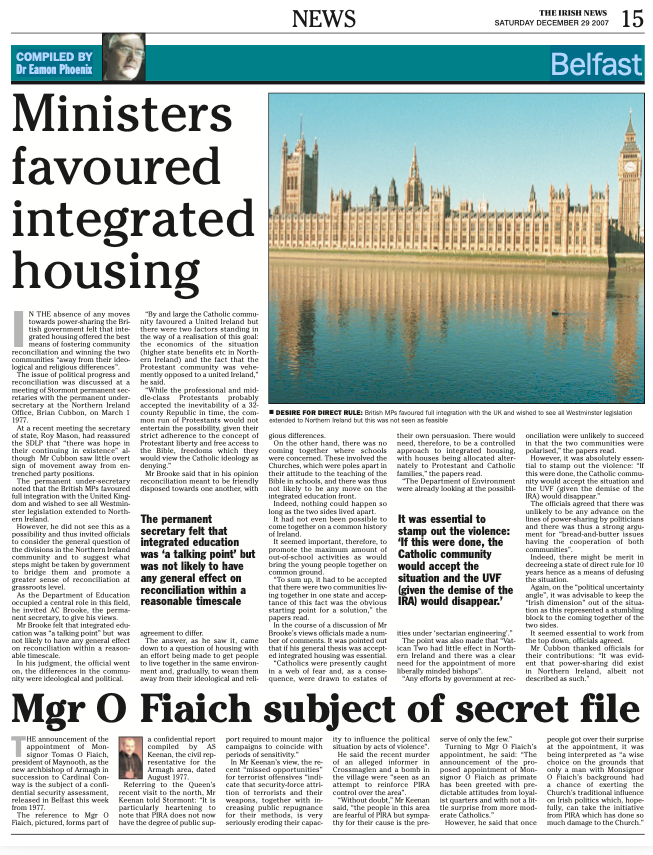
The permanent under-secretary noted that the British MPs favoured full integration with the United Kingdom and wished to see all Westminster legislation extended to Northern Ireland.
However, he did not see this as a possibility and thus invited officials to consider the general question of the divisions in the Northern Ireland community and to suggest what steps might be taken by government to bridge them and promote a greater sense of reconciliation at grassroots level.
As the Department of Education occupied a central role in this field, he invited AC Brooke, the permanent secretary, to give his views.
Mr Brooke felt that integrated education was “a talking point” but was not likely to have any general effect on reconciliation within a reasonable timescale.
In his judgment, the official went on, the differences in the community were ideological and political.
“By and large the Catholic community favoured a United Ireland but there were two factors standing in the way of a realisation of this goal: the economics of the situation (higher state benefits etc in Northern Ireland) and the fact that the Protestant community was vehemently opposed to a united Ireland,” he said.
“While the professional and middle-class Protestants probably accepted the inevitability of a 32-county Republic in time, the common run of Protestants would not entertain the possibility, given their strict adherence to the concept of Protestant liberty and free access to the Bible, freedoms which they would view the Catholic ideology as denying.”
Mr Brooke said that in his opinion reconciliation meant to be friendly disposed towards one another, with agreement to differ. The answer, as he saw it, came down to a question of housing with an effort being made to get people to live together in the same environment and, gradually, to wean them away from their ideological and religious differences.
On the other hand, there was no coming together where schools were concerned. These involved the Churches, which were poles apart in their attitude to the teaching of the Bible in schools, and there was thus not likely to be any move on the integrated education front.
Indeed, nothing could happen so long as the two sides lived apart. It had not even been possible to come together on a common history of Ireland.
It seemed important, therefore, to promote the maximum amount of out-of-school activities as would bring the young people together on common ground.
“To sum up, it had to be accepted that there were two communities living together in one state and acceptance of this fact was the obvious starting point for a solution,” the papers read.
In the course of a discussion of Mr Brooke’s views officials made a number of comments. It was pointed out that if his general thesis was accepted integrated housing was essential.
“Catholics were presently caught in a web of fear and, as a consequence, were drawn to estates of their own persuasion. There would need, therefore, to be a controlled approach to integrated housing, with houses being allocated alternately to Protestant and Catholic families,” the papers read.
“The Department of Environment were already looking at the possibilities under ‘sectarian engineering’.”
The point was also made that “Vatican Two had little effect in Northern Ireland and there was a clear need for the appointment of more liberally minded bishops”.
“Any efforts by government at reconciliation were unlikely to succeed in that the two communities were polarised,” the papers read.
However, it was absolutely essential to stamp out the violence: “If this were done, the Catholic community would accept the situation and the UVF (given the demise of the IRA) would disappear.”
The officials agreed that there was unlikely to be any advance on the lines of power-sharing by politicians and there was thus a strong argument for “bread-and-butter issues having the cooperation of both communities”.
Indeed, there might be merit in decreeing a state of direct rule for 10 years hence as a means of defusing the situation. Again, on the “political uncertainty angle”, it was advisable to keep the “Irish dimension” out of the situation as this represented a stumbling block to the coming together of the two sides.
It seemed essential to work from the top down, officials agreed.
Mr Cubbon thanked officials for their contributions: “It was evident that power-sharing did exist in Northern Ireland, albeit not described as such.”
Mgr O Fiaich subject of secret file
The announcement of the appointment of Monsignor Tomas O Fiaich, president of Maynooth, as the new archbishop of Armagh in succession to Cardinal Conway is the subject of a confidential security assessment, released in Belfast this week from 1977.
The reference to Mgr O Fiaich forms part of a confidential report compiled by AS Keenan, the civil representative for the Armagh area, dated August 1977.
Referring to the Queen’s recent visit to the north, Mr Keenan told Stormont: “It is particularly heartening to note that PIRA does not now have the degree of public support required to mount major campaigns to coincide with periods of sensitivity.”
In Mr Keenan’s view, the recent “missed opportunities” for terrorist offensives “indicate that security-force attrition of terrorists and their weapons, together with increasing public repugnance for their methods, is very seriously eroding their capacity to influence the political situation by acts of violence”.
He said the recent murder of an alleged informer in Crossmaglen and a bomb in the village were “seen as an attempt to reinforce PIRA control over the area”.
“Without doubt,” Mr Keenan said, “the people in this area are fearful of PIRA but sympathy for their cause is the preserve of only the few.”
Turning to Mgr O Fiaich’s appointment, he said: “The announcement of the proposed appointment of Monsignor O Fiaich as primate has been greeted with predictable attitudes from loyalist quarters and with not a little surprise from more moderate Catholics.”
However, he said that once people got over their surprise at the appointment, it was being interpreted as “a wise choice on the grounds that only a man with Monsignor O Fiaich’s background had a chance of exerting the Church’s traditional influence on Irish politics which, hopefully, can take the initiative from PIRA which has done so much damage to the Church.”