

1977 State Papers (page 4)
December 28 2007
Publication Date
British army was ready to seize power stations in UUAC strike, Mason’s handling of crisis increased his standing
State Paper Snippet
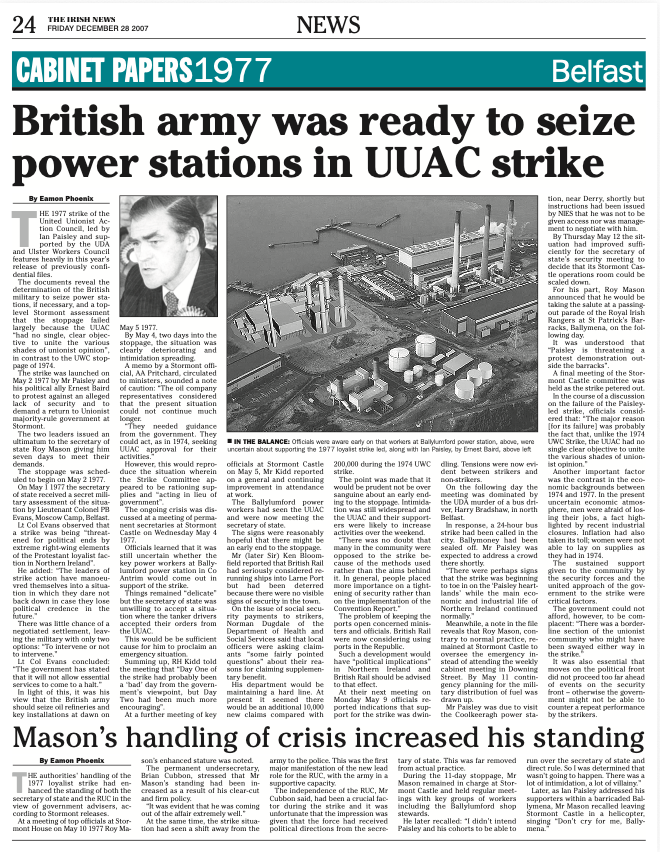
British army was ready to seize power stations in UUAC strike
The 1977 strike of the United Unionist Action Council, led by Ian Paisley and supported by the UDA and Ulster Workers Council features heavily in this year’s release of previously confidential files.
The documents reveal the determination of the British military to seize power stations, if necessary, and a top-level Stormont assessment that the stoppage failed largely because the UUAC “had no single, clear objective to unite the various shades of unionist opinion”, in contrast to the UWC stoppage of 1974.
The strike was launched on May 2 1977 by Mr Paisley and his political ally Ernest Baird to protest against an alleged lack of security and to demand a return to Unionist majority-rule government at Stormont. The two leaders issued an ultimatum to the secretary of state Roy Mason giving him seven days to meet their demands. The stoppage was scheduled to begin on May 2 1977.
On May 1 1977 the secretary of state received a secret military assessment of the situation by Lieutenant Colonel PB Evans, Moscow Camp, Belfast. Lt Col Evans observed that a strike was being “threatened for political ends by extreme right-wing elements of the Protestant loyalist faction in Northern Ireland”.
He added: “The leaders of strike action have manoeuvred themselves into a situation in which they dare not back down in case they lose political credence in the future.”
There was little chance of a negotiated settlement, leaving the military with only two options: “To intervene or not to intervene.” Lt Col Evans concluded: “The government has stated that it will not allow essential services to come to a halt.” In light of this, it was his view that the British army should seize oil refineries and key installations at dawn on May 5 1977.
By May 4, two days into the stoppage, the situation was clearly deteriorating and intimidation spreading. A memo by a Stormont official, AA Pritchard, circulated to ministers, sounded a note of caution: “The oil company representatives considered that the present situation could not continue much longer. They needed guidance from the government. They could act, as in 1974, seeking UUAC approval for their activities.” However, this would reproduce the situation wherein the Strike Committee appeared to be rationing supplies and “acting in lieu of government”.
The ongoing crisis was discussed at a meeting of permanent secretaries at Stormont Castle on Wednesday May 4 1977. Officials learned that it was still uncertain whether the key power workers at Ballylumford power station in Co Antrim would come out in support of the strike. Things remained “delicate” but the secretary of state was unwilling to accept a situation where the tanker drivers accepted their orders from the UUAC. This would be sufficient cause for him to proclaim an emergency situation.
Summing up, RH Kidd told the meeting that “Day One of the strike had probably been a ‘bad’ day from the government’s viewpoint, but Day Two had been much more encouraging”. At a further meeting of key officials at Stormont Castle on May 5, Mr Kidd reported on a general and continuing improvement in attendance at work. The Ballylumford power workers had seen the UUAC and were now meeting the secretary of state. The signs were reasonably hopeful that there might be an early end to the stoppage.
Mr (later Sir) Ken Bloomfield reported that British Rail had seriously considered re-running ships into Larne Port but had been deterred because there were no visible signs of security in the town. On the issue of social security payments to strikers, Norman Dugdale of the Department of Health and Social Services said that local officers were asking claimants “some fairly pointed questions” about their reasons for claiming supplementary benefit. His department would be maintaining a hard line. At present it seemed there would be an additional 10,000 new claims compared with 200,000 during the 1974 UWC strike.
The point was made that it would be prudent not be over sanguine about an early ending to the stoppage. Intimidation was still widespread and the UUAC and their supporters were likely to increase activities over the weekend. “There was no doubt that many in the community were opposed to the strike because of the methods used rather than the aims behind it. In general, people placed more importance on a tightening of security rather than on the implementation of the Convention Report.”
The problem of keeping the ports open concerned ministers and officials. British Rail were now considering using ports in the Republic. Such a development would have “political implications” in Northern Ireland and British Rail should be advised to that effect.
At their next meeting on Monday May 9 officials reported indications that support for the strike was dwindling. Tensions were now evident between strikers and non-strikers. On the following day the meeting was dominated by the UDA murder of a bus driver, Harry Bradshaw, in north Belfast. In response, a 24-hour bus strike had been called in the city. Ballymoney had been sealed off. Mr Paisley was expected to address a crowd there shortly. “There were perhaps signs that the strike was beginning to toe in on the ‘Paisley heartlands’ while the main economic and industrial life of Northern Ireland continued normally.”
Meanwhile, a note in the file reveals that Roy Mason, contrary to normal practice, remained at Stormont Castle to oversee the emergency instead of attending the weekly cabinet meeting in Downing Street. By May 11 contingency planning for the military distribution of fuel was drawn up. Mr Paisley was due to visit the Coolkeeragh power station, near Derry, shortly but instructions had been issued by NIES that he was not to be given access nor was management to negotiate with him.
By Thursday May 12 the situation had improved sufficiently for the secretary of state’s security meeting to decide that its Stormont Castle operations room could be scaled down. For his part, Roy Mason announced that he would be taking the salute at a passing-out parade of the Royal Irish Rangers at St Patrick’s Barracks, Ballymena, on the following day. It was understood that “Paisley is threatening a protest demonstration outside the barracks”.
A final meeting of the Stormont Castle committee was held as the strike petered out. In the course of a discussion on the failure of the Paisley-led strike, officials considered that: “The major reason [for its failure] was probably the fact that, unlike the 1974 UWC Strike, the UUAC had no single clear objective to unite the various shades of unionist opinion.”
Another important factor was the contrast in the economic backgrounds between 1974 and 1977. In the present uncertain economic atmosphere, men were afraid of losing their jobs, a fact highlighted by recent industrial closures. Inflation had also taken its toll; women were not able to lay on supplies as they had in 1974.
The sustained support given to the community by the security forces and the united approach of the government to the strike were critical factors. The government could not afford, however, to be complacent: “There was a borderline section of the unionist community who might have been swayed either way in the strike.” It was also essential that moves on the political front did not proceed too far ahead of events on the security front – otherwise the government might not be able to counter a repeat performance by the strikers.
Mason’s handling of crisis increased his standing
The authorities’ handling of the 1977 loyalist strike had enhanced the standing of both the secretary of state and the RUC in the view of government advisers, according to Stormont releases.
At a meeting of top officials at Stormont House on May 10 1977 Roy Mason’s enhanced stature was noted. The permanent undersecretary, Brian Cubbon, stressed that Mr Mason’s standing had been increased as a result of his clear-cut and firm policy. “It was evident that he was coming out of the affair extremely well.”
At the same time, the strike situation had seen a shift away from the army to the police. This was the first major manifestation of the new lead role for the RUC, with the army in a supportive capacity.
The independence of the RUC, Mr Cubbon said, had been a crucial factor during the strike and it was unfortunate that the impression was given that the force had received political directions from the secretary of state. This was far removed from actual practice.
During the 11-day stoppage, Mr Mason remained in charge at Stormont Castle and held regular meetings with key groups of workers including the Ballylumford shop stewards.
He later recalled: “I didn’t intend Paisley and his cohorts to be able to run over the secretary of state and direct rule. So I was determined that wasn’t going to happen. There was a lot of intimidation, a lot of villainy.”
Later, as Ian Paisley addressed his supporters within a barricaded Ballymena, Mr Mason recalled leaving Stormont Castle in a helicopter, singing “Don’t cry for me, Ballymena.”