

1977 State Papers (page 3)
December 28 2007
Publication Date
Officials worried over fate of west Belfast employer, Paisley slams ‘propaganda’
State Paper Snippet
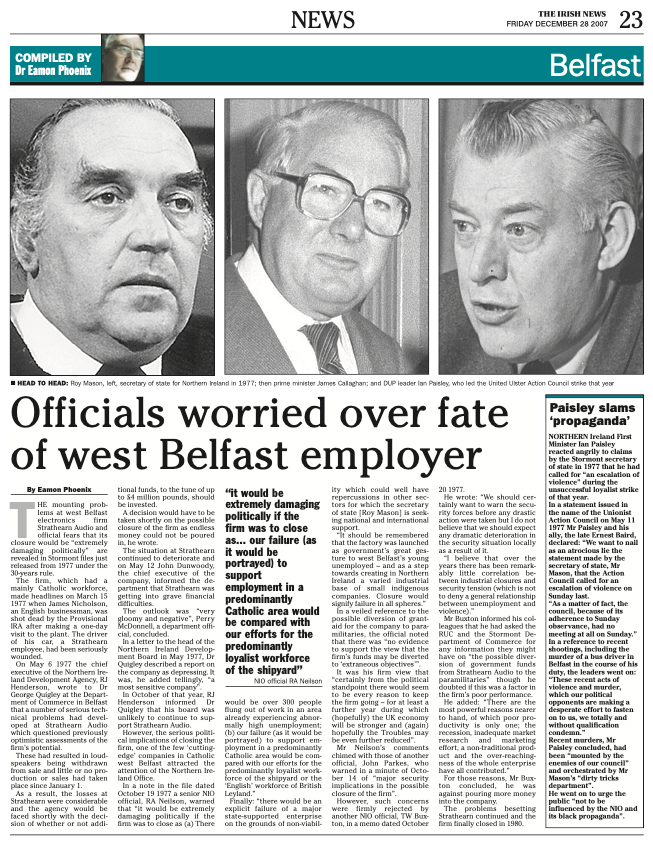
Officials worried over fate of west Belfast employer
The mounting problems at west Belfast electronics firm Strathearn Audio and official fears that its closure would be “extremely damaging politically” are revealed in Stormont files just released from 1977 under the 30-years rule.
The firm, which had a mainly Catholic workforce, made headlines on March 15 1977 when James Nicholson, an English businessman, was shot dead by the Provisional IRA after making a one-day visit to the plant. The driver of his car, a Strathearn employee, had been seriously wounded.
On May 6 1977 the chief executive of the Northern Ireland Development Agency, RJ Henderson, wrote to Dr George Quigley at the Department of Commerce in Belfast that a number of serious technical problems had developed at Strathearn Audio which questioned previously optimistic assessments of the firm’s potential.
These had resulted in loudspeakers being withdrawn from sale and little or no production or sales had taken place since January 1.
As a result, the losses at Strathearn were considerable and the agency would be faced shortly with the decision of whether or not additional funds, to the tune of up to £4 million pounds, should be invested.
A decision would have to be taken shortly on the possible closure of the firm as endless money could not be poured in, he wrote.
The situation at Strathearn continued to deteriorate and on May 12 John Dunwoody, the chief executive of the company, informed the department that Strathearn was getting into grave financial difficulties.
The outlook was “very gloomy and negative”, Perry McDonnell, a department official, concluded.
In a letter to the head of the Northern Ireland Development Board in May 1977, Dr Quigley described a report on the company as depressing. It was, he added tellingly, “a most sensitive company”.
In October of that year, RJ Henderson informed Dr Quigley that his board was unlikely to continue to support Strathearn Audio.
However, the serious political implications of closing the firm, one of the few ‘cutting-edge’ companies in Catholic west Belfast attracted the attention of the Northern Ireland Office.
In a note in the file dated October 19 1977 a senior NIO official, RA Neilson, warned that “it would be extremely damaging politically if the firm was to close as (a) There would be over 300 people flung out of work in an area already experiencing abnormally high unemployment; (b) our failure (as it would be portrayed) to support employment in a predominantly Catholic area would be compared with our efforts for the predominantly loyalist workforce of the shipyard or the ‘English’ workforce of British Leyland.”
Finally: “there would be an explicit failure of a major state-supported enterprise on the grounds of non-viability which could well have repercussions in other sectors for which the secretary of state [Roy Mason] is seeking national and international support.
“It should be remembered that the factory was launched as government’s great gesture to west Belfast’s young unemployed – and as a step towards creating in Northern Ireland a varied industrial base of small indigenous companies. Closure would signify failure in all spheres.”
In a veiled reference to the possible diversion of grant-aid for the company to paramilitaries, the official noted that there was “no evidence to support the view that the firm’s funds may be diverted to ‘extraneous objectives’”.
It was his firm view that “certainly from the political standpoint there would seem to be every reason to keep the firm going – for at least a further year during which (hopefully) the UK economy will be stronger and (again) hopefully the Troubles may be even further reduced”.
Mr Neilson’s comments chimed with those of another official, John Parkes, who warned in a minute of October 14 of “major security implications in the possible closure of the firm”.
However, such concerns were firmly rejected by another NIO official, TW Buxton, in a memo dated October 20 1977. He wrote: “We should certainly want to warn the security forces before any drastic action were taken but I do not believe that we should expect any dramatic deterioration in the security situation locally as a result of it.
“I believe that over the years there has been remarkably little correlation between industrial closures and security tension (which is not to deny a general relationship between unemployment and violence).”
Mr Buxton informed his colleagues that he had asked the RUC and the Stormont Department of Commerce for any information they might have on “the possible diversion of government funds from Strathearn Audio to the paramilitaries” though he doubted if this was a factor in the firm’s poor performance.
He added: “There are the most powerful reasons nearer to hand, of which poor productivity is only one; the recession, inadequate market research and marketing effort, a non-traditional product and the over-reachingness of the whole enterprise have all contributed.”
For those reasons, Mr Buxton concluded, he was against pouring more money into the company.
The problems besetting Strathearn continued and the firm finally closed in 1980.
Paisley slams ‘propaganda’
Northern Ireland First Minister Ian Paisley reacted angrily to claims by the Stormont secretary of state in 1977 that he had called for “an escalation of violence” during the unsuccessful loyalist strike of that year.
In a statement issued in the name of the Unionist Action Council on May 11 1977 Mr Paisley and his ally, the late Ernest Baird, declared: “We want to nail as an atrocious lie the statement made by the secretary of state, Mr Mason, that the Action Council called for an escalation of violence on Sunday last.
“As a matter of fact, the council, because of its adherence to Sunday observance, had no meeting at all on Sunday.”
In a reference to recent shootings, including the murder of a bus driver in Belfast in the course of his duty, the leaders went on: “These recent acts of violence and murder, which our political opponents are making a desperate effort to fasten on to us, we totally and without qualification condemn.”
Recent murders, Mr Paisley concluded, had been “mounted by the enemies of our council” and orchestrated by Mr Mason’s “dirty tricks department”.
He went on to urge the public “not to be influenced by the NIO and its black propaganda”.