

1977 State Papers (page 2)
December 28 2007
Publication Date
British government shifts north policy away from power-sharing, Some files to remain secret, Concern over cinema attacks, Honours list exclusion proposal, PM congratulates Mason
State Paper Snippet
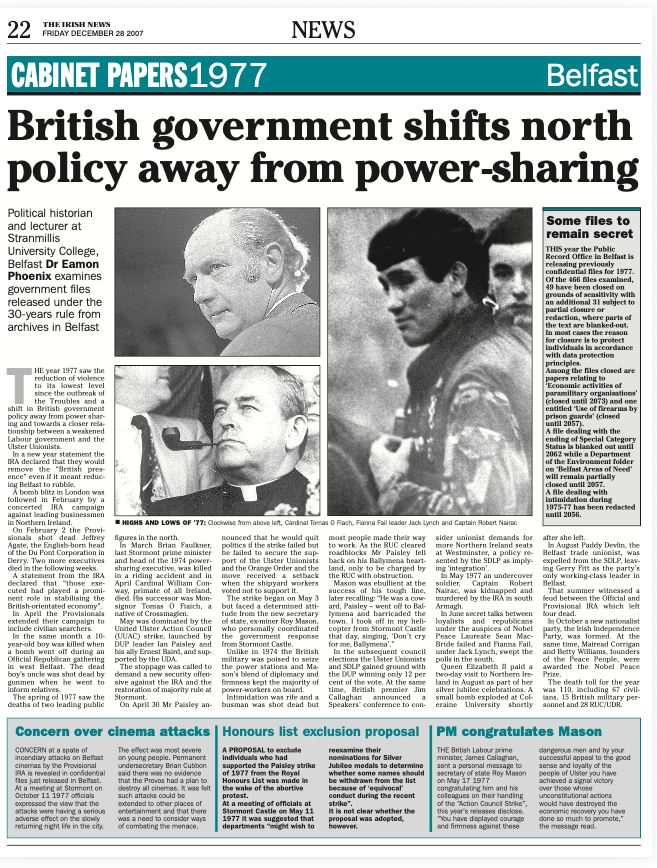
British government shifts north policy away from power-sharing
Political historian and lecturer at Stranmillis College, Belfast Dr Eamon Phoenix examines the government files released under the 30-years rule from archives in Belfast…
The year 1977 saw the reduction of violence to its lowest level since the outbreak of the Troubles and a shift in British government policy away from power sharing and towards a closer relationship between a weakened Labour government and the Ulster Unionists.
In a new year statement the IRA declared that they would remove the “British presence” even if it meant reducing Belfast to rubble. A bomb blitz in London was followed in February by a concerted IRA campaign against leading businessmen in Northern Ireland.
On February 2 the Provisionals shot dead Jeffrey Agate, the English-born head of the Du Pont Corporation in Derry. Two more executives died in the following weeks. A statement from the IRA declared that “those executed had played a prominent role in stabilising the British-orientated economy”.
In April the Provisionals extended their campaign to include civilian searchers. In the same month a 10-year-old boy was killed when a bomb went off during an Official Republican gathering in west Belfast. The dead boy’s uncle was shot dead by gunmen when he went to inform relatives.
The spring of 1977 saw the deaths of two leading public figures in the north. In March Brian Faulkner, last Stormont prime minister and head of the 1974 power-sharing executive, was killed in a riding accident and in April Cardinal William Conway, primate of all Ireland, died. His successor was Monsignor Tomas O Fiaich, a native of Crossmaglen.
May was dominated by the United Ulster Action Council (UUAC) strike, launched by DUP leader Ian Paisley and his ally Ernest Baird, and supported by the UDA. The stoppage was called to demand a new security offensive against the IRA and the restoration of majority rule at Stormont.
On April 30 Mr Paisley announced that he would quit politics if the strike failed but he failed to secure the support of the Ulster Unionists and the Orange Order and the move received a setback when the shipyard workers voted not to support it.
The strike began on May 3 but faced a determined attitude from the new secretary of state, ex-miner Roy Mason, who personally coordinated the government response from Stormont Castle.
Unlike in 1974 the British military was poised to seize the power stations and Mason’s blend of diplomacy and firmness kept the majority of power-workers on board. Intimidation was rife and a busman was shot dead but most people made their way to work. As the RUC cleared roadblocks Mr Paisley fell back on his Ballymena heartland, only to be charged by the RUC with obstruction.
Mason was ebullient at the success of his tough line, later recalling: “He was a coward, Paisley – went off to Ballymena and barricaded the town. I took off in my helicopter from Stormont Castle that day, singing, ‘Don’t cry for me, Ballymena’.”
In the subsequent council elections the Ulster Unionists and SDLP gained ground with the DUP winning only 12 per cent of the vote. At the same time, British premier Jim Callaghan announced a Speakers’ conference to consider unionist demands for more Northern Ireland seats at Westminster, a policy resented by the SDLP as implying ‘integration’.
In May 1977 an undercover soldier, Captain Robert Nairac, was kidnapped and murdered by the IRA in south Armagh. In June secret talks between loyalists and republicans under the auspices of Nobel Peace Laureate Sean MacBride failed and Fianna Fail, under Jack Lynch, swept the polls in the south.
Queen Elizabeth II paid a two-day visit to Northern Ireland in August as part of her silver jubilee celebrations. A small bomb exploded at Coleraine University shortly after she left. In August Paddy Devlin, the Belfast trade unionist, was expelled from the SDLP, leaving Gerry Fitt as the party’s only working-class leader in Belfast.
That summer witnessed a feud between the Official and Provisional IRA which left four dead. In October a new nationalist party, the Irish Independence Party, was formed. At the same time, Mairead Corrigan and Betty Williams, founders of the Peace People, were awarded the Nobel Peace Prize.
The death toll for the year was 110, including 67 civilians, 15 British military personnel and 28 RUC/UDR.
Some files to remain secret
This year the Public Record Office in Belfast is releasing previously confidential files for 1977. Of the 466 files examined, 49 have been closed on grounds of sensitivity with an additional 31 subject to partial closure or redaction, where parts of the text are blanked-out. In most cases the reason for closure is to protect individuals in accordance with data protection principles.
Among the files closed are papers relating to ‘Economic activities of paramilitary organisations’ (closed until 2073) and one entitled ‘Use of firearms by prison guards’ (closed until 2057).
A file dealing with the ending of Special Category Status is blanked out until 2062 while a Department of the Environment folder on ‘Belfast Areas of Need’ will remain partially closed until 2057. A file dealing with intimidation during 1975-77 has been redacted until 2056.
Concern over cinema attacks
Concern at a spate of incendiary attacks on Belfast cinemas by the Provisional IRA is revealed in confidential files just released in Belfast. At a meeting at Stormont on October 11 1977 officials expressed the view that the attacks were having a serious adverse effect on the slowly returning night life in the city.
The effect was most severe on young people. Permanent undersecretary Brian Cubbon said there was no evidence that the Provos had a plan to destroy all cinemas. It was felt such attacks could be extended to other places of entertainment and that there was a need to consider ways of combating the menace.
Honours list exclusion proposal
A proposal to exclude individuals who had supported the Paisley strike of 1977 from the Royal Honours List was made in the wake of the abortive protest.
At a meeting of officials at Stormont Castle on May 11 1977 it was suggested that departments “might wish to reexamine their nominations for Silver Jubilee medals to determine whether some names should be withdrawn from the list because of ‘equivocal’ conduct during the recent strike”. It is not clear whether the proposal was adopted, however.
PM congratulates Mason
The British Labour prime minister, James Callaghan, sent a personal message to secretary of state Roy Mason on May 17 1977 congratulating him and his colleagues on their handling of the “Action Council Strike”, this year’s releases disclose.
“You have displayed courage and firmness against these dangerous men and by your successful appeal to the good sense and loyalty of the people of Ulster you have achieved a signal victory over those whose unconstitutional actions would have destroyed the economic recovery you have done so much to promote,” the message read.