

1976 State Papers (page 9)
January 01 2007
Publication Date
Counter-marchers blamed for stoking civil rights fire, ‘Only Paisley could keep control’, MP’s UVF training allegations probed
State Paper Snippet
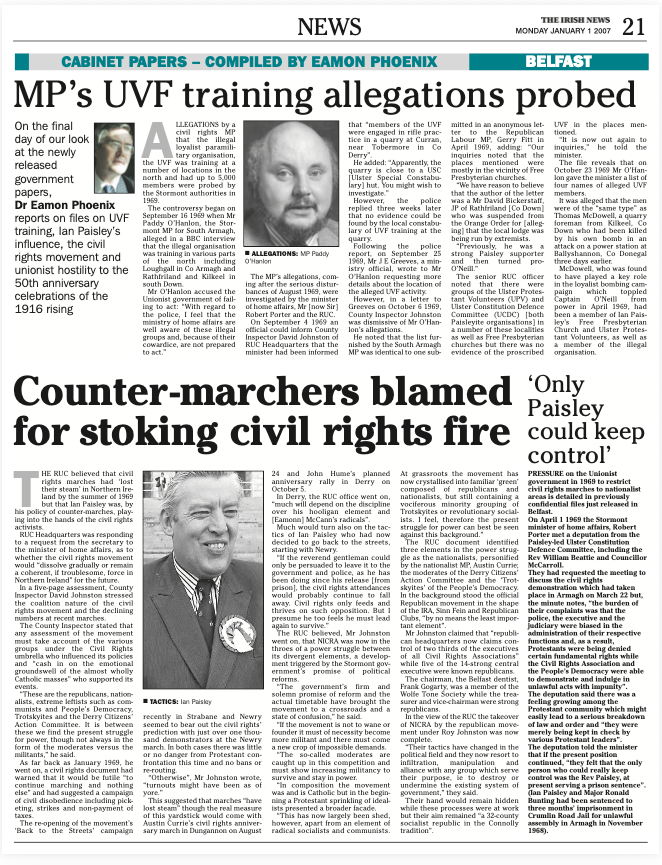
Counter-marchers blamed for stoking civil rights fire
THE RUC believed that civil rights marches had ‘lost their steam’ in Northern Ireland by the summer of 1969 but that Ian Paisley was, by his policy of counter-marches, playing into the hands of the civil rights activists.
RUC Headquarters was responding to a request from the secretary to the minister of home affairs, as to whether the civil rights movement would “dissolve gradually or remain a coherent, if troublesome, force in Northern Ireland” for the future.
In a five-page assessment, County Inspector David Johnston stressed the coalition nature of the civil rights movement and the declining numbers at recent marches.
The County Inspector stated that any assessment of the movement must take account of the various groups under the Civil Rights umbrella who influenced its policies and “cash in on the emotional groundswell of the almost wholly Catholic masses” who supported its events.
“These are the republicans, nationalists, extreme leftists such as communists and People’s Democracy, Trotskyites and the Derry Citizens’ Action Committee. It is between these we find the present struggle for power, though not always in the form of the moderates versus the militants,” he said.
As far back as January 1969, he went on, a civil rights document had warned that it would be futile “to continue marching and nothing else” and had suggested a campaign of civil disobedience including picketing, strikes and non-payment of taxes.
The re-opening of the movement’s ‘Back to the Streets’ campaign recently in Strabane and Newry seemed to bear out the civil rights’ prediction with just over one thousand demonstrators at the Newry march. In both cases there was little or no danger from Protestant confrontation this time and no bans or re-routing.
“Otherwise”, Mr Johnston wrote, “turnouts might have been as of yore.”
This suggested that marches “have lost steam” though the real measure of this yardstick would come with Austin Currie’s civil rights anniversary march in Dungannon on August 24 and John Hume’s planned anniversary rally in Derry on October 5.
In Derry, the RUC office went on, “much will depend on the discipline over his hooligan element and [Eamonn] McCann’s radicals”.
Much would turn also on the tactics of Ian Paisley who had now decided to go back to the streets, starting with Newry.
“If the reverend gentleman could only be persuaded to leave it to the government and police, as he has been doing since his release [from prison], the civil rights attendances would probably continue to fall away. Civil rights only feeds and thrives on such opposition. But I presume he too feels he must lead again to survive.”
The RUC believed, Mr Johnston went on, that NICRA was now in the throes of a power struggle between its divergent elements, a development triggered by the Stormont government’s promise of political reforms.
“The government’s firm and solemn promise of reform and the actual timetable have brought the movement to a crossroads and a state of confusion,” he said.
“If the movement is not to wane or founder it must of necessity become more militant and there must come a new crop of impossible demands.
“The so-called moderates are caught up in this competition and must show increasing militancy to survive and stay in power.
“In composition the movement was and is Catholic but in the beginning a Protestant sprinkling of idealists presented a broader facade.
“This has now largely been shed, however, apart from an element of radical socialists and communists.
At grassroots the movement has now crystallised into familiar ‘green’ composed of republicans and nationalists, but still containing a vociferous minority grouping of Trotskyites or revolutionary socialists. I feel, therefore the present struggle for power can best be seen against this background.”
The RUC document identified three elements in the power struggle as the nationalists, personified by the nationalist MP, Austin Currie; the moderates of the Derry Citizens’ Action Committee and the ‘Trotskyites’ of the People’s Democracy. In the background stood the official Republican movement in the shape of the IRA, Sinn Fein and Republican Clubs, “by no means the least important element”.
Mr Johnston claimed that “republican headquarters now claims control of two thirds of the executives of all Civil Rights Associations” while five of the 14-strong central executive were known republicans.
The chairman, the Belfast dentist, Frank Gogarty, was a member of the Wolfe Tone Society while the treasurer and vice-chairman were strong republicans.
In the view of the RUC the takeover of NICRA by the republican movement under Roy Johnston was now complete.
“Their tactics have changed in the political field and they now resort to infiltration, manipulation and alliance with any group which serve their purpose, ie to destroy or undermine the existing system of government,” they said.
Their hand would remain hidden while these processes were at work but their aim remained “a 32-county socialist republic in the Connolly tradition”.
‘Only Paisley could keep control’
PRESSURE on the Unionist government in 1969 to restrict civil rights marches to nationalist areas is detailed in previously confidential files just released in Belfast.
On April 1 1969 the Stormont minister of home affairs, Robert Porter met a deputation from the Paisley-led Ulster Constitution Defence Committee, including the Rev William Beattie and Councillor McCarroll.
They had requested the meeting to discuss the civil rights demonstration which had taken place in Armagh on March 22 but, the minute notes, “the burden of their complaints was that the police, the executive and the judiciary were biased in the administration of their respective functions and, as a result, Protestants were being denied certain fundamental rights while the Civil Rights Association and the People’s Democracy were able to demonstrate and indulge in unlawful acts with impunity”.
The deputation said there was a feeling growing among the Protestant community which might easily lead to a serious breakdown of law and order and “they were merely being kept in check by various Protestant leaders”.
The deputation told the minister that if the present position continued, “they felt that the only person who could really keep control was the Rev Paisley, at present serving a prison sentence”.
(Ian Paisley and Major Ronald Bunting had been sentenced to three months’ imprisonment in Crumlin Road Jail for unlawful assembly in Armagh in November 1968).
MP’s UVF training allegations probed
Allegations by a civil rights MP that the illegal loyalist paramilitary organisation, the UVF was training at a number of locations in the north and had up to 5,000 members were probed by the Stormont authorities in 1969.
The controversy began on September 16 1969 when Mr Paddy O’Hanlon, the Stormont MP for South Armagh, alleged in a BBC interview that the illegal organisation was training in various parts of the north including Loughgall in Co Armagh and Rathfriland and Killreel in south Down.
Mr O’Hanlon accused the Unionist government of failing to act: “With regard to the police, I feel that the ministry of home affairs are well aware of these illegal groups and, because of their cowardice, are not prepared to act.”
The MP’s allegations, coming after the serious disturbances of August 1969, were investigated by the minister of home affairs, Mr [now Sir] Robert Porter and the RUC.
On September 4 1969 an official could inform County Inspector David Johnston of RUC Headquarters that the minister had been informed that “members of the UVF were engaged in rifle practice in a quarry at Curran, near Tobermore in Co Derry”.
He added: “Apparently, the quarry is close to a USC [Ulster Special Constabulary] hut. You might wish to investigate.”
However, the police replied three weeks later that no evidence could be found by the local constabulary of UVF training at the quarry.
Following the police report, on September 25 1969, Mr J E Greeves, a ministry official, wrote to Mr O’Hanlon requesting more details about the location of the alleged UVF activity.
However, in a letter to Greeves on October 6 1969, County Inspector Johnston was dismissive of Mr O’Hanlon’s allegations.
He noted that the list furnished by the South Armagh MP was identical to one submitted in an anonymous letter to the Republican Labour MP, Gerry Fitt in April 1969, adding: “Our inquiries noted that the places mentioned were mostly in the vicinity of Free Presbyterian churches.
“We have reason to believe that the author of the letter was a Mr David Bickerstaff, JP of Rathfriland [Co Down] who was suspended from the Orange Order for [alleging] that the local lodge was being run by extremists.
“Previously, he was a strong Paisley supporter and then turned pro-O’Neill.”
The senior RUC officer noted that there were groups of the Ulster Protestant Volunteers (UPV) and Ulster Constitution Defence Committee (UCDC) [both Paisleyite organisations] in a number of these localities as well as Free Presbyterian churches but there was no evidence of the proscribed UVF in the places mentioned.
“It is now out again to inquiries,” he told the minister.
The file reveals that on October 23 1969 Mr O’Hanlon gave the minister a list of four names of alleged UVF members.
It was alleged that the men were of the “same type” as Thomas McDowell, a quarry foreman from Kilkeel, Co Down who had been killed by his own bomb in an attack on a power station at Ballyshannon, Co Donegal three days earlier.
McDowell, who was found to have played a key role in the loyalist bombing campaign which toppled Captain O’Neill from power in April 1969, had been a member of Ian Paisley’s Free Presbyterian Church and Ulster Protestant Volunteers, as well as a member of the illegal organisation.