

1976 State Papers (page 7)
December 30 2006
Publication Date
‘Civil rights/IRA tag was wrong and dangerous’, Violence not easily eradicated: think-tank, Military paper on Derry hooliganism
State Paper Snippet
Violence not easily eradicated: think-tank
For historical reasons conflict is built into society in Northern Ireland. The roots of this conflict are many and varied and therefore, not likely to be readily eradicated in the short term.’
This was the conclusion of a high-level Stormont think tank on the Northern security situation in March 1976, just released in Belfast under the Thirty Year Rule.
The paper by the Working Party on Law and Order of the Stormont Secretariat traced the violence to a number of underlying causes: ‘They include the traditional friction between the Gael and the Scots/Irish planter stock; the cultural divide between the Catholics and the Protestants; the economic disparity (though now diminishing) in the wealth commanded by the two communities; anti-British feeling in some sections of the Irish community; Protestant fears of a “take-over” of the province by the Republic.’
Arising from these historical roots, violence had become endemic in Northern Ireland, the report went on: ‘History may have so structured society that conflict is inevitable. But individuals do not see themselves as taking to the bomb and the bullet in order to act out a historical imperative.’
Rather, motivation stemmed from three sources: the first was ‘the traditional republican desire to expel the British from Ireland and create a United Ireland’.
This was matched ‘by the determination of the loyalist majority in Northern Ireland not to be subjugated in this way.
“Civil disaffection arising from community conflict: This is the other side of the coin. Even if the dispute about sovereignty over Northern Ireland did not exist it is clear that those who believe, rightly or wrongly, that they are socially and economically disadvantaged would resort to protest action and possibly violence.’
‘The corruption of the past six years of violence’ which had resulted in the inculcation of violence in the minds of young people.
Against this background of history, the Working Party identified five major threats to law and order.
The first was from the Provisional IRA. The think tank concluded that ‘whatever political accommodation may be reached in the north, there will, for several years to come, be a residual Provisional campaign’.
Secondly, the paper identified the danger of ‘acts of violence arising from the grievances, real or imaginary, in the Catholic community’.
These grievances included ‘a sense of non-participation in government in the broadest sense’, economic factors, provocation by militant loyalists and resentment at ‘a too overt British presence’.
The third threat stemmed from the loyalist paramilitaries which, the memo concluded, ‘are here to stay at least as long as the threat of republican violence continues’.
‘Civil rights/IRA tag was wrong and dangerous’
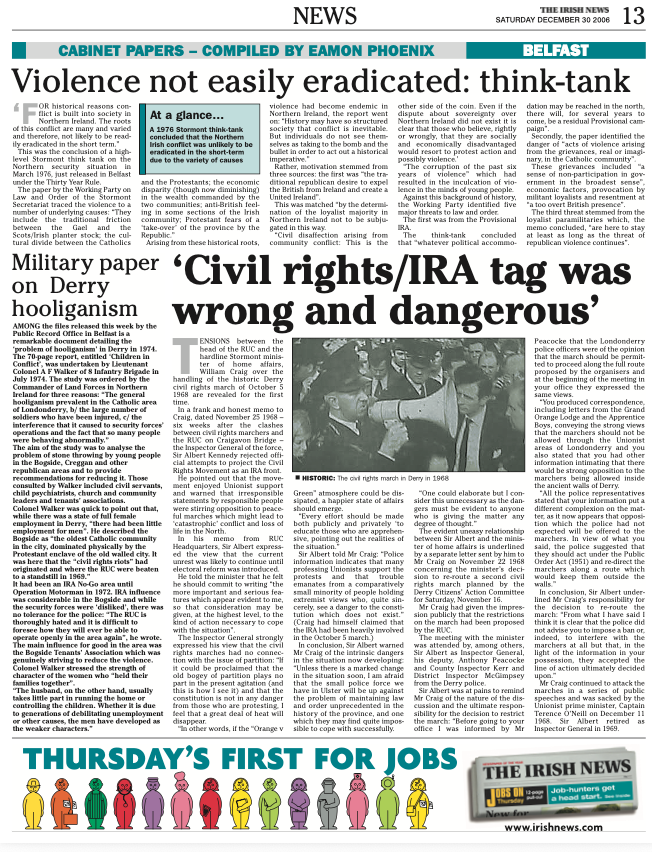
Tensions between the head of the RUC and the hardline Stormont minister of home affairs, William Craig, over the handling of the historic Derry civil rights march of October 5 1968 are revealed for the first time.
In a frank and honest memo to Craig, dated November 25 1968 – six weeks after the clashes between civil rights marchers and the RUC on Craigavon Bridge – the Inspector General of the force, Sir Albert Kennedy rejected official attempts to project the Civil Rights Movement as an IRA front.
He pointed out that the movement enjoyed Unionist support and warned that irresponsible statements by responsible people were stirring opposition to peaceful marches which might lead to ‘catastrophic’ conflict and loss of life in the North.
In his memo from RUC Headquarters, Sir Albert expressed the view that the current unrest was likely to continue until electoral reform was introduced.
He told the minister that he felt he should commit to writing ‘the more important and serious features which appear evident to me, so that consideration may be given, at the highest level, to the kind of action necessary to cope with the situation’.
The Inspector General strongly expressed his view that the civil rights marches had no connection with the issue of partition: ‘If it could be proclaimed that the old bogey of partition plays no part in the present agitation (and this is how I see it) and that the constitution is not in any danger from those who are protesting, I feel that a great deal of heat will disappear.
‘In other words, if the “Orange v Green” atmosphere could be dissipated, a happier state of affairs should emerge.
‘Every effort should be made both publicly and privately to educate those who are apprehensive, pointing out the realities of the situation.’
Sir Albert told Mr Craig: ‘Police information indicates that many professing Unionists support the protests and that trouble emanates from a comparatively small minority of people holding extremist views who, quite sincerely, see a danger to the constitution which does not exist.’
In conclusion, Sir Albert warned Mr Craig of the intrinsic dangers in the situation now developing: ‘Unless there is a marked change in the situation soon, I am afraid that the small police force we have in Ulster will be up against the problem of maintaining law and order unprecedented in the history of the province, and one which they may find quite impossible to cope with successfully.
‘One could elaborate but I consider this unnecessary as the dangers must be evident to anyone who is giving the matter any degree of thought.’
The evident uneasy relationship between Sir Albert and the minister of home affairs is underlined by a separate letter sent by him to Mr Craig on November 22 1968 concerning the minister’s decision to re-route a second civil rights march planned by the Derry Citizens’ Action Committee for Saturday, November 16.
Mr Craig had given the impression publicly that the restrictions on the march had been proposed by the RUC.
The meeting with the minister was attended by, among others, Sir Albert as Inspector General, his deputy, Anthony Peacocke and County Inspector Kerr and District Inspector McGimpsey from the Derry police.
Sir Albert was at pains to remind Mr Craig of the nature of the discussion and the ultimate responsibility for the decision to restrict the march: ‘Before going to your office I was informed by Mr Peacocke that the Londonderry police officers were of the opinion that the march should be permitted to proceed along the full route proposed by the organisers and at the beginning of the meeting in your office they expressed the same views.
‘You produced correspondence, including letters from the Grand Orange Lodge and the Apprentice Boys, conveying the strong views that the marchers should not be allowed through the Unionist areas of Londonderry and you also stated that you had other information intimating that there would be strong opposition to the marchers being allowed inside the ancient walls of Derry.
‘All the police representatives stated that your information put a different complexion on the matter, as it now appears that opposition which the police had not expected will be offered to the marchers. In view of what you said, the police suggested that they should act under the Public Order Act (1951) and re-direct the marchers along a route which would keep them outside the walls.’
In conclusion, Sir Albert underlined Mr Craig’s responsibility for the decision to re-route the march: ‘From what I have said I think it is clear that the police did not advise you to impose a ban or, indeed, to interfere with the marchers at all but that, in the light of the information in your possession, they accepted the line of action ultimately decided upon.’
Mr Craig continued to attack the marches in a series of public speeches and was sacked by the Unionist prime minister, Captain Terence O’Neill on December 11 1968. Sir Albert retired as Inspector General in 1969.
Military paper on Derry hooliganism
AMONG the files released this week by the Public Record Office in Belfast is a remarkable document detailing the ‘problem of hooliganism’ in Derry in 1974.
The 70-page report, entitled ‘Children in Conflict’, was undertaken by Lieutenant Colonel A F Walker of 8 Infantry Brigade in July 1974. The study was ordered by the Commander of Land Forces in Northern Ireland for three reasons: “The general hooliganism prevalent in the Catholic area of Londonderry, b/ the large number of soldiers who have been injured, c/ the interference that it caused to security forces’ operations and the fact that so many people were behaving abnormally.”
The aim of the study was to analyse the problem of stone throwing by young people in the Bogside, Creggan and other republican areas and to provide recommendations for reducing it. Those consulted by Walker included civil servants, child psychiatrists, church and community leaders and tenants’ associations.
Colonel Walker was quick to point out that, while there was a state of full female employment in Derry, “there had been little employment for men”. He described the Bogside as “the oldest Catholic community in the city, dominated physically by the Protestant enclave of the old walled city. It was here that the “civil rights riots” had originated and where the RUC were beaten to a standstill in 1969.”
It had been an IRA No-Go area until Operation Motorman in 1972. IRA influence was considerable in the Bogside and while the security forces were ‘disliked’, there was no tolerance for the police: “The RUC is thoroughly hated and it is difficult to foresee how they will ever be able to operate openly in the area again”, he wrote.
The main influence for good in the area was the Bogside Tenants’ Association which was genuinely striving to reduce the violence.
Colonel Walker stressed the strength of character of the women who “held their families together”.
“The husband, on the other hand, usually takes little part in running the home or controlling the children. Whether it is due to generations of debilitating unemployment or other causes, the men have developed as the weaker characters.”