

1976 State Papers (page 6)
December 30 2006
Publication Date
British at pains to avoid ‘embarrassing’ leaders of the Peace Movement, Fitt shunned dinner over SAS gaffe, SDLP greatly concerned at Northern Ireland’s deteriorating economy
State Paper Snippet
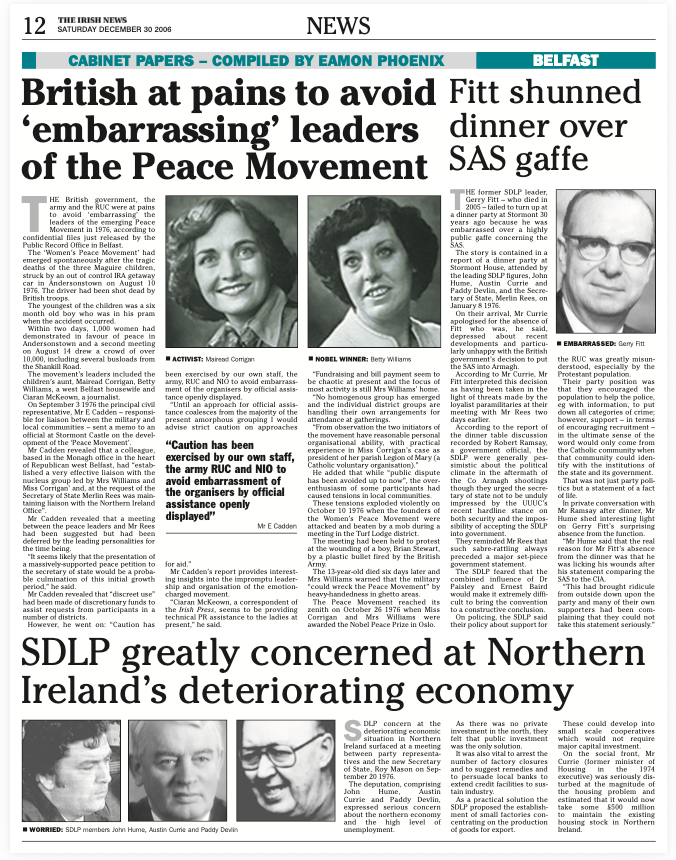
British at pains to avoid ‘embarrassing’ leaders of the Peace Movement
The British government, the army and the RUC were at pains to avoid ‘embarrassing’ the leaders of the emerging Peace Movement in 1976, according to confidential files just released by the Public Record Office in Belfast.
The ‘Women’s Peace Movement’ had emerged spontaneously after the tragic deaths of the three Maguire children, struck by an out of control IRA getaway car in Andersonstown on August 10 1976. The driver had been shot dead by British troops.
The youngest of the children was a six month old boy who was in his pram when the accident occurred.
Within two days, 1,000 women had demonstrated in favour of peace in Andersonstown and a second meeting on August 14 drew a crowd of over 10,000, including several busloads from the Shankill Road.
The movement’s leaders included the children’s aunt, Mairead Corrigan, Betty Williams, a west Belfast housewife and Ciaran McKeown, a journalist.
On September 3 1976 the principal civil representative, Mr E Cadden – responsible for liaison between the military and local communities – sent a memo to an official at Stormont Castle on the development of the ‘Peace Movement’.
Mr Cadden revealed that a colleague, based in the Monagh office in the heart of Republican west Belfast, had “established a very effective liaison with the nucleus group led by Mrs Williams and Miss Corrigan” and, at the request of the Secretary of State Merlin Rees, was maintaining liaison with the Northern Ireland Office.
Mr Cadden revealed that a meeting between the peace leaders and Mr Rees had been suggested but had been deferred by the leading personalities for the time being.
“It seems likely that the presentation of a massively-supported peace petition to the secretary of state would be a probable culmination of this initial growth period,” he said.
Mr Cadden revealed that “discreet use” had been made of discretionary funds to assist requests from participants in a number of districts.
However, he went on: “Caution has been exercised by our own staff, the army, RUC and NIO to avoid embarrassment of the organisers by official assistance openly displayed.
“Until an approach for official assistance coalesces from the majority of the present amorphous grouping I would advise strict caution on approaches for aid.”
Mr Cadden’s report provides interesting insights into the impromptu leadership and organisation of the emotion-charged movement.
“Ciaran McKeown, a correspondent of the Irish Press, seems to be providing technical PR assistance to the ladies at present,” he said.
“Fundraising and bill payment seem to be chaotic at present and the focus of most activity is still Mrs Williams’ home.
“No homogenous group has emerged and the individual district groups are handling their own arrangements for attendance at gatherings.
“From observation the two initiators of the movement have reasonable personal organisational ability, with practical experience in Miss Corrigan’s case as president of her parish Legion of Mary (a Catholic voluntary organisation).”
He added that while “public dispute has been avoided up to now”, the over-enthusiasm of some participants had caused tensions in local communities.
These tensions exploded violently on October 10 1976 when the founders of the Women’s Peace Movement were attacked and beaten by a mob during a meeting in the Turf Lodge district.
The meeting had been held to protest at the wounding of a boy, Brian Stewart, by a plastic bullet fired by the British Army.
The 13-year-old died six days later and Mrs Williams warned that the military “could wreck the Peace Movement” by heavy-handedness in ghetto areas.
The Peace Movement reached its zenith on October 26 1976 when Miss Corrigan and Mrs Williams were awarded the Nobel Peace Prize in Oslo.
Fitt shunned dinner over SAS gaffe
The former SDLP leader, Gerry Fitt – who died in 2005 – failed to turn up at a dinner party at Stormont 30 years ago because he was embarrassed over a highly public gaffe concerning the SAS.
The story is contained in a report of a dinner party at Stormont House, attended by the leading SDLP figures, John Hume, Austin Currie and Paddy Devlin, and the Secretary of State, Merlin Rees, on January 8 1976.
On their arrival, Mr Currie apologised for the absence of Fitt who was, he said, depressed about recent developments and particularly unhappy with the British government’s decision to put the SAS into Armagh.
According to Mr Currie, Mr Fitt interpreted this decision as having been taken in the light of threats made by the loyalist paramilitaries at their meeting with Mr Rees two days earlier.
According to the report of the dinner table discussion recorded by Robert Ramsay, a government official, the SDLP were generally pessimistic about the political climate in the aftermath of the Co Armagh shootings though they urged the secretary of state not to be unduly impressed by the UUUC’s recent hardline stance on both security and the impossibility of accepting the SDLP into government.
They reminded Mr Rees that such sabre-rattling always preceded a major set-piece government statement.
The SDLP feared that the combined influence of Dr Paisley and Ernest Baird would make it extremely difficult to bring the convention to a constructive conclusion.
On policing, the SDLP said their policy about support for the RUC was greatly misunderstood, especially by the Protestant population.
Their party position was that they encouraged the population to help the police, eg with information, to put down all categories of crime; however, support – in terms of encouraging recruitment – in the ultimate sense of the word would only come from the Catholic community when that community could identify with the institutions of the state and its government.
That was not just party politics but a statement of a fact of life.
In private conversation with Mr Ramsay after dinner, Mr Hume shed interesting light on Gerry Fitt’s surprising absence from the function.
“Mr Hume said that the real reason for Mr Fitt’s absence from the dinner was that he was licking his wounds after his statement comparing the SAS to the CIA.
“This had brought ridicule from outside down upon the party and many of their own supporters had been complaining that they could not take this statement seriously.”
SDLP greatly concerned at Northern Ireland’s deteriorating economy
SDLP concern at the deteriorating economic situation in Northern Ireland surfaced at a meeting between party representatives and the new Secretary of State, Roy Mason on September 20 1976.
The deputation, comprising John Hume, Austin Currie and Paddy Devlin, expressed serious concern about the northern economy and the high level of unemployment.
As there was no private investment in the north, they felt that public investment was the only solution.
It was also vital to arrest the number of factory closures and to suggest remedies and to persuade local banks to extend credit facilities to sustain industry.
As a practical solution the SDLP proposed the establishment of small factories concentrating on the production of goods for export.
These could develop into small scale cooperatives which would not require major capital investment.
On the social front, Mr Currie (former minister of Housing in the 1974 executive) was seriously disturbed at the magnitude of the housing problem and estimated that it would now take some £500 million to maintain the existing housing stock in Northern Ireland.