

1976 State Papers (page 11)
January 01 2007
Publication Date
RUC chief’s prophetic warning about disputed Orange parades, Irish army veterans cause headache
State Paper Snippet
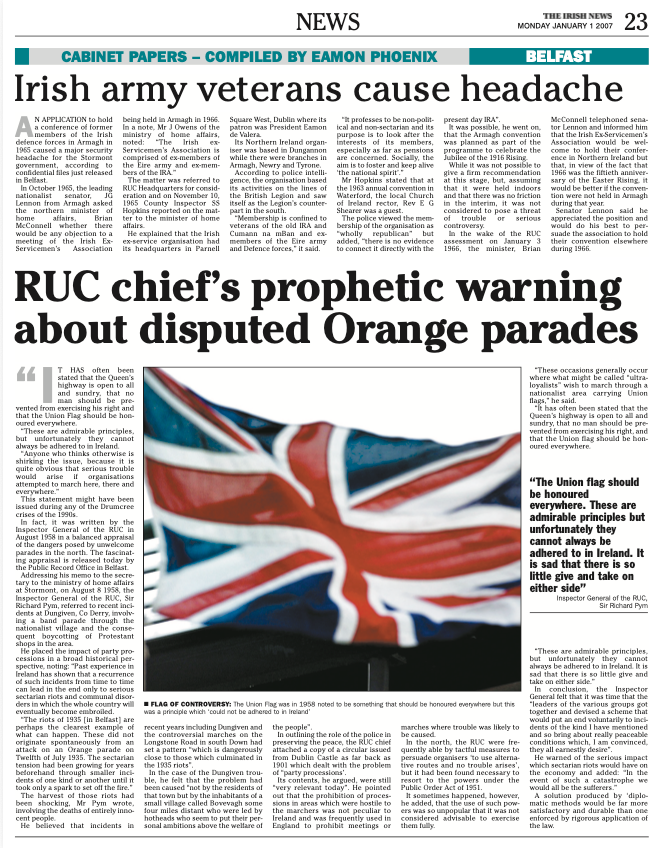
RUC chief’s prophetic warning about disputed Orange parades
“IT HAS often been stated that the Queen’s highway is open to all and sundry, that no man should be prevented from exercising his right and that the Union Flag should be honoured everywhere.
“These are admirable principles, but unfortunately they cannot always be adhered to in Ireland.
“Anyone who thinks otherwise is shirking the issue, because it is quite obvious that serious trouble would arise if organisations attempted to march here, there and everywhere.”
This statement might have been issued during any of the Drumcree crises of the 1990s.
In fact, it was written by the Inspector General of the RUC in August 1958 in a balanced appraisal of the dangers posed by unwelcome parades in the north. The fascinating appraisal is released today by the Public Record Office in Belfast.
Addressing his memo to the secretary to the ministry of home affairs at Stormont, on August 8 1958, the Inspector General of the RUC, Sir Richard Pym, referred to recent incidents at Dungiven, Co Derry, involving a band parade through the nationalist village and the consequent boycotting of Protestant shops in the area.
He placed the impact of party processions in a broad historical perspective, noting: “Past experience in Ireland has shown that a recurrence of such incidents from time to time can lead in the end only to serious sectarian riots and communal disorders in which the whole country will eventually become embroiled.
“The riots of 1935 [in Belfast] are perhaps the clearest example of what can happen. These did not originate spontaneously from an attack on an Orange parade on Twelfth of July 1935. The sectarian tension had been growing for years beforehand through smaller incidents of one kind or another until it took only a spark to set off the fire.”
The harvest of those riots had been shocking, Mr Pym wrote, involving the deaths of entirely innocent people.
He believed that incidents in recent years including Dungiven and the controversial marches on the Longstone Road in south Down had set a pattern “which is dangerously close to those which culminated in the 1935 riots”.
In the case of the Dungiven trouble, he felt that the problem had been caused “not by the residents of that town but by the inhabitants of a small village called Bovevagh some four miles distant who were led by hotheads who seem to put their personal ambitions above the welfare of the people”.
In outlining the role of the police in preserving the peace, the RUC chief attached a copy of a circular issued from Dublin Castle as far back as 1901 which dealt with the problem of “party processions’.
Its contents, he argued, were still “very relevant today”. He pointed out that the prohibition of processions in areas which were hostile to the marchers was not peculiar to Ireland and was frequently used in England to prohibit meetings or marches where trouble was likely to be caused.
In the north, the RUC were frequently able by tactful measures to persuade organisers ‘to use alternative routes and no trouble arises’, but it had been found necessary to resort to the powers under the Public Order Act of 1951.
It sometimes happened, however, he added, that the use of such powers was so unpopular that it was not considered advisable to exercise them fully.
“These occasions generally occur where what might be called “ultraloyalists” wish to march through a nationalist area carrying Union flags,” he said.
“It has often been stated that the Queen’s highway is open to all and sundry, that no man should be prevented from exercising his right, and that the Union flag should be honoured everywhere.
“These are admirable principles, but unfortunately they cannot always be adhered to in Ireland. It is sad that there is so little give and take on either side.”
In conclusion, the Inspector General felt that it was time that the “leaders of the various groups got together and devised a scheme that would put an end voluntarily to incidents of the kind I have mentioned and so bring about really peaceable conditions which, I am convinced, they all earnestly desire”.
He warned of the serious impact which sectarian riots would have on the economy and added: “In the event of such a catastrophe we would all be the sufferers.”
A solution produced by ‘diplomatic methods would be far more satisfactory and durable than one enforced by rigorous application of the law.
Irish army veterans cause headache
An APPLICATION to hold a conference of former members of the Irish defence forces in Armagh in 1965 caused a major security headache for the Stormont government, according to confidential files just released in Belfast.
In October 1965, the leading nationalist senator, JG Lennon from Armagh asked the northern minister of home affairs, Brian McConnell whether there would be any objection to a meeting of the Irish Ex-Servicemen’s Association being held in Armagh in 1966.
In a note, Mr J Owens of the ministry of home affairs, noted: “The Irish ex-Servicemen’s Association is comprised of ex-members of the Eire army and ex-members of the IRA.”
The matter was referred to RUC Headquarters for consideration and on November 10, 1965 County Inspector SS Hopkins reported on the matter to the minister of home affairs.
He explained that the Irish ex-service organisation had its headquarters in Parnell Square West, Dublin where its patron was President Eamon de Valera.
Its Northern Ireland organiser was based in Dungannon while there were branches in Armagh, Newry and Tyrone.
According to police intelligence, the organisation based its activities on the lines of the British Legion and saw itself as the Legion’s counterpart in the south.
“Membership is confined to veterans of the old IRA and Cumann na mBan and ex-members of the Eire army and Defence forces,” it said.
“It professes to be non-political and non-sectarian and its purpose is to look after the interests of its members, especially as far as pensions are concerned. Socially, the aim is to foster and keep alive ‘the national spirit’.”
Mr Hopkins stated that at the 1963 annual convention in Waterford, the local Church of Ireland rector, Rev E G Shearer was a guest.
The police viewed the membership of the organisation as “wholly republican” but added, “there is no evidence to connect it directly with the present day IRA”.
It was possible, he went on, that the Armagh convention was planned as part of the programme to celebrate the Jubilee of the 1916 Rising.
While it was not possible to give a firm recommendation at this stage, but, assuming that it were held indoors and that there was no friction in the interim, it was not considered to pose a threat of trouble or serious controversy.
In the wake of the RUC assessment on January 3 1966, the minister, Brian McConnell telephoned senator Lennon and informed him that the Irish Ex-Servicemen’s Association would be welcome to hold their conference in Northern Ireland but that, in view of the fact that 1966 was the fiftieth anniversary of the Easter Rising, it would be better if the convention were not held in Armagh during that year.
Senator Lennon said he appreciated the position and would do his best to persuade the association to hold their convention elsewhere during 1966.