

1976 State Papers (page 10)
January 01 2007
Publication Date
Unionist hostility to Easter Rising celebrations chronicled in files, ‘Student march seen as a sell-out of Ulster’
State Paper Snippet
Unionist hostility to Easter Rising celebrations chronicled in files
THE rising tide of unionist hostility to plans to mark the fiftieth anniversary of the 1916 Rising in the North are chronicled in confidential cabinet files of the old Stormont government released this week in Belfast.
Five months before the celebrations on December 1 1965, a senior RUC officer at police headquarters briefed the Stormont minister of home affairs, Brian McConnell on the likelihood of large-scale marches and concerts throughout Northern Ireland.
“This will be a period of extreme tension in the province and any action by the IRA in the interim would make the situation explosive,’ he told the minister.
“It is to be hoped that good sense will prevail with extremists on both sides of the community and that they will neither by word nor deed set alight passions which could so easily start political and sectarian
troubles in Northern Ireland.”
Two months later on February 15 1966 a leading Co Armagh unionist and B Special Commandant, Captain Michael Armstrong passed on to the government the views of one of his ‘most responsible’ sub-district commandants in the part-time force who doubted the wisdom of permitting the Easter celebrations to take place.
The unnamed sub-district commandant warned the Stormont authorities: “It must be remembered that the persons taking part in these celebrations are not respectable Roman Catholics and nationalists, but persons who are members or are associated with illegal organisations who have no jurisdiction in Northern Ireland and at one time or other were and still are prepared to shoot and kill members of Her Majesty’s forces.”
By March 1966, resolutions hostile to republican parades to mark the Rising were pouring in to RUC Headquarters and the ministry of home affairs.
On March 5 1966 the secretary of the Belfast Committee of the Apprentice Boys of Derry sent a strongly-worded resolution to the minister protesting ‘that a certain section of people whom we class as “rebels” should be permitted to come from the Republic of Ireland and be permitted to associate with those of their kind in the six counties to celebrate the 1916 Easter Rising and to carry their Tricolour in parades and demonstrations which might excise Her Majesty’s loyal subjects.
In the same month, Belfast Corporation decided to ban a Republican Party booking of the Ulster Hall for a concert to mark the fiftieth anniversary of the insurrection.
The close relationship between the Orange Order and the Unionist government, most of whose members were Orangemen, is reflected in an exchange of letters between the Grand Secretary of the Co Derry Grand Orange Lodge, Alfred Lee and the minister of home affairs, Brian McConnell in April 1966.
Mr Lee had written to the minister, whom he addressed as ‘Brother McConnell’, to protest at a celebration of the Rising in Kilrea, Co Derry, commencing with a Mass at Drumagarner Chapel and a parade of bands through the town on Easter Monday.
“I have been assured that this parade will be resented very much by the majority of the people of Kilrea, especially as there was trouble (previously) during a Hibernian demonstration,” he said.
He urged the minister to ban the event. However in his reply to ‘Brother Lee’, Mr McConnell stated that he had been informed that the parade would consist of two Hibernian bands parading to a chapel a mile outside the town.
“As the parade is not going through the town of Kilrea”, he added, “the police have no reason to believe that it is likely to lead to a breach of the peace.”
The parade was permitted.
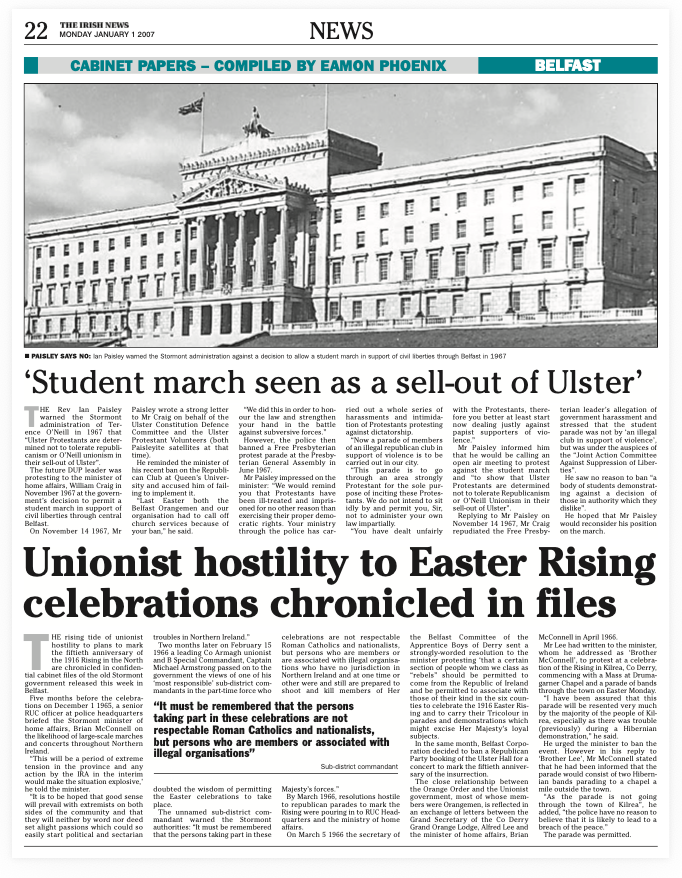
‘Student march seen as a sell-out of Ulster’
THE Rev Ian Paisley warned the Stormont administration of Terence O’Neill in 1967 that “Ulster Protestants are determined not to tolerate republicanism or O’Neill unionism in their sell-out of Ulster”.
The future DUP leader was protesting to the minister of home affairs, William Craig in November 1967 at the government’s decision to permit a student march in support of civil liberties through central Belfast.
On November 14 1967, Mr Paisley wrote a strong letter to Mr Craig on behalf of the Ulster Constitution Defence Committee and the Ulster Protestant Volunteers (both Paisleyite satellites at that time).
He reminded the minister of his recent ban on the Republican Club at Queen’s University and accused him of failing to implement it.
“Last Easter both the Belfast Orangemen and our organisation had to call off church services because of your ban,” he said.
“We did this in order to honour the law and strengthen your hand in the battle against subversive forces.”
However, the police then banned a Free Presbyterian protest parade at the Presbyterian General Assembly in June 1967.
Mr Paisley impressed on the minister: “We would remind you that Protestants have been ill-treated and imprisoned for no other reason than exercising their proper democratic rights. Your ministry through the police has carried out a whole series of harassments and intimidation of Protestants protesting against dictatorship.
“Now a parade of members of an illegal republican club in support of violence is to be carried out in our city.
“This parade is to go through an area strongly Protestant for the sole purpose of inciting these Protestants. We do not intend to sit idly by and permit you, Sir, not to administer your own law impartially.
“You have dealt unfairly with the Protestants, therefore you better at least start now dealing justly against papist supporters of violence.”
Mr Paisley informed him that he would be calling an open air meeting to protest against the student march and “to show that Ulster Protestants are determined not to tolerate Republicanism or O’Neill Unionism in
their sell-out of Ulster”.
Replying to Mr Paisley on November 14 1967, Mr Craig repudiated the Free Presbyterian leader’s allegation of government harassment and stressed that the student parade was not by ‘an illegal club in support of violence’, but was under the auspices of the “Joint Action Committee Against Suppression of Liberties”.
He saw no reason to ban “a body of students demonstrating against a decision of those in authority which they dislike”.
He hoped that Mr Paisley would reconsider his position on the march.