

1975 State Papers (page 8)
December 30 2005
Publication Date
Year started on optimistic note but ended in violence
State Paper Snippet
Year started on optimistic note but ended in violence
Continuing his reports from hundreds of confidential government files released under the 30-year rule, historian Dr Eamon Phoenix focuses on the fate of the 1975 Constitutional Convention
The year 1975 opened on a note of optimism as the IRA agreed to extend a ceasefire it had declared following secret talks with Protestant clergy at Feakle, Co Clare. However, the UDA warned that any concessions by the British government would result in an unprecedented escalation of violence.
On January 6, during a UDA feud, Charles Harding Smith, the organisation’s commander in west Belfast, was wounded by a gunman.
The IRA ceasefire broke down in January with bomb attacks in London and Manchester, prompting peace marches in Ireland, north and south.
On January 30 the Gardiner Report recommended the phasing out of ‘special category status’ for paramilitary prisoners while, ominously, secretary of state Merlyn Rees announced the building of H blocks at the Maze Prison.
In February, following a promise by Rees to reduce troop levels and phase out internment if the IRA ended all offensive operations, the Provisional army council announced an indefinite ceasefire.
Eighty detainees were released at once and ‘incident centres’, manned by Sinn Fein, were set up in nationalist areas to monitor the ceasefire and liaise with British officials.
However, the IRA’s demand for a British declaration to withdraw from Ireland was not forthcoming.
The year saw internal feuding within the UDA and UVF and between the Official IRA and the Provisionals.
In April five Protestants were murdered by an explosion at the Mountainview Tavern on the Shankill Road and two Catholics were shot dead in retaliation.
On April 28 a leading Official IRA member, Billy McMillen, was shot dead in Belfast in a feud between the Officials and the breakaway INLA.
In March the Price sisters, sentenced for their part in the London bombings of 1973, were transferred to Armagh Prison from England following a prolonged hunger strike.
In May elections were held for the promised Constitutional Convention, set up by the Labour government to consider the possibility of a political agreement in the wake of the collapse of the power-sharing executive the previous year.
The result was a sweeping victory for the anti-Sunningdale unionists in the United Ulster Unionist Coalition (UUUC).
They won 47 of the 78 seats, with the SDLP taking 17. With the loyalists standing on an inflexible platform of majority rule, the prospect of an accommodation seemed slim.
In the wake of the elections one of the Feakle clergymen, The Rev William Arlow, claimed that the British government had given a firm commitment to the IRA that Britain would withdraw from the north if the convention broke down.
The government denied this but both the unionists and the SDLP were uneasy.
In June, Northern Ireland voted by a slight majority (52 per cent) in favour of the UK remaining in the EEC.
The summer saw the gradual breakdown of the IRA ceasefire with the killing of four soldiers by a Provisional bomb in south Armagh.
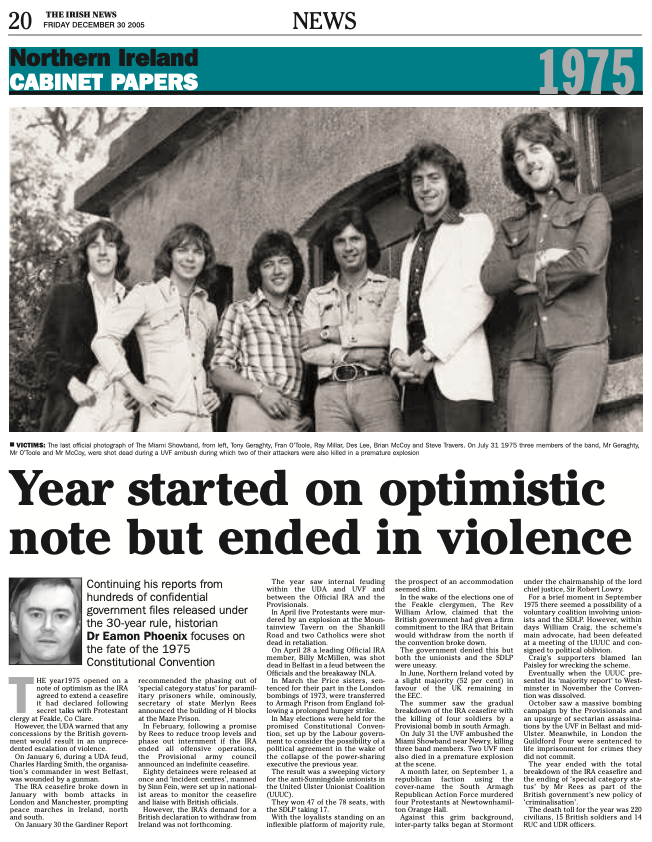
On July 31 the UVF ambushed the Miami Showband near Newry, killing three band members. Two UVF men also died in a premature explosion at the scene.
A month later, on September 1, a republican faction using the cover-name the South Armagh Republican Action Force murdered four Protestants at Newtownhamilton Orange Hall.
Against this grim background, inter-party talks began at Stormont under the chairmanship of the lord chief justice, Sir Robert Lowry.
For a brief moment in September 1975 there seemed a possibility of a voluntary coalition involving unionists and the SDLP. However, within days William Craig, the scheme’s main advocate, had been defeated at a meeting of the UUUC and consigned to political oblivion.
Craig’s supporters blamed Ian Paisley for wrecking the scheme.
Eventually when the UUUC presented its ‘majority report’ to Westminster in November the Convention was dissolved.
October saw a massive bombing campaign by the Provisionals and an upsurge of sectarian assassinations by the UVF in Belfast and mid-Ulster. Meanwhile, in London the Guildford Four were sentenced to life imprisonment for crimes they did not commit.
The year ended with the total breakdown of the IRA ceasefire and the ending of ‘special category status’ by Mr Rees as part of the British government’s new policy of ‘criminalisation’.
The death toll for the year was 220 civilians, 15 British soldiers and 14 RUC and UDR officers.