

1975 State Papers (page 3)
December 29 2005
Publication Date
Faulkner tells ministers time is running out for executive, Pressure to talk to the UWC, Plan to introduce integrated education in north proposed, Academic selection discussed by cabinet
State Paper Snippet
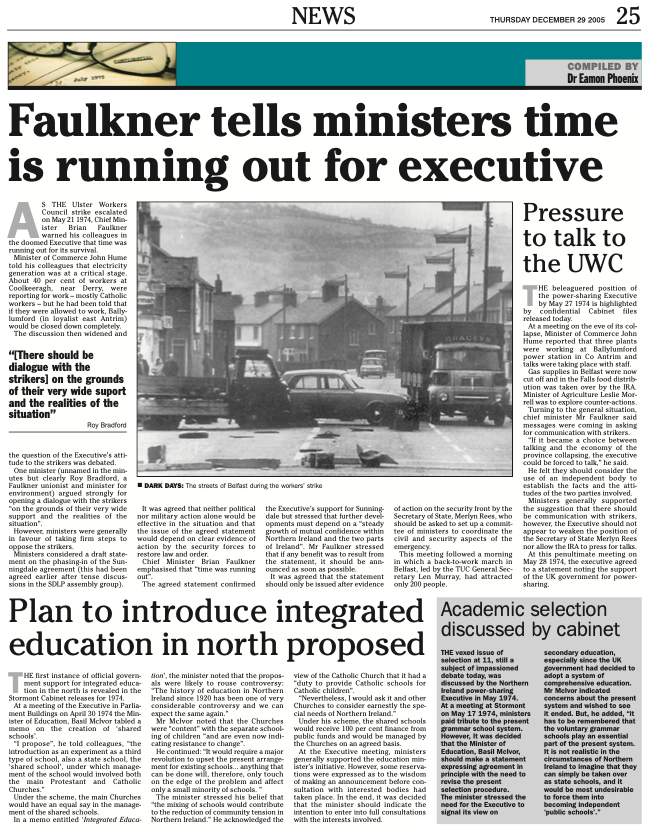
Faulkner tells ministers time is running out for executive
As the Ulster Workers Council strike escalated on May 21 1974, Chief Minister Brian Faulkner warned his colleagues in the doomed Executive that time was running out for its survival.
Minister of Commerce John Hume told his colleagues that electricity generation was at a critical stage. About 40 per cent of workers at Coolkeeragh, near Derry, were reporting for work – mostly Catholic workers – but he had been told that if they were allowed to work, Ballylumford (in loyalist east Antrim) would be closed down completely.
The discussion then widened and the question of the Executive’s attitude to the strikers was debated.
One minister (unnamed in the minutes but clearly Roy Bradford, a Faulkner unionist and minister for environment) argued strongly for opening a dialogue with the strikers “on the grounds of their very wide support and the realities of the situation”. However, ministers were generally in favour of taking firm steps to oppose the strikers.
Ministers considered a draft statement on the phasing-in of the Sunningdale agreement (this had been agreed earlier after tense discussions in the SDLP assembly group). It was agreed that neither political nor military action alone would be effective in the situation and that the issue of the agreed statement would depend on clear evidence of action by the security forces to restore law and order.
Chief Minister Brian Faulkner emphasised that “time was running out”.
The agreed statement confirmed the Executive’s support for Sunningdale but stressed that further developments must depend on a “steady growth of mutual confidence within Northern Ireland and the two parts of Ireland”. Mr Faulkner stressed that if any benefit was to result from the statement, it should be announced as soon as possible.
It was agreed that the statement should only be issued after evidence of action on the security front by the Secretary of State, Merlyn Rees, who should be asked to set up a committee of ministers to coordinate the civil and security aspects of the emergency.
This meeting followed a morning in which a back-to-work march in Belfast, led by the TUC General Secretary Len Murray, had attracted only 200 people.
Pressure to talk to the UWC
The beleaguered position of the power-sharing Executive by May 27 1974 is highlighted by confidential Cabinet files released today.
At a meeting on the eve of its collapse, Minister of Commerce John Hume reported that three plants were working at Ballylumford power station in Co Antrim and talks were taking place with staff.
Gas supplies in Belfast were now cut off and in the Falls food distribution was taken over by the IRA. Minister of Agriculture Leslie Morrell was to explore counter-actions.
Turning to the general situation, chief minister Mr Faulkner said messages were coming in asking for communication with strikers. “If it became a choice between talking and the economy of the province collapsing, the executive could be forced to talk,” he said.
He felt they should consider the use of an independent body to establish the facts and the attitudes of the two parties involved.
Ministers generally supported the suggestion that there should be communication with strikers, however, the Executive should not appear to weaken the position of the Secretary of State Merlyn Rees nor allow the IRA to press for talks.
At this penultimate meeting on May 28 1974, the executive agreed to a statement noting the support of the UK government for power-sharing.
Plan to introduce integrated education in north proposed
The first instance of official government support for integrated education in the north is revealed in the Stormont Cabinet releases for 1974.
At a meeting of the Executive in Parliament Buildings on April 30 1974 the Minister of Education, Basil McIvor, tabled a memo on the creation of ‘shared schools’.
“I propose”, he told colleagues, “the introduction as an experiment as a third type of school, also a state school, the ‘shared school’, under which management of the school would involve both the main Protestant and Catholic Churches.”
Under the scheme, the main Churches would have an equal say in the management of the shared schools.
In a memo entitled ‘Integrated Education’, the minister noted that the proposals were likely to rouse controversy: “The history of education in Northern Ireland since 1920 has been one of very considerable controversy and we can expect the same again.”
Mr McIvor noted that the Churches were “content” with the separate schooling of children “and are even now indicating resistance to change”.
He continued: “It would require a major revolution to upset the present arrangement for existing schools… anything that can be done will, therefore, only touch on the edge of the problem and affect only a small minority of schools.”
The minister stressed his belief that “the mixing of schools would contribute to the reduction of community tension in Northern Ireland.” He acknowledged the view of the Catholic Church that it had a “duty to provide Catholic schools for Catholic children”.
“Nevertheless, I would ask it and other Churches to consider earnestly the special needs of Northern Ireland.”
Under his scheme, the shared schools would receive 100 per cent finance from public funds and would be managed by the Churches on an agreed basis.
At the Executive meeting, ministers generally supported the education minister’s initiative. However, some reservations were expressed as to the wisdom of making an announcement before consultation with interested bodies had taken place. In the end, it was decided that the minister should indicate the intention to enter into full consultations with the interests involved.
Academic selection discussed by cabinet
The vexed issue of selection at 11, still a subject of impassioned debate today, was discussed by the Northern Ireland power-sharing Executive in May 1974.
At a meeting at Stormont on May 17 1974, ministers paid tribute to the present grammar school system. However, it was decided that the Minister of Education, Basil McIvor, should make a statement expressing agreement in principle with the need to revise the present selection procedure.
The minister stressed the need for the Executive to signal its view on secondary education, especially since the UK government had decided to adopt a system of comprehensive education.
Mr McIvor indicated concerns about the present system and wished to see it ended.
But, he added, “it has to be remembered that the voluntary grammar schools play an essential part of the present system. It is not realistic in the circumstances of Northern Ireland to imagine that they can simply be taken over as state schools, and it would be most undesirable to force them into becoming independent ‘public schools’.”