

1975 State Papers (page 11)
December 30 2005
Publication Date
Unionist divisions scuppered proposals for power sharing
State Paper Snippet
Unionist divisions scuppered proposals for power sharing
The dramatic emergence of the ‘voluntary coalition’ idea in talks between the Loyalist Coalition parties and the SDLP can be traced in the files of the abortive 1975 Constitutional Convention.
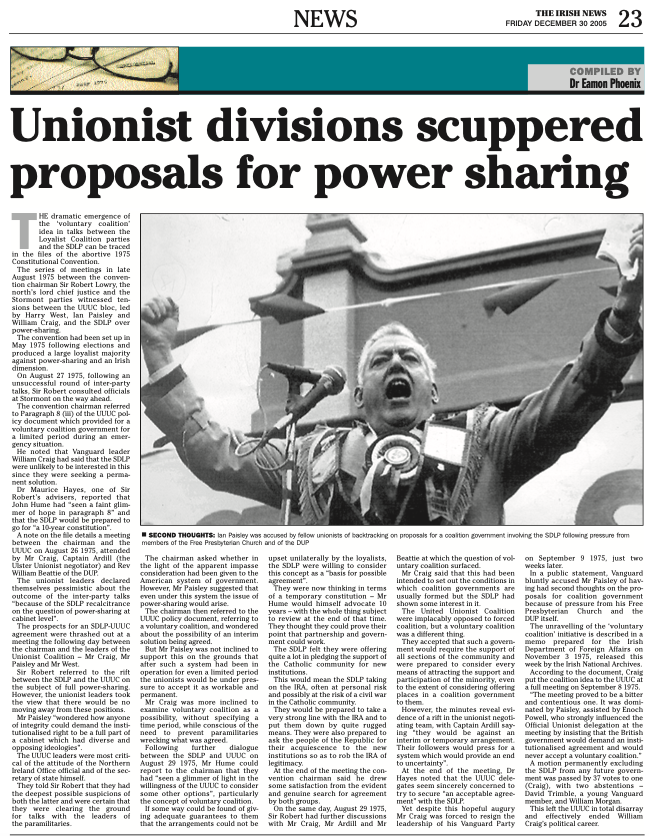
The series of meetings in late August 1975 between the convention chairman Sir Robert Lowry, the north’s lord chief justice and the Stormont parties witnessed tensions between the UUUC bloc, led by Harry West, Ian Paisley and William Craig, and the SDLP over power-sharing.
The convention had been set up in May 1975 following elections and produced a large loyalist majority against power-sharing and an Irish dimension.
On August 27 1975, following an unsuccessful round of inter-party talks, Sir Robert consulted officials at Stormont on the way ahead.
The convention chairman referred to Paragraph 8 (iii) of the UUUC policy document which provided for a voluntary coalition government for a limited period during an emergency situation.
He noted that Vanguard leader William Craig had said that the SDLP were unlikely to be interested in this since they were seeking a permanent solution.
Dr Maurice Hayes, one of Sir Robert’s advisers, reported that John Hume had “seen a faint glimmer of hope in paragraph 8” and that the SDLP would be prepared to go for “a 10-year constitution”.
A note on the file details a meeting between the chairman and the UUUC on August 26 1975, attended by Mr Craig, Captain Ardill (the Ulster Unionist negotiator) and Rev William Beattie of the DUP.
The unionist leaders declared themselves pessimistic about the outcome of the inter-party talks “because of the SDLP recalcitrance on the question of power-sharing at cabinet level”.
The prospects for an SDLP-UUUC agreement were thrashed out at a meeting the following day between the chairman and the leaders of the Unionist Coalition – Mr Craig, Mr Paisley and Mr West.
Sir Robert referred to the rift between the SDLP and the UUUC on the subject of full power-sharing. However, the unionist leaders took the view that there would be no moving away from these positions.
Mr Paisley “wondered how anyone of integrity could demand the institutionalised right to be a full part of a cabinet which had diverse and opposing ideologies”.
The UUUC leaders were most critical of the attitude of the Northern Ireland Office official and of the secretary of state himself.
They told Sir Robert that they had the deepest possible suspicions of both the latter and were certain that they were clearing the ground for talks with the leaders of the paramilitaries.
The chairman asked whether in the light of the apparent impasse consideration had been given to the American system of government. However, Mr Paisley suggested that even under this system the issue of power-sharing would arise.
The chairman then referred to the UUUC policy document, referring to a voluntary coalition, and wondered about the possibility of an interim solution being agreed.
But Mr Paisley was not inclined to support this on the grounds that after such a system had been in operation for even a limited period the unionists would be under pressure to accept it as workable and permanent.
Mr Craig was more inclined to examine voluntary coalition as a possibility, without specifying a time period, while conscious of the need to prevent paramilitaries wrecking what was agreed.
Following further dialogue between the SDLP and UUUC on August 29 1975, Mr Hume could report to the chairman that they had “seen a glimmer of light in the willingness of the UUUC to consider some other options”, particularly the concept of voluntary coalition.
If some way could be found of giving adequate guarantees to them that the arrangements could not be upset unilaterally by the loyalists, the SDLP were willing to consider this concept as a “basis for possible agreement”.
They were now thinking in terms of a temporary constitution – Mr Hume would himself advocate 10 years – with the whole thing subject to review at the end of that time. They thought they could prove their point that partnership and government could work.
The SDLP felt they were offering quite a lot in pledging the support of the Catholic community for new institutions.
This would mean the SDLP taking on the IRA, often at personal risk and possibly at the risk of a civil war in the Catholic community.
They would be prepared to take a very strong line with the IRA and to put them down by quite rugged means. They were also prepared to ask the people of the Republic for their acquiescence to the new institutions so as to rob the IRA of legitimacy.
At the end of the meeting the convention chairman said he drew some satisfaction from the evident and genuine search for agreement by both groups.
On the same day, August 29 1975, Sir Robert had further discussions with Mr Craig, Mr Ardill and Mr Beattie at which the question of voluntary coalition surfaced.
Mr Craig said that this had been intended to set out the conditions in which coalition governments are usually formed but the SDLP had shown some interest in it.
The United Unionist Coalition were implacably opposed to forced coalition, but a voluntary coalition was a different thing.
They accepted that such a government would require the support of all sections of the community and were prepared to consider every means of attracting the support and participation of the minority, even to the extent of considering offering places in a coalition government to them.
However, the minutes reveal evidence of a rift in the unionist negotiating team, with Captain Ardill saying “they would be against an interim or temporary arrangement. Their followers would press for a system which would provide an end to uncertainty”.
At the end of the meeting, Dr Hayes noted that the UUUC delegates seem sincerely concerned to try to secure “an acceptable agreement” with the SDLP.
Yet despite this hopeful augury Mr Craig was forced to resign the leadership of his Vanguard Party on September 9 1975, just two weeks later.
In a public statement, Vanguard bluntly accused Mr Paisley of having had second thoughts on the proposals for coalition government because of pressure from his Free Presbyterian Church and the DUP itself.
The unravelling of the ‘voluntary coalition’ initiative is described in a memo prepared for the Irish Department of Foreign Affairs on November 3 1975, released this week by the Irish National Archives.
According to the document, Craig put the coalition idea to the UUUC at a full meeting on September 8 1975.
“The meeting proved to be a bitter and contentious one. It was dominated by Paisley, assisted by Enoch Powell, who strongly influenced the Official Unionist delegation at the meeting by insisting that the British government would demand an institutionalised agreement and would never accept a voluntary coalition.”
A motion permanently excluding the SDLP from any future government was passed by 37 votes to one (Craig), with two abstentions – David Trimble, a young Vanguard member, and William Morgan.
This left the UUUC in total disarray and effectively ended William Craig’s political career.