

1975 State Papers (page 1)
December 29 2005
Publication Date
Executive saw 1974 as ‘year of reconciliation’, Files released from 1975 and 1974, The 1974 Power Sharing Executive, Security dominated January meeting at Stormont
State Paper Snippet
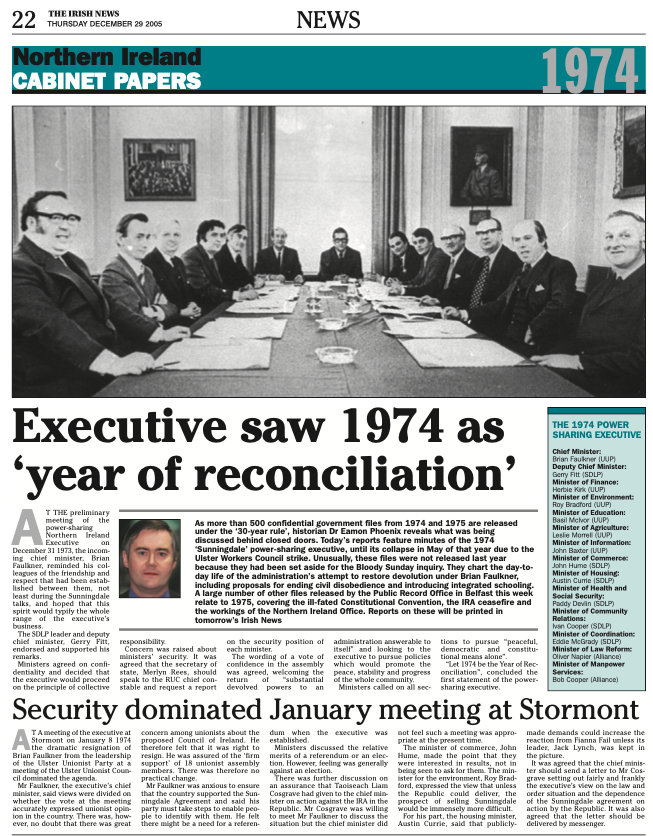
Files released from 1975 and 1974
As more than 500 confidential government files from 1974 and 1975 are released under the ‘30-year rule’, historian Dr Eamon Phoenix reveals what was being discussed behind closed doors.
Today’s reports feature minutes of the 1974 ‘Sunningdale’ power-sharing executive, until its collapse in May of that year due to the Ulster Workers Council strike.
Unusually, these files were not released last year because they had been set aside for the Bloody Sunday inquiry.
They chart the day-to-day life of the administration’s attempt to restore devolution under Brian Faulkner, including proposals for ending civil disobedience and introducing integrated schooling.
A large number of other files released by the Public Record Office in Belfast this week relate to 1975, covering the ill-fated Constitutional Convention, the IRA ceasefire and the workings of the Northern Ireland Office. Reports on these will be printed in tomorrow’s Irish News
Executive saw 1974 as ‘year of reconciliation’
At the preliminary meeting of the power-sharing Northern Ireland Executive on December 31 1973, the incoming chief minister, Brian Faulkner, reminded his colleagues of the friendship and respect that had been established between them, not least during the Sunningdale talks, and hoped that this spirit would typify the whole range of the executive’s business.
The SDLP leader and deputy chief minister, Gerry Fitt, endorsed and supported his remarks.
Ministers agreed on confidentiality and decided that the executive would proceed on the principle of collective responsibility.
Concern was raised about ministers’ security. It was agreed that the secretary of state, Merlyn Rees, should speak to the RUC chief constable and request a report on the security position of each minister.
The wording of a vote of confidence in the assembly was agreed, welcoming the return of “substantial devolved powers to an administration answerable to itself” and looking to the executive to pursue policies which would promote the peace, stability and progress of the whole community.
Ministers called on all sections to pursue “peaceful, democratic and constitutional means alone”.
“Let 1974 be the Year of Reconciliation”, concluded the first statement of the power-sharing executive.
The 1974 power sharing executive
Chief Minister:
Brian Faulkner (UUP)
Deputy Chief Minister:
Gerry Fitt (SDLP)
Minister of Finance:
Herbie Kirk (UUP)
Minister of Environment:
Roy Bradford (UUP)
Minister of Education:
Basil McIvor (UUP)
Minister of Agriculture:
Leslie Morrell (UUP)
Minister of Information:
John Baxter (UUP)
Minister of Commerce:
John Hume (SDLP)
Minister of Housing:
Austin Currie (SDLP)
Minister of Health and
Social Security:
Paddy Devlin (SDLP)
Minister of Community
Relations:
Ivan Cooper (SDLP)
Minister of Coordination:
Eddie McGrady (SDLP)
Minister of Law Reform:
Oliver Napier (Alliance)
Minister of Manpower
Services:
Bob Cooper (Alliance)
Security dominated January meeting at Stormont
At a meeting of the executive at Stormont on January 8 1974 the dramatic resignation of Brian Faulkner from the leadership of the Ulster Unionist Party at a meeting of the Ulster Unionist Council dominated the agenda.
Mr Faulkner, the executive’s chief minister, said views were divided on whether the vote at the meeting accurately expressed unionist opinion in the country. There was, however, no doubt that there was great concern among unionists about the proposed Council of Ireland. He therefore felt that it was right to resign. He was assured of the ‘firm support’ of 18 unionist assembly members. There was therefore no practical change.
Mr Faulkner was anxious to ensure that the country supported the Sunningdale Agreement and said his party must take steps to enable people to identify with them. He felt there might be a need for a referendum when the executive was established.
Ministers discussed the relative merits of a referendum or an election. However, feeling was generally against an election.
There was further discussion on an assurance that Taoiseach Liam Cosgrave had given to the chief minister on action against the IRA in the Republic. Mr Cosgrave was willing to meet Mr Faulkner to discuss the situation but the chief minister did not feel such a meeting was appropriate at the present time.
The minister of commerce, John Hume, made the point that they were interested in results, not in being seen to ask for them. The minister for the environment, Roy Bradford, expressed the view that unless the Republic could deliver, the prospect of selling Sunningdale would be immensely more difficult.
For his part, the housing minister, Austin Currie, said that publicly-made demands could increase the reaction from Fianna Fail unless its leader, Jack Lynch, was kept in the picture.
It was agreed that the chief minister should send a letter to Mr Cosgrave setting out fairly and frankly the executive’s view on the law and order situation and the dependence of the Sunningdale agreement on action by the Republic. It was also agreed that the letter should be delivered by messenger.