

1974 State Papers (page 5)
January 03 2005
Publication Date
Mutual sorrow as executive collapses, Paramilitaries joined UWC strike meeting, Fear for potential IRA takeover in the event of a ‘Doomsday’ situation in Northern Ireland, Protestant clergy negotiated ceasefire with PIRA,
State Paper Snippet
Mutual sorrow as executive collapses
THE minutes of the final meeting of the power sharing Executive on May 28 1974 reveal that ministers expressed their “mutual sorrow” at the collapse of a great experiment as they failed to agree on the issue of opening talks with the UWC strikers.
At the final, emotion-charged meeting at Stormont Castle, the Chief Minister Brian Faulkner summed up the position as seen by him and his Unionist colleagues: “The army operating a minimal petrol and oil supply system, the Belfast gas plant no longer supplying gas, the power stations in process of shutting down with the prospect of a total black-out, water supply and sewerage services at grave risk, food distribution in jeopardy and feed distribution to farms stopped.”
Against this background he saw only two options. First, to attempt to break the strike, either by sitting it out and involving the community in severe hardship – including loss of life and intolerable damage to industry and commerce – or by intervention in which the British army would run the essential services. This could result, at best, in prolonged stalemate with unacceptable hardship to the population and severe damage to the economy. Mr Faulkner could not accept this option.
The second option was the possibility of negotiating either directly with the UWC or through intermediaries.
Secretary of state Merlyn Rees and the Minister of State Stan Orme were strongly opposed to any form of negotiation.
Mr Faulkner and his Unionist colleagues were opposed to the sacrifice of the economy and life of Northern Ireland for the maintenance of a position which was increasingly unrealistic.
He had given long and earnest thought to the possible options, taking account of the factual appraisal of the likely pattern of events outlined to him by the Permanent Secretaries.
As a result, he and his party colleagues were convinced that the proper option was to seek agreement with Mr Rees to initiate discussions through intermediaries.
In a subsequent discussion, Minister of Commerce John Hume expressed total disagreement with this conclusion.
In his view, the Executive, having asked the secretary of state for certain action and been assured of the army’s capacity to follow through, should stand firm.
There were fundamental political principles not only for the authority of the Executive, but for British authority in the north. He was convinced that if power could be restored the public would get back to work. He would not resign.
The Deputy Chief Minister, Gerry Fitt [now Lord Fitt], recalled that the Executive had made a united request to the secretary of state to which he had responded.
Mr Rees was therefore entitled to their loyalty. If not, the result would be a very hostile United Kingdom – no Harland and Wolff, no Short Brothers.
He saw no possibility of a change of heart by the strikers who wanted to bring down the Constitution.
For his part, the Minister of Housing Austin Currie emphasised he was not speaking from a party political standpoint.
He feared the present movement was towards a Fascist takeover and reassertion of Protestant ascendancy which would never be accepted by the Catholic population who would be driven into the arms of the IRA. Civil war would be inevitable. He advocated progress towards ‘Sunningdale Two’ (ie ratification of the Sunningdale Agreement).
The Chief Minister Mr Faulkner summed up by saying there was not a consensus view, but a majority view that the Executive should open communication with the strikers, preferably by way of mediation.
He would report that view to the secretary of state. Mr Hume stated that he did not favour that course of action.
The Chief Minister reported he had spoken to the secretary of state who had said he was not prepared to agree to mediation. Mr Faulkner offered his resignation and those of his Unionist colleagues and Mr Rees accepted them.
The minutes of this final meeting make sad reading: “Ministers exchanged good wishes and expressed mutual sorrow that the great cooperative and, to that point, the very successful effort which had been made by all of them should have ended.”
Paramilitaries joined UWC strike meeting
CONFIDENTIAL Cabinet files released in London reveal that DUP leader Ian Paisley and his UUUC colleagues were joined by loyalist paramilitaries at a meeting with then Minister of State Stan Orme at Stormont Castle during the 1974 Ulster Workers’ Council Strike.
The meeting took place on May 15 1974, the first day of the UWC stoppage.
According to the minutes, there followed a long and sometimes heated discussion about the reasons for the strike and who was leading it.
Messrs Paisley, Craig and Laird said that the strike was the direct result of the frustrations felt by the Protestant majority as a failure of the British government to respond to the vote in the February general election.
People did not want Sunningdale. It would be a failure and Mr Paisley personally regretted the secretary of state (Merlyn Rees) discussing his future with politicians of a foreign country.
Mr Orme replied that the government’s view was that the people of Northern Ireland had expressed their wishes in the Assembly elections (the previous year) and the government would not be deflected from its course by intimidation of the kind the workers were now trying to force.
For his part, Mr Craig threatened that worse was to come if the government did not listen to reason.
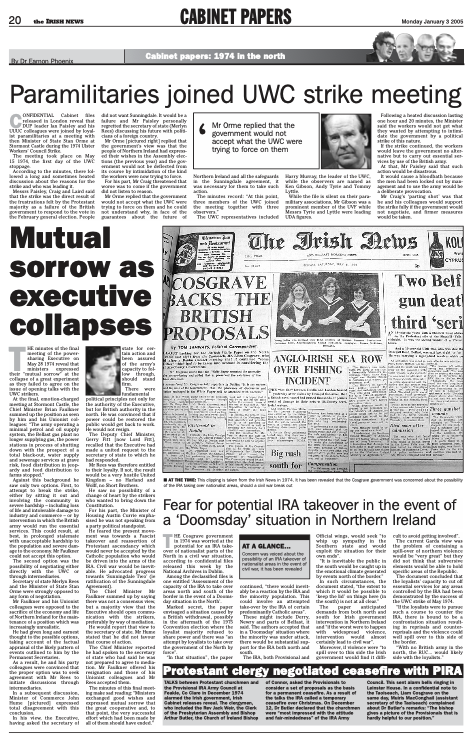
Mr Orme replied that the government would not accept what the UWC were trying to force on them and he could not understand why, in face of the guarantees about the future of Northern Ireland and all the safeguards in the Sunningdale agreement, it was necessary for them to take such action.
The minutes record: “At this point, three members of the UWC joined the meeting together with three observers.”
The UWC representatives included Harry Murray, the leader of the UWC, while the observers are named as Ken Gibson, Andy Tyrie and Tommy Lyttle.
While the file is silent on their paramilitary associations, Mr Gibson was a prominent member of the UVF while Messrs Tyrie and Lyttle were leading UDA figures.
Following a heated discussion lasting one hour and 20 minutes, the Minister said the workers would not get what they wanted by attempting to intimidate the government by a political strike of this nature.
If the strike continued, the workers would leave the government no alternative but to carry out essential services by use of the British army.
At that, Mr Paisley said that such action would be disastrous.
It would cause a bloodbath because the men had been locked out by management and to use the army would be a deliberate provocation.
Mr Craig’s ‘parting shot’ was that he and his colleagues would support the strike fully if the government would not negotiate, and firmer measures would be taken.
Fear for potential IRA takeover in the event of a ‘Doomsday’ situation in Northern Ireland
THE Cosgrave government in 1974 was worried at the potential for an IRA takeover of nationalist parts of the North in a civil war situation, according to confidential files released this week by the National Archives in Dublin.
Among the declassified files is one entitled ‘Assessment of the capacity of the IRA to take over areas north and south of the border in the event of a Doomsday situation in the North’.
Marked secret, the paper envisaged a situation caused by a British withdrawal, possibly in the aftermath of the 1975 Convention election where the loyalist majority refused to share power and there was “an attempt by loyalists to take over the government of the North by force”.
“In that situation”, the paper continued, “there would inevitably be a reaction by the IRA and the minority population. This could involve an attempted take-over by the IRA of certain predominantly Catholic areas”.
These might include Derry, Newry and parts of Belfast, it said. The authors accepted that in a ‘Doomsday’ situation where the minority was under attack, there would be substantial support for the IRA both north and south.
The IRA, both Provisional and Official wings, would seek “to whip up sympathy in the Southern state and would exploit the situation for their own ends”.
“It is inevitable the public in the south would be caught up in the emotional climate generated by events north of the border.”
In such circumstances, the document stated, “the extent to which it would be possible to ‘keep the lid’ on things here (in the south) is not at all clear.”
The paper anticipated demands from both north and south for Irish government intervention in Northern Ireland and “if the worst were to happen with widespread violence, intervention would almost certainly lead to civil war”.
Moreover, if violence were “to spill over to this side the Irish government would find it difficult to avoid getting involved”.
The current Garda view was the problem of containing a spill-over of northern violence would be “very great” but they did not think that subversive elements would be able to hold specific areas of the Republic.
The document concluded that the loyalists’ capacity to cut off essential services for any areas controlled by the IRA had been demonstrated by the success of the UWC strike of May 1974.
“If the loyalists were to pursue such a course to counter the IRA, there is bound to be a confrontation situation resulting in reprisals and counter-reprisals and the violence could well spill over to this side of the border.
“With no British army in the north, the RUC… would likely side with the loyalists.”
Protestant clergy negotiated ceasefire with PIRA
TALKS between Protestant churchmen and the Provisional IRA Army Council at Feakle, Co Clare in December 1974 alarmed the Irish government, Irish Cabinet releases reveal.
The clergymen, who included the Rev Jack Weir, the Clerk of the Presbyterian Assembly and Bishop Arthur Butler, the Church of Ireland Bishop
of Connor, asked the Provisionals to consider a set of proposals as the basis for a permanent ceasefire.
As a result of the talks the IRA called a temporary ceasefire over Christmas. On December 12, Dr Butler declared that the churchmen were “most impressed with the attitude and fair-mindedness” of the IRA Army Council.
This sent alarm bells ringing in Leinster House. In a confidential note to the Taoiseach, Liam Cosgrave on the same day, Muiris MacConghail (assistant secretary of the Taoiseach) complained about Dr Butler’s remarks: “The bishop gives a picture of the Provisionals that is hardly helpful to our position.”