

1974 State Papers (page 3)
January 01 2005
Publication Date
Leaders’ private letters revealed, Chief minister pressed for McGuinness arrest, Cardinal’s fear of ‘Doomsday’, Nuclear sub to be sent to Belfast, Paisley: ‘A demagogue’ says Rees
State Paper Snippet
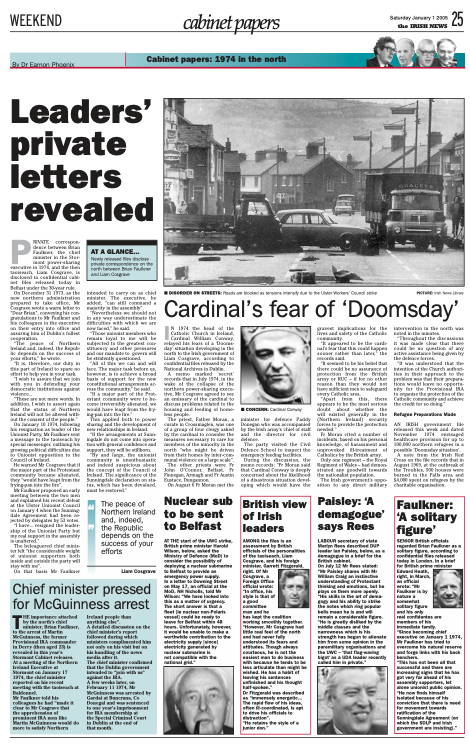
Leaders’ private letters revealed
PRIVATE correspondence between Brian Faulkner, the chief minister in the Stormont power-sharing executive in 1974, and the then taoiseach, Liam Cosgrave, is disclosed in confidential cabinet files released today in Belfast under the 30-year rule.
On December 31 1973, as the new northern administration prepared to take office, Mr Cosgrave wrote a warm letter to “Dear Brian”, conveying his congratulations to Mr Faulkner and his colleagues in the executive on their entry into office and assuring him of Dublin’s fullest cooperation.
“The peace of Northern Ireland and, indeed, the Republic depends on the success of your efforts,” he wrote.
“It is, therefore, our duty in this part of Ireland to spare no effort to help you in your task.
“I wish to assure that we join with you in defending your democratic institutions against violence…
“These are not mere words. In addition, I wish to assert again that the status of Northern Ireland will not be altered without the consent of the people.” On January 10 1974, following his resignation as leader of the Unionist Barty, Mr
Faulkner sent a message to the taoiseach by special messenger, outlining his growing political difficulties due to Unionist opposition to the Council of Ireland.
He warned Mr Cosgrave that if the major part of the Protestant community became alienated, they “would have leapt from the frying-pan into the fire”.
Mr Faulkner proposed an early meeting between the two men and explained his recent defeat at the Ulster Unionist Council on January 4 when the Sunning-dale Agreement had been rejected by delegates by 53 votes.
“I have… resigned the leadership of the Unionist Party but my real support in the assembly is unaltered.”
The beleaguered chief minister felt “the considerable weight of unionist supporters both inside and outside the party will stay with me”.
On that basis Mr Faulkner intended to carry on as chief minister. The executive, he added, “can still command a majority in the assembly”.
“Nevertheless we should not in any way underestimate the difficulties with which we are now faced,” he said.
“Those unionist members who remain loyal to me will be subjected to the greatest constituency and other pressures and our mandate to govern will be stridently questioned.
“All of this we can and will face. The major task before us, however, is to achieve a broad basis of support for the new constitutional arrangements across the community,” he said.
“If a major part of the Protestant community were to become irreversibly alienated, we would have leapt from the frying-pan into the fire.”
This applied both to power sharing and the development of new relationships in Ireland.
“If the arrangements at Sunningdale do not come into operation with general confidence and support, they will be stillborn.
“By and large, the unionist community is unenthusiastic and indeed suspicious about the concept of the Council of Ireland. The significance of the Sunningdale declaration on status, which has been devalued, must be restored.”
Chief minister pressed for McGuinness arrest
THE importance attached by the north’s chief minister, Brian Faulkner, to the arrest of Martin McGuinness, the former Provisional IRA commander in Derry (then aged 23) is revealed in this year’s Stormont Cabinet releases.
At a meeting of the Northern Ireland Executive at Stormont on January 17 1974, the chief minister reported on his recent meeting with the taoiseach at Baldonnel.
Mr Faulkner told his colleagues he had “made it clear to Mr Cosgrave that the apprehension of prominent IRA men like Martin McGuinness would do more to satisfy Northern Ireland people than anything else.
A detailed discussion on the chief minister’s report followed during which ministers complimented him not only on his visit but on his handling of the news media after it.
The chief minister confirmed that the Dublin government intended to “join with us” against the IRA.
A few weeks later, on February 11 1974, Mr McGuinness was arrested by Garda! at Buncrana, Co Donegal and was sentenced to one year’s imprisonment for IRA membership at the Special Criminal Court in Dublin at the end of that month.
Cardinal’s fear of ‘Doomsday’
IN 1974 the head of the Catholic Church in Ireland, Cardinal William Conway, relayed his fears of a ‘Doomsday’ situation developing in the north to the Irish government of Liam Cosgrave, according to confidential files released by the National Archives in Dublin.
A memo marked ‘secret’ records that in July 1974, in the wake of the collapse of the northern power-sharing executive, Mr Cosgrave agreed to see an emissary of the cardinal to discuss problems related to the housing and feeding of homeless people.
The priest, Father Moran, a curate in Crossmaglen, was one of a group of four clergy asked by the cardinal to consider the measures necessary to care for members of the minority in the north “who might be driven from their homes by inter-communal violence on a large scale”.
The other priests were Fr John O’Connor, Belfast, Fr Finnegan, Armagh and Fr Austin Eustace, Dungannon.
On August 6 Fr Moran met the minister for defence Paddy Donegan who was accompanied by the Irish army’s chief of staff and the director for civil defence.
The party visited the Civil Defence School to inspect the emergency feeding facilities.
During the discussion, the memo records: “Fr Moran said that Cardinal Conway is deeply concerned about the likelihood of a disastrous situation developing which would have the gravest implications for the lives and safety of the Catholic community.
“It appeared to be the cardinal’s fear that this could happen sooner rather than later,” the records said.
“It seemed to be his belief that there could be no assurance of protection from the British army or RUC – if for no other reason than they would not have sufficient men to safeguard every Catholic area.
“Apart from this, there appears to be the most serious doubt about whether the will existed generally in the (Northern Ireland) security forces to provide the protection needed.”
Fr Moran cited a number of incidents, based on his personal knowledge, of harassment and unprovoked ill-treatment of Catholics by the British army.
Only one regiment – the Royal Regiment of Wales – had demonstrated any goodwill towards the nationalist population.
The Irish government’s opposition to any direct military intervention in the north was noted in the minutes.
“Throughout the discussions it was made clear that there could be no question of any active assistance being given by the defence forces.
“It was understood that the intention of the Church authorities in their approach to the problem was that their preparations would leave no opportunity for the Provisional IRA to organise the protection of the Catholic community and achieve the credit for so doing.”
Nuclear sub to be sent to Belfast
AT THE start of the UWC strike, British prime minister Harold Wilson, below, asked the Ministry of Defence (MoD) to consider the possibility of deploying a nuclear submarine to Belfast to provide an emergency power supply.
In a letter to Downing Street on May 17, an official at the MoD, NH Nicholls, told Mr Wilson: “We have looked into this as a matter of urgency. The short answer is that a fleet [ie nuclear non-Polaris vessel] could be ready to leave for Belfast within 48 hours. Unfortunately, however, it would be unable to make a worthwhile contribution to the electricity supply [since] electricity generated by nuclear submarine is not compatible with the national grid.”
Paisley: ‘A demagogue’ says Rees
LABOUR secretary of state Merlyn Rees described DUP leader Ian Paisley, below, as a demagogue in a brief for the British cabinet.
On July 12 Mr Rees stated: “Mr Paisley shares with Mr William Craig an instinctive understanding of Protestant thinking and emotions, but he plays on them more openly.
“His skills in the art of demagogy and his ability to strike the notes which ring popular bells mean he is and will remain a considerable figure.
“He is greatly disliked by the middle classes and the narrowness which is his strength has begun to alienate him from some opinion in the paramilitary organisations and the UWC – ‘that flag-waving bigot’ as a UDA leader recently called him in private.”
Refugee Preparations Made
AN IRISH government file released this week and dated November 1974 envisaged healthcare provision for up to 100,000 northern refugees in a possible ‘Doomsday situation’.
A note from the Irish Red Cross on the file records that in August 1969, at the outbreak of the Troubles, 500 houses were burned in the Falls area and £4,000 spent on refugees by the charitable organisation.
Faulkner: ‘A solitary figure’
SENIOR British officials regarded Brian Faulkner as a solitary figure, according to confidential files released today in London. In a brief for British prime Edward Heath, right, in March, an official wrote: “Mr Faulkner is by nature a somewhat solitary figure and his only real confidantes are members of his immediate family.
“Since becoming chief executive on January 11974, Mr Faulkner has tried to overcome his natural reserve and forge links with his back benchers.
“This has not been all that successful and there are increasing signs that he has got very far ahead of his assembly supporters, let alone unionist public opinion. “He now finds himself isolated because of his conviction that there is need for movement towards ratification of the Sunningdale Agreement (on which the SDLP and Irish government are insisting).”
British view of Irish leaders
AMONG the files is an assessment by British officials of the personalities of the taoiseach, Liam Cosgrave, and his foreign minister, Garrett Fitzgerald, right. Of Mr Cosgrave, a Foreign Office official wrote: “In office, his style is that of a good committee man and he has kept the coalition working smoothly together.
“However, Mr Cosgrave had little real feel of the north and had never fully understood its fears and attitudes. Though always courteous, he is not the easiest man to do business with because he tends to be less articulate than might be wished. He has a habit of leaving his sentences unfinished and his thought half-spoken.”
Dr Fitzgerald was described as “immensely energetic… The rapid flow of his ideas, often ill-coordinated, is apt to drive his officials to distraction”.
“He retains the style of a junior don.”