

1973 State Papers (page 8)
January 02 2004
Publication Date
Whitelaw thought UDA ‘less vicious’ than the IRA, Priest and businessman in ceasefire bid, Secretary of state met top loyalists, Memo reveals scale of refugee problems
State Paper Snippet
Whitelaw thought UDA ‘less vicious’ than the IRA
IN DECEMBER 1972 the British secretary of state for the north, William Whitelaw, told Orangemen at Stormont that “he had never equated the UDA with the IRA in the viciousness of their activities”.
Security, power-sharing and the proposed Council of Ireland dominated the meeting between Mr Whitelaw and a Grand Orange Lodge delegation which included the Rev Martin Smyth, James Molyneux MP and Sir George Clark.
The delegation complained at the failure of the prime minister Edward Heath to meet them during his recent visit to Northern Ireland, saying that, “as organisers of the Covenant of the previous year”, they “represented the democratic interests of 350,000 people”.
Turning to security, the secretary of state said he was gravely disturbed by a recent development which could inhibit successes against the IRA.
The recent spate of sectarian murders meant that “support for the IRA would be encouraged in some areas and there would be renewed demands for more troops to be diverted from hard Roman Catholic areas to other areas, with the consequent risk of a resurgence of IRA activities”.
Mr Whitelaw said it was wrongly alleged that all these murders were the work of Protestant extremists but he believed that some of them were and that the attack on Catholic workers at the Rolls Royce factory in east Belfast the previous night had been the work of Protestants.
The security forces, he said, would do their best to track down the perpetrators but they frequently encountered “a wall of silence”.
The Orangemen said they accepted that a good deal of the recent murders were the work of Protestants. However, they warned that if the security situation were to drift, “murders on this scale would be a natural consequence”.
The secretary of state said “he had never equated the UDA with the IRA in the level of viciousness of their activities. He believed that many UDA members would shrink from the kind of murders which were now being committed”.
The Orange representatives accepted that there was a case for saying that Protestants should have been detained when internment was introduced but felt that the fear of the ordinary Protestant community was not understood at Westminster, which “tended to portray a situation of two warring tribes”.
They told Mr Whitelaw that it should be made clear that political terrorism would never produce concessions.
“The political vacuum should be removed. People would not come forward and join the security forces as long as they believed that there was a basic plan that Northern Ireland should gradually drift into a republic.
“The White Paper would indicate that the British government were neutral on the subject of the union. There were fears amongst the RUC that they would be devalued and demoralised in the way that the old RIC had been (in 1920).”
They lamented the “destruction of the B Specials and their replacement by the ineffective UDR”.
On the issue of policing, Mr Whitelaw stressed that “it had to be faced that there was a total refusal to accept the RUC in large areas”. However, the Orange delegation suggested that the Catholic population had “acquiesced in terrorism”.
“The Catholics hoped that a republic would be brought about, and the Roman Catholic leadership had therefore been ambiguous in its condemnation of violence. The cardinal, for example, was unrelenting about the integration of schools.”
They hoped that only accredited Catholics would be selected to take part in government. The line taken by John Hume and others was that “with the abolition of Stormont the Catholic population should work for their ultimate objective”.
The secretary of state replied that many members of the Catholic community wished to share responsibility and should be given a chance to do so.
Turning to the British government’s forthcoming constitutional proposals, the Orange delegation said that they generally supported the Unionist Party position but did not follow it in detail. They emphasised that the Orange Order was less likely than the Unionist Party to accept “a non-viable” Stormont. If no strong structure could be restored they would accept integration because of their British loyalties.
The major issues were the control of security and the structure of any executive in the north. A coalition, they said, would never work in Northern Ireland because one third of the people would always be trying to undermine and destroy.
The real danger was that if the proposals were unacceptable to the majority, the Orange Order would be unable to exercise any control over the situation. As far as the creation of an executive was concerned, it would be quite wrong if people such as Paddy Devlin, who was really a “lifelong republican”, were placed in power.
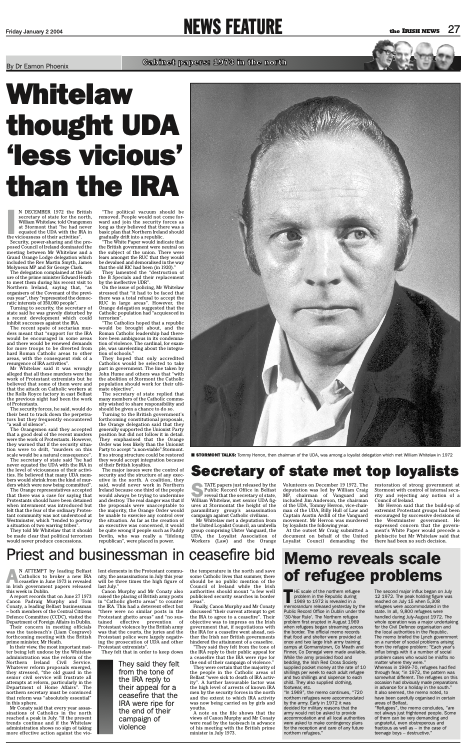
Secretary of state met top loyalists
STATE papers just released by the Public Record Office in Belfast reveal that the secretary of state, William Whitelaw, met senior UDA figures at Stormont at the height of the paramilitary group’s assassination campaign against Catholic civilians.
Mr Whitelaw met a deputation from the United Loyalist Council, an umbrella group comprising Ulster Vanguard, the UDA, the Loyalist Association of Workers (Law) and the Orange Volunteers on December 19 1972.
The deputation was led by William Craig MP, chairman of Vanguard and included Jim Anderson, the chairman of the UDA, Tommy Herron, vice-chairman of the UDA, Billy Hull of Law and Captain Austin Ardill of the Vanguard movement. Mr Herron was murdered by loyalists the following year.
At the outset Mr Craig submitted a document on behalf of the United Loyalist Council demanding the restoration of strong government at Stormont with control of internal security and rejecting any notion of a Council of Ireland.
Mr Herron said that the build-up of extremist Protestant groups had been encouraged by successive decisions of the Westminster government. He expressed concern that the government’s White Paper would precede a plebiscite but Mr Whitelaw said that there had been no such decision.
Priest and businessman in ceasefire bid
AN ATTEMPT by leading Belfast Catholics to broker a new IRA ceasefire in June 1973 is revealed in Irish government papers released this week in Dublin.
A report records that on June 27 1973 Canon Padraig Murphy and Tom Conaty, a leading Belfast businessman – both members of the Central Citizens Defence Committee (CCDC), visited the Department of Foreign Affairs in Dublin.
Their concern in meeting officials was the taoiseach’s (Liam Cosgrave) forthcoming meeting with the British prime minister, Mr Heath.
In their view, the most important matter being left undone by the Whitelaw administration was the reform of the Northern Ireland Civil Service. Whatever reform proposals emerged, they stressed, “the old guard in the senior civil service will frustrate all attempts at reform, particularly in the Department of Home Affairs”. The northern secretary must be convinced that reform was “absolutely essential” in this sphere.
Mr Conaty said that every year assassinations of Catholics in the north reached a peak in July. “If the present trends continue and if the Whitelaw administration shows no sign of taking more effective action against the violent elements in the Protestant community, the assassinations in July this year will be three times the high figure of last July.”
Canon Murphy and Mr Conaty also raised the placing of British army posts in “Catholic ghetto areas” to counter the IRA. This had a deterrent effect but “there were no similar posts in the Protestant ghetto areas” and “no sustained effective prevention of Protestant violence by the British army was that the courts, the juries and the Protestant police were largely negativing the prosecution of UDA and other Protestant extremists”.
They felt that in order to keep down the temperature in the north and save some Catholic lives that summer, there should be no public mention of the Council of Ireland while the Irish authorities should mount “a few well publicised security searches in border areas”.
Finally, Canon Murphy and Mr Conaty discussed “their current attempt to get the IRA to agree to a ceasefire”. Their objective was to impress on the Irish government that, if negotiations with the IRA for a ceasefire went ahead, neither the Irish nor British governments hindered the attainment of a ceasefire.
“They said they felt from the tone of the IRA reply to their public appeal for a ceasefire that the IRA were ripe for the end of their campaign of violence.”
They were certain that the majority of the people in the Catholic areas of Belfast “were sick to death of IRA activity”. A further favourable factor was the high level of arrests of known IRA men by the security forces in the north and the extent to which IRA activity was now being carried on by girls and youths.
A note on the file shows that the views of Canon Murphy and Mr Conaty were read by the taoiseach in advance of his meeting with the British prime minister in July 1973.
Memo reveals scale of refugee problems
THE scale of the northern refugee problem in the Republic during 1969 to 1972 is revealed in a memorandum released yesterday by the Public Record Office in Dublin under the ‘30-Year Rule’. The Northern refugee problem first erupted in August 1969 when refugees began streaming across the border.
The official memo records that food and shelter were provided at once and two large Irish army training camps at Gormanstown, Co Meath and Firmer, Co Donegal were made available. While the army provided food and bedding, the Irish Red Cross Society supplied pocket money at the rate of 10 shillings per week to each adult refugee and two shillings and sixpence to each child. They also supplied clothing, footwear, etc.
“In 1969 ”, the memo continues, “720 northern refugees were accommodated by the army. Early in 1972 it was decided for military reasons that the army would not be asked to provide accommodation and all local authorities were asked to make contingency plans for the reception and care of any future northern refugees.”
The second major influx began on July 12 1972. The peak holding figure was reached on July 15 when 5,308 refugees were accommodated in the state. In all, 9,800 refugees were handled during July-August 1972. The whole operation was a major undertaking for the Civil Defence organisation and the local authorities in the Republic.
The memo briefed the Lynch government on a number of social problems arising from the refugee problem: “Each year’s influx brings with it a number of social problem cases who would be misfits no matter where they were.”
Whereas in 1969-70, refugees had fled through fear, “in 1972, the pattern was somewhat different. The refugees on this occasion had obviously made preparations in advance for a holiday in the south.” It also seemed, the memo noted, to have been carefully organised in certain areas of Belfast.
“Refugees”, the memo concludes, “are not always just frightened people. Some of them can be very demanding and ungrateful, even obstreperous and fractious as well as – in the case of teenage boys – destructive.”