

1973 State Papers (page 6)
January 02 2004
Publication Date
LEGAL FLAG Minister took part in covert meetings, Irish consul and leading unionist in secret talks, Paramilitary activity, Paisley demands the ‘domination of Catholic ghetto areas by British army’, Hume reveals talks with unionists
State Paper Snippet
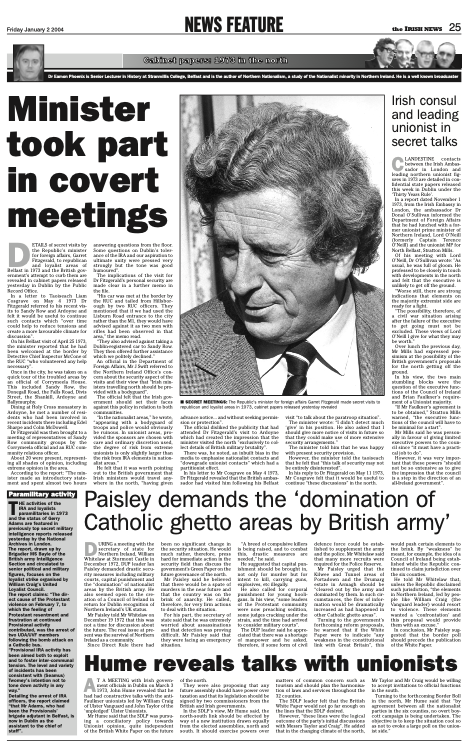
Minister took part in covert meetings
DETAILS of secret visits by the Republic’s minister for foreign affairs, Garret Fitzgerald, to republican and loyalist areas of Belfast in 1973 and the British government’s attempt to curb them are revealed in cabinet papers released yesterday in Dublin by the Public Record Office.
In a letter to Taoiseach Liam Cosgrave on May 4 1973 Dr Fitzgerald referred to his recent visits to Sandy Row and Ardoyne and felt it would be useful to continue such contacts which “over time could help to reduce tensions and create a more favourable climate for discussion”.
On his Belfast visit of April 25 1973, the minister reported that he had been welcomed at the border by Detective Chief Inspector McCone of the RUC “who volunteered any help necessary”.
Once in the city, he was taken on a quick tour of the troubled areas by an official of Corrymeela House. This included Sandy Row, the Donegal! Road, the Falls Road, Divis Street, the Shan kill, Ardoyne and Ballymurphy.
Dining at Holy Cross monastery in Ardoyne, he met a number of residents who had been involved in recent incidents there including Edel Sharpe and Colm McDowell.
Dr Fitzgerald was then brought to a meeting of representatives of Sandy Row community groups by the Corrymeela official and an RUC community relations officer.
About 20 were present, representing all shades of opinion, including extreme opinion in the area.
According to the report: “The minister made an introductory statement and spent almost two hours
answering questions from the floor. Some questions on Dublin’s tolerance of the IRA and our aspiration to ultimate unity were pressed very strongly but the tone was good humoured”.
The implications of the visit for Dr Fitzgerald’s personal security are made clear in a further memo in the file.
“His car was met at the border by the RUC and tailed from Hillsborough by two RUC officers. They mentioned that if we had used the Lisburn Road entrance to the city rather than the Ml, they would have advised against it as two men with rifles had been observed in that area,” the memo read.
“They also advised against taking a Dublin-registered car to Sandy Row. They then offered further assistance which we politely declined.”
An official in the Department of Foreign Affairs, Mr J Swift referred to the Northern Ireland Office’s concern about the security aspect of the visits and their view that “Irish ministers travelling north should be provided with a bodyguard”.
The official felt that the Irish government should set their faces against this policy in relation to both communities.
“In the nationalist areas,” he wrote, “appearing with a bodyguard of troops and police would obviously be ruinous. In unionist areas, provided the sponsors are chosen with care and ordinary discretion used, the degree of risk from extreme unionists is only slightly larger than the risk from IRA elements in nationalist areas.”
He felt that it was worth pointing out to the British government that Irish ministers would travel anywhere in the north, “having given advance notice… and without seeking permission or protection”.
The official disliked the publicity that had attended Dr Fitzgerald’s visit to Ardoyne which had created the impression that the minister visited the north “exclusively to collect details of British military brutality”.
There was, he noted, an inbuilt bias in the media to emphasise nationalist contacts and “downgrade unionist contacts” which had a partitionist effect.
In his letter to Mr Cosgrave on May 4 1973, Dr Fitzgerald revealed that the British ambassador had visited him following his Belfast visit “to talk about the paratroop situation”.
The minister wrote: “I didn’t detect much ‘give’ in his position. He also asked that I should give more notice of visits in future so that they could make use of more extensive security arrangements.”
The minister told him that he was happy with present security provision.
However, the minister told the taoiseach that he felt that “this talk of security may not be entirely disinterested”.
In his reply to Dr Fitzgerald on May 11 1973, Mr Cosgrave felt that it would be useful to continue “these discussions” in the north.
Paramilitary activity
THE activities of the IRA and loyalists paramilitaries in 1973 and the status of Gerry Adams are featured in previously top secret military intelligence reports released yesterday by the National Archives in London.
The report, drawn up by Brigadier MS Bayle of the British army Intelligence Section and circulated to senior political and military figures, focuses on the loyalist strike organised by William Craig’s United Loyalist Council.
The report claims: “The direct cause of the Protestant violence on February 7, to which the feeling of Protestant resentment and frustration at continued Provisional activity contributed, was the arrest of two UDA/UVF members following the bomb attack on a Catholic bus.
“Provisional IRA activity has been aimed both to exploit and to foster inter-communal tension. The level and variety of incidents has been consistent with (Seamus) Twomey’s intention not to tone down activity in any way.”
Detailing the arrest of IRA officers, the report claimed “that Mr Adams, who had been the Provisionals’ brigade adjutant in Belfast, is now in Dublin as the assistant to the chief of staff”.
Irish consul and leading unionist in secret talks
CLANDESTINE contacts between the Irish Ambassador in London and leading northern unionist figures in 1973 are detailed in confidential state papers released this week in Dublin under the ‘Thirty Years Rule’.
In a report dated November 1, 1973, from the Irish Embassy in London, the ambassador Dr Donal O’Sullivan informed the Department of Foreign Affairs that he had lunched with a former unionist prime minister of Northern Ireland, Lord O’Neill (formerly Captain Terence O’Neill) and the unionist MP for North Belfast, Stratton Mills.
Of his meeting with Lord O’Neill, Dr O’Sullivan wrote: “As usual, he was full of gloom. He professed to be closely in touch with developments in the north and felt that the executive is unlikely to get off the ground.
“Worse still, there are strong indications that elements on the majority extremist side are ready for a fight.
“The possibility, therefore, of a civil war situation arising after the failure of the executive to get going must not be excluded. These views of Lord O’Neill I give for what they may be worth.”
Over lunch the previous day, Mr Mills had expressed pessimism at the possibility of the British government’s proposals for the north getting off the ground.
In his view, the two main stumbling blocks were the question of the executive functions of the Council of Ireland and Brian Faulkner’s requirement of a Unionist majority.
“If Mr Faulkner’s agreement is to be obtained,” Stratton Mills warned, “the executive functions of the council will have to be minimal for a start”.
Mr Mills said he was personally in favour of giving limited executive powers to the council since “it must have a practical job to do”.
However, it was very important that these powers “should not be so extensive as to give the impression that the council is a step in the direction of an all-Ireland government”.
Paisley demands the ‘domination of Catholic ghetto areas by British army’
DURING a meeting with the secretary of state for Northern Ireland, William Whitelaw at Stormont Castle in December 1972, DUP leader Ian Paisley demanded drastic security measures including military courts, capital punishment and the “domination” of nationalist areas by the British army. He also seemed open to the creation of a Council of Ireland in return for Dublin recognition of Northern Ireland’s UK status.
Mr Paisley told Mr Whitelaw on December 19 1972 that this was not a time for discussion about the future. The real issue at present was the survival of Northern Ireland as a community.
Since Direct Rule there had been no significant change in the security situation. He would much rather, therefore, press hard for immediate action in the security field than discuss the government’s Green Paper on the future governance of the north.
Mr Paisley said he believed that there would be a spate of murders in the near future and that the country was on the brink of anarchy. He called, therefore, for very firm actions to deal with the situation.
For his part, the secretary of state said that he was extremely worried about assassinations and that detection was proving difficult. Mr Paisley said that they were facing an emergency situation.
“A breed of compulsive killers is being raised, and to combat this, drastic measures are needed,” he said.
He suggested that capital punishment should be brought in, not only for murder but for intent to kill, carrying guns, explosives, etc illegally.
He also called for corporal punishment for young hooligans. In his view, “some leaders of the Protestant community were now preaching sedition, some judges cracking under the strain, and the time had arrived to consider military courts”.
The DUP leader said he appreciated that there was a shortage of manpower and he asked, therefore, if some form of civil defence force could be established to supplement the army and the police. Mr Whitelaw said that many more recruits were required for the Police Reserve.
Mr Paisley urged that the Kilwee and Tunnel areas of Portadown and the Drumarg estate in Armagh should be “cleared out by the army and dominated by them. In such circumstances, the flow of information would be dramatically increased as had happened in other Catholic ghetto areas”.
Turning to the government’s forthcoming reform proposals, he warned that if the White Paper were to indicate “any weakness in the constitutional link with Great Britain”, this would push certain elements to the brink. By “weakness” he meant, for example, the idea of a Council of Ireland being established while the Republic continued to claim jurisdiction over the six counties.
He told Mr Whitelaw that, unless the Republic disclaimed such jurisdiction, “the elements in Northern Ireland, led by people like William Craig (the Vanguard leader) would resort to violence. These elements wanted a ‘confrontation’ and this proposal would provide them with an excuse.”
In conclusion, Mr Paisley suggested that the border poll should precede the publication of the White Paper.
Hume reveals talks with unionists
AT A MEETING with Irish government officials in Dublin on March 3 1973, John Hume revealed that he had had constructive talks with the anti-Faulkner unionists led by William Craig of Ulster Vanguard and John Taylor of the ‘unpledged’ Ulster Unionists.
Mr Hume said that the SDLP was pursuing a conciliatory policy towards Unionist opinion, quite independent of the British White Paper on the future
of the north.
They were also proposing that any future assembly should have power over taxation and that its legislation should be signed by two commissioners from the British and Irish governments.
In the SDLP’s view, Mr Hume said, the north-south link should be affected by way of a new institution drawn equally from the elected assemblies, north and south. It should exercise powers over matters of common concern such as tourism and should plan the harmonisation of laws and services throughout the 32 counties.
The SDLP leader felt that the British White Paper would not go far enough on the lines that the SDLP desired.
However, “these lines were the logical outcome of the party’s initial discussions with Messrs Taylor and Craig”. He added that in the changing climate of the north,
Mr Taylor and Mr Craig would be willing to accept invitations to official functions in the south.
Turning to the forthcoming Border Boll in the north, Mr Hume said that “by agreement between all the nationalist parties in the six counties, no overt boycott campaign is being undertaken. The objective is to keep the situation cool so as not to evoke a large poll on the unionist side.”