

1973 State Papers (page 4)
January 01 2004
Publication Date
Reconciliation is not a word to win over unionists - Faulkner, Faulkner against power sharing in 1973, British army in community relations report
State Paper Snippet
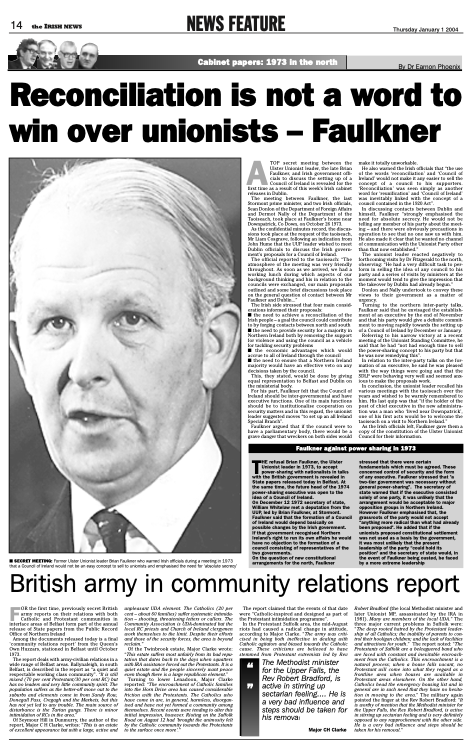
Reconciliation is not a word to win over unionists – Faulkner
AVERAGE(A TOP secret meeting between the Ulster Unionist leader, the late Brian Faulkner, and Irish government officials to discuss the setting up of a Council of Ireland is revealed for the first time as a result of this week’s Irish cabinet releases in Dublin.
The meeting between Faulkner, the last Stormont prime minister, and two Irish officials, Sean Donlon of the Department of Foreign Affairs and Dermot Nally of the Department of the Taoiseach, took place at Faulkner’s home near Downpatrick, Co Down, on October 26 1973.
As the confidential minutes record, the discussions took place at the request of the taoiseach, Mr hi am Cosgrave, following an indication from John Hume that the UUP leader wished to meet Dublin officials to discuss the Irish government’s proposals for a Council of Ireland.
The official reported to the taoiseach: “The atmosphere of the meeting was very friendly throughout. As soon as we arrived, we had a working lunch during which aspects of our background thinking and his in relation to the councils were exchanged, our main proposals outlined and some brief discussions took place on the general question of contact between Mr Faulkner and Dublin…”
The Irish side stressed that four main considerations informed their proposals:
■ the need to achieve a reconciliation of the Irish people – a goal the council could contribute to by forging contacts between north and south
■ the need to provide security for a majority in Northern Ireland both by removing the support for violence and using the council as a vehicle for tackling security problems
■ the economic advantages which would accrue to all of Ireland through the council
■ the need to ensure that a Northern Ireland majority would have an effective veto on any decisions taken by the council.
This, they stated, would be done by giving equal representation to Belfast and Dublin on the ministerial body.
For his part, Faulkner felt that the Council of Ireland should be inter-governmental and have executive functions. One of its main functions should be to institutionalise cooperation on security matters and in this regard, the unionist leader suggested moves “to set up an all Ireland Special Branch”.
Faulkner argued that if the council were to have a parliamentary body, there would be a grave danger that wreckers on both sides would make it totally unworkable.
He also warned the Irish officials that “the use of the words ‘reconciliation’ and ‘Council of Ireland’ would not make it any easier to sell the concept of a council to his supporters.
‘Reconciliation’ was seen simply as another word for ‘reunification’ and ‘Council of Ireland’ was inevitably linked with the concept of a council contained in the 1920 Act”.
In discussing contacts between Dublin and himself, Faulkner “strongly emphasised the need for absolute secrecy. He would not be telling any member of his party about the meeting – and there were obviously precautions in operation to see that no one saw us with him. He also made it clear that he wanted no channel of communication with the Unionist Party other than that now established.”
The unionist leader reacted negatively to forthcoming visits by Dr Fitzgerald to the north, observing: “He had a very difficult task to perform in selling the idea of any council to his party and a series of visits by ministers at the moment would tend to give the impression that the takeover by Dublin had already begun.”
Donlon and Nally undertook to convey these views to their government as a matter of urgency.
Turning to the northern inter-party talks, Faulkner said that he envisaged the establishment of an executive by the end of November and that his party would give a definite commitment to moving rapidly towards the setting up of a Council of Ireland by December or January.
Referring to his narrow victory at a recent meeting of the Unionist Standing Committee, he said that he had “not had enough time to sell the power-sharing concept to his party but that he was now remedying this”.
In relation to the inter-party talks on the formation of an executive, he said he was pleased with the way things were going and that the SDLP were behaving very well and seemed anxious to make the proposals work.
In conclusion, the unionist leader recalled his various meetings with the taoiseach over the years and wished to be warmly remembered to him. His last quip was that “if the holder of the post of chief executive in the new administration was a man who ‘lived near Downpatrick’, one of his first acts would be to welcome the taoiseach on a visit to Northern Ireland.”
As the Irish officials left, Faulkner gave them a copy of the constitution of the Ulster Unionist Council for their information.
Faulkner against power sharing in 1973
THE refusal Brian Faulkner, the Ulster Unionist leader in 1973, to accept power-sharing with nationalists in talks with the British government is revealed in State papers released today in Belfast. At the same time, the future head of the 1974 power-sharing executive was open to the idea of a Council of Ireland.
On December 12 1972 secretary of state, William Whitelaw met a deputation from the UUP, led by Brian Faulkner, at Stormont. Faulkner said that the formation of a Council of Ireland would depend basically on possible changes by the Irish government. If that government recognised Northern Ireland’s right to run its own affairs he would have no objection to the formation of a council consisting of representatives of the two governments.
On the question of new constitutional arrangements for the north, Faulkner stressed that there were certain fundamentals which must be agreed. These concerned control of security and the form of any executive.
Faulkner stressed that “a two-tier government was necessary without general power-sharing”. The secretary of state warned that if the executive consisted solely of one party, it was unlikely that the arrangement would be acceptable to major opposition groups in Northern Ireland.
However Faulkner emphasised that, the grassroots of the party would not accept “anything more radical than what had already been proposed”. He added that if the unionists proposed constitutional settlement was not used as a basis by the government, it was most unlikely that the present leadership of the party “could hold its position” and the secretary of state would, in the event of Faulkner being ousted, be faced by a more extreme leadership
British army in community relations report
FOR the first time, previously secret British army reports on their relations with both Catholic and Protestant communities in interface areas of Belfast form part of the annual release of State papers from the Public Record Office of Northern Ireland.
Among the documents released today is a final ‘community relations report’ from the Queen’s Own Huzzars, stationed in Belfast until October 1973.
The report deals with army-civilian relations in a wide range of Belfast areas. Ballynafeigh, in south Belfast, is described in the report as “a quiet and respectable working class community”.
“It is still mixed (70 per cent Protestant/30 per cent RC) but has no leaders and very little community spirit. The population suffers as the better-off move out to the suburbs and elements come in from Sandy Row, Donegall Pass, Cregagh and the Markets, but this has not yet led to any trouble. The main source of disturbance is the Tartan gangs. There is minor intimidation of RCs in the area.”
Of Seymour Hill in Dunmurry, the author of the report, Major C H Clarke, writes: “This is an estate of excellent appearance but with a large, active and unpleasant UDA element. The Catholics (20 per cent – about 60 families) suffer systematic intimidation – shooting, threatening letters or callers. The Community Association is UDA-dominated but the local RC priests and Church of Ireland clergymen work themselves to the limit. Despite their efforts and those of the security forces, the area is beyond reclaim.”
Of the Twinbrook estate, Major Clarke wrote: “This estate suffers most unfairly from its bad reputation that dates back to the days when squatters with IRA assistance forced out the Protestants. It is a quiet estate and the people sincerely want peace even though there is a large republican element.”
Turning to lower Lenadoon, Major Clarke reported: “The encroachment of Catholic families into the Horn Drive area has caused considerable friction with the Protestants. The Catholics who have come in are, in general, harmless, disorganised and have not yet formed a community among themselves. Recent events were tending to alter this initial impression, however. Rioting on the Suffolk Road on August 12 had ‘brought the animosity felt by the Catholic community towards the Protestants to the surface once more’.”
The report claimed that the events of that date were “Catholic-inspired and designed as part of the Protestant intimidation programme”.
In the Protestant Suffolk area, the mid-August riots had caused a radical change in attitude, according to Major Clarke. “The army was criticised in being both ineffective in dealing with Catholic agitators and biased towards the Catholic cause. These criticisms are believed to have stemmed from Protestant extremists led by Rev Robert Bradford (the local Methodist minister and later Unionist MP, assassinated by the IRA in 1981). Many are members of the local UDA.”
The three major current problems in Suffolk were: “The deep rooted hatred by the Protestant leadership of all Catholics; the inability of parents to control their hooligan children; and the lack of facilities and attractions for youth.”
The report noted: “The Protestants of Suffolk are a beleaguered band who are faced with constant and inevitable encroachment from the Catholics. This encroachment is a natural process; when a house falls vacant, no Protestant will come into what they regard as a frontline area when houses are available in Protestant areas elsewhere.
On the other hand, Catholics head the emergency housing list and in general are in such need that they have no hesitation in moving to the area.”
The military again pointed the finger at the Rev Robert Bradford: “It is worthy of mention that the Methodist minister for the Upper Falls, the Rev Robert Bradford, is active in stirring up sectarian feeling and is very definitely opposed to any rapprochement with the other side. He is a very bad influence and steps should be taken for his removal.”