

1973 State Papers (page 3)
January 01 2004
Publication Date
GOC ‘delight’ at Aghalane Bridge bomb, Council of Ireland discussed, Stormont Papers 1973, Think tank submits paper on ‘Irish dimension’, Sack of Catholic Church condemned
State Paper Snippet
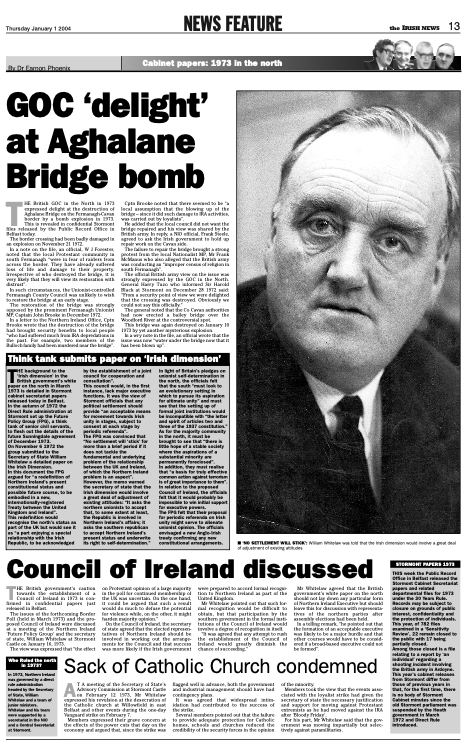
GOC ‘delight’ at Aghalane Bridge bomb
THE British GOC in the North in 1973 expressed delight at the destruction of Aghalane Bridge on the Fermanagh-Cavan border by a bomb explosion in 1973. This is revealed in confidential Stormont files released by the Public Record Office in Belfast today.
The border crossing had been badly damaged in an explosion on November 21 1972.
In a note on the file, an official, W J Forester, noted that the local Protestant community in south Fermanagh “were in fear of raiders from across the border. They have already suffered loss of life and damage to their property. Irrespective of who destroyed the bridge, it is very likely that they will view its restoration with distrust”.
In such circumstances, the Unionist-controlled Fermanagh County Council was unlikely to wish to restore the bridge at an early stage.
The restoration of the bridge was strongly opposed by the prominent Fermanagh Unionist MP, Captain John Brooke in December 1972.
In a letter to the Northern Ireland Office, Cptn Brooke wrote that the destruction of the bridge had brought security benefits to local people “who had suffered much from IRA depredations in the past. For example, two members of the Bulloch family had been murdered near the bridge”.
Cptn Brooke noted that there seemed to be “a local assumption that the blowing up of the bridge – since it did such damage to IRA activities, was carried out by loyalists”.
He added that the local council did not want the bridge repaired and his view was shared by the British army. In reply, a NIO official, Frank Steele, agreed to ask the Irish government to hold up repair work on the Cavan side.
The failure to repair the bridge brought a strong protest from the local Nationalist MP, Mr Frank McManus who also alleged that the British army was conducting an “improper census of religion in south Fermanagh”.
The official British army view on the issue was strongly expressed by the GOC in the North. General Harry Tuzo who informed Sir Harold Black at Stormont on December 28 1972 said: “From a security point of view we were delighted that the crossing was destroyed. Obviously we could not say this officially.”
The general noted that the Co Cavan authorities had now erected a bailey bridge over the Woodford River at the controversial spot.
This bridge was again destroyed on January 10 1973 by yet another mysterious explosion.
In a wry note in the file, an official wrote that the issue was now “water under the bridge now that it has been blown up”.
Stormont Papers 1973
THIS week the Public Record Office in Belfast released the Stormont Cabinet Secretariat papers and related departmental files for 1973 under the 30 Years Rule.
Records may be subject to closure on grounds of public interest, confidentiality and the protection of individuals. This year, of 782 files examined in a ‘Sensitivity Review’, 22 remain closed to the public with 17 being partially closed.
Among those closed is a file relating to a report by ‘an individual’ regarding a shooting incident involving the British army in Ardoyne.
This year’s cabinet releases from Stormont differ from those of previous years in that, for the first time, there is no body of Stormont Cabinet minutes since the old Stormont parliament was suspended by the Heath government in March 1972 and Direct Rule introduced.
Think tank submits paper on ‘Irish dimension’
THE background to the ‘Irish dimension’ in the British government’s white paper on the north in March 1973 is detailed in Stormont cabinet secretariat papers released today in Belfast.
In the autumn of 1972 the Direct Rule administration at Stormont set up the Future Policy Group (FPG), a think tank of senior civil servants, to flesh out the details of the future Sunningdale agreement of December 1973.
On November 6 1972 the group submitted to the Secretary of State William Whitelaw a detailed paper on the Irish Dimension.
In this document the FPG argued for “a redefinition of Northern Ireland’s present constitutional status and possible future course, to be embodied in a new, internationally-registered Treaty between the United Kingdom and Ireland”. This redefinition would recognise the north’s status as part of the UK but would see it as “a part enjoying a special relationship with the Irish Republic, to be acknowledged
by the establishment of a joint council for cooperation and consultation”.
This council would, in the first instance, lack major executive functions. It was the view of Stormont officials that any political settlement should provide “an acceptable means for movement towards Irish unity in stages, subject to consent at each stage by periodic referenda”.
The FPG was convinced that “No settlement will ‘stick’ for more than a brief period if it does not tackle the fundamental and underlying problem of the relationship between the UK and Ireland, of which the Northern Ireland problem is an aspect”.
However, the memo warned the secretary of state that the Irish dimension would involve a great deal of adjustment of existing attitudes: “It asks the northern unionists to accept that, to some extent at least, the Republic is involved in Northern Ireland’s affairs; it asks the southern republican to accept Northern Ireland’s present status and underwrite its right to self-determination.”
In light of Britain’s pledges on unionist self-determination in the north, the officials felt that the south “must look to an evolutionary setting in which to pursue its aspiration for ultimate unity” and must see that the setting up of formal joint institutions would be incompatible with “the letter and spirit of articles two and three of the 1937 constitution.”
As for the majority community in the north, it must be brought to see that “there is little hope of a stable society where the aspirations of a substantial minority are permanently foreclosed”. In addition, they must realise that “a basis for truly effective common action against terrorism is of great importance to them”. In relation to the proposed Council of Ireland, the officials felt that it would probably be impossible to win initial support for executive powers.
The FPG felt that their proposal for periodic referenda on Irish unity might serve to alienate unionist opinion. The officials envisaged a new Anglo-Irish treaty confirming any new constitutional arrangements.
Who Ruled the north In 1973?
In 1973, Northern Ireland was governed by a direct rule administration headed by the Secretary of State, William Whitelaw and a team of junior ministers. Whitelaw and his team were supported by a secretariat in the NIO and a Central Secretariat at Stormont.
Council of Ireland discussed
THE British government’s caution towards the establishment of a Council of Ireland in 1973 is confirmed in confidential papers just released in Belfast.
The issues of the forthcoming Border Poll (held in March 1973) and the proposed Council of Ireland were discussed at a meeting of the Northern Ireland ‘Future Policy Group’ and the secretary of state, William Whitelaw at Stormont Castle on January 16, 1973.
The view was expressed that “the effect on Protestant opinion of a large majority in the poll for continued membership of the UK was uncertain. On the one hand, it could be argued that such a result would do much to defuse the potential for violence while, on the other, it might harden majority opinion.”
On the Council of Ireland, the secretary of state agreed that the elected representatives of Northern Ireland should be involved in working out the arrangements for the Council and that success was more likely if the Irish government were prepared to accord formal recognition to Northern Ireland as part of the United Kingdom.
Mr Whitelaw pointed out that such formal recognition would be difficult to obtain, but that participation by the southern government in the formal institutions of the Council of Ireland would involve a degree of recognition in itself.
“It was agreed that any attempt to rush the establishment of the Council of Ireland would greatly diminish the chance of succeeding.”
Mr Whitelaw agreed that the British government’s white paper on the north should not lay down any particular form of Northern Ireland Executive but should leave this for discussion with representatives of the northern parties after assembly elections had been held.
In a telling remark, “he pointed out that the formation of an acceptable executive was likely to be a major hurdle and that other courses would have to be considered if a broad-based executive could not be formed”.
Sack of Catholic Church condemned
AT A meeting of the Secretary of State’s Advisory Commission at Stormont Castle on February 12 1973, Mr Whitelaw expressed his revulsion at the desecration of the Catholic church at Willowfield in east Belfast and other events during the one-day Vanguard strike on February 7.
Members expressed their grave concern at the effects of the power cuts that day on the economy and argued that, since the strike was flagged well in advance, both the government and industrial management should have had contingency plans.
It was agreed that widespread intimidation had contributed to the success of the strike.
Several members pointed out that the failure to provide adequate protection for Catholic homes, schools and churches reduced the credibility of the security forces in the opinion of the minority.
Members took the view that the events associated with the loyalist strike had given the secretary of state the necessary justification and support for moving against Protestant extremists as he had moved against the IRA after ‘Bloody Friday’.
For his part, Mr Whitelaw said that the government was moving impartially but selectively against paramilitaries