

1972 State Papers (page 3)
January 01 2003
Publication Date
Dying days of Unionist government, British army handed £300 over to IRA representatives, Civil rights movement a ‘threat’, Cabinet told of widespread alienation of Catholics, John Taylor proposed rerouting contentious parades in 1972, Paisley ‘talks’ with the SDLP, Areas free from ‘IRA control’, Cabinet secrets revealed
State Paper Snippet
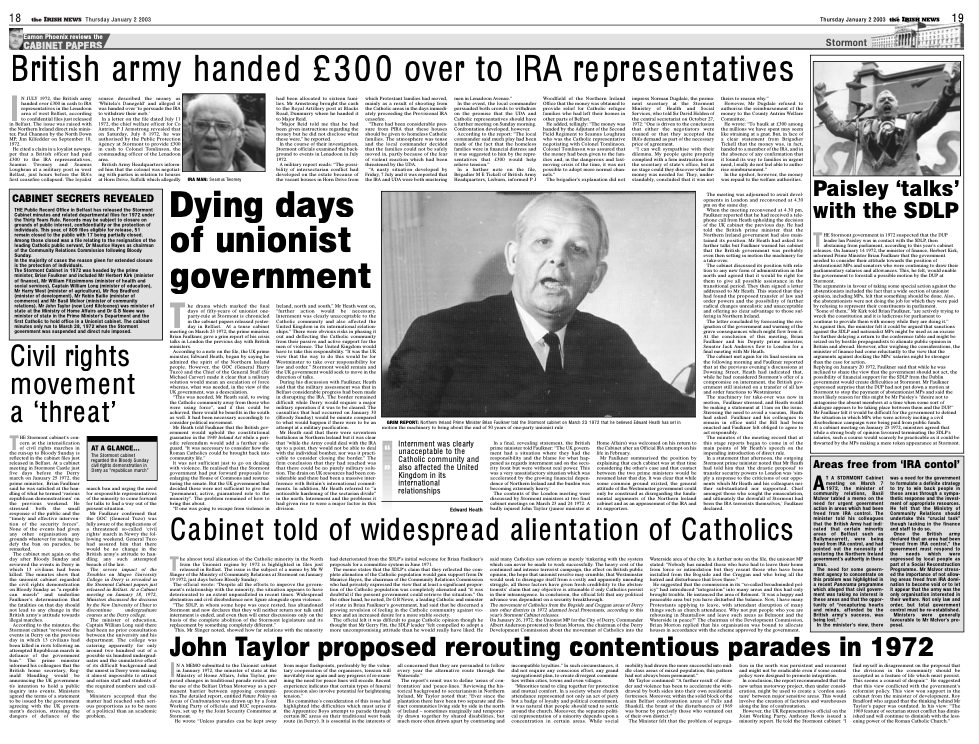
Dying days of Unionist government
The drama which marked the final days of fifty-years of unionist one-party rule at Stormont is chronicled in the cabinet papers released yesterday in Belfast.
At a tense cabinet meeting on March 23 1972, the prime minister, Brian Faulkner, gave a grim report of his crisis talks in London the previous day with British ministers. According to a note on the file, the UK prime minister, Edward Heath, began by saying he admired the spirit of the Northern Ireland people.
However, the GOC (General Harry Tuzo) and the Chief of the General Staff (Sir Michael Carver) made it clear that a military solution would mean an escalation of force, whereas what was needed, in the view of the UK government, was a de-escalation.
“This was needed, Mr Heath said, to swing the Catholic community away from those who were using force”, and if this could be achieved, there would be benefits in the south as well. It had been necessary accordingly to consider political movement.
Mr Heath told Faulkner that the British government would uphold the constitutional guarantee in the 1949 Ireland Act while a periodic referendum would add a further safeguard.
“It was necessary to consider how the Roman Catholics could be brought back into community life.” It was not sufficient just to go on dealing with violence.
He realised that the Stormont government had put forward proposals for enlarging the House of Commons and restructuring the senate. But the UK government had decided these were not sufficient to give the “permanent, active, guaranteed role to the minority”.
The problem remained of how to bring this about. “If one was going to escape from violence in Ireland, north and south,” Mr Heath went on, “further action would be necessary. Internment was clearly unacceptable to the Catholic community and also affected the United Kingdom in its international relationships.”
There were obvious risks in phasing it out and deflecting the Catholic community from their passive and active support for the men of violence. The United Kingdom would have to take this responsibility.
“It was the UK view that the way to do this would be for Westminster to take over responsibility for law and order.” Stormont would remain and the UK government would seek to move in the direction of talks.
During his discussion with Faulkner, Heath said that the military assessment was that in Belfast considerable progress had been made in disrupting the IRA. The border remained difficult while Derry would require a major military operation if it was to be cleared.
The casualties that had occurred on January 30 (Bloody Sunday) would be minute compared to what would happen if there were to be an attempt at a military pacification.
Mr Heath said that there were seventeen battalions in Northern Ireland but it was clear that “while the Army could deal with the IRA up to a point, they would not be able to deal with the individual bomber, nor was it practicable to consider closing the border.”
The firm conclusion that they had reached was that there could be no purely military solution. The drain on UK resources had been considerable and there had been a massive interference with Britain’s international commitments.
In addition, Mr Heath referred to “a noticeable hardening of the sectarian divide” in the north. Internment and the problems it had given rise to were a major factor in this division.
In a final, revealing statement, the British prime minister told Faulkner: “The UK government had a situation where they had the responsibility and the blame for what happened as regards internment and on the security front but were without real power. This was a very unsatisfactory situation which was accelerated by the growing financial dependence of Northern Ireland and the burden was becoming extremely heavy.’
The contents of the London meeting were discussed by Stormont ministers at two final cabinet meetings on March 23 and 24 1972.
A badly injured John Taylor (junior minister at Home Affairs) was welcomed on his return to the Cabinet after an Official IRA attempt on his life in February.
Mr Faulkner summarised the position by explaining that each cabinet was at that time considering the other’s case and that contact between the two prime ministers would be resumed later that day.
It was clear that while some common ground existed, the general attitude of the Westminster government could only be construed as disregarding the fundamental arguments of the Northern Ireland cabinet and as an appeasement of the IRA and its supporters.
The meeting was adjourned to await developments in London and reconvened at 4.30 pm on the same day.
When the meeting reconvened at 4.30 pm, Faulkner reported that he had received a telephone call from Heath upholding the decision of the UK cabinet the previous day. He had told the British prime minister that the Northern Ireland government had also maintained its position.
Mr Heath had asked for further talks but Faulkner warned his cabinet that the British government was probably even then setting in motion the machinery for a take-over.
The cabinet discussed its position with relation to any new form of administration in the north and agreed that it would be right for them to give all possible assistance in the transitional period. They then signed a letter addressed to Mr Heath.
This stated that they had found the proposed transfer of law and order powers and the possibility of further radical changes unrealistic and unacceptable and offering no clear advantage to those suffering in Northern Ireland.
The letter concluded by forecasting the resignation of the government and warning of the grave consequences which might flow from it.
At the conclusion of this meeting, Brian Faulkner and his Deputy prime minister, Senator Jack Andrews flew to London for a final meeting with Mr Heath.
The cabinet met again for its final session on the following morning and Faulkner reported that at the previous evening’s discussions at Downing Street, Heath had indicated that, while he had considered Stormont’s offer of a compromise on internment, the British government still insisted on a transfer of all law and order functions to Westminster.
The machinery for take-over was now in motion, Faulkner stressed, and Heath would be making a statement at 11am on the issue. Stressing the need to avoid a vacuum, Heath had asked Faulkner and his colleagues to remain in office until the Bill had been enacted and Faulkner felt obliged to agree to act responsibly.
The minutes of the meeting record that at this stage reports began to come in of the main points of Mr Heath’s speech on the impending introduction of direct rule.
In a statement that afternoon, the outgoing Stormont prime minister noted that Mr Heath had told him that ‘the drastic proposal’ to transfer security powers to London was ‘simply a response to the criticisms of our opponents which Mr Heath and his colleagues neither substantiated nor supported.
Chief amongst those who sought the emasculation, and ultimately the downfall of Stormont had been the IRA terrorists themselves,’ Faulkner declared.
British army handed £300 over to IRA representatives
IN JULY 1972, the British army handed over £300 in cash to IRA representatives in the Lenadoon area of west Belfast, according to confidential files just released in Belfast.
The issue was raised with the Northern Ireland direct rule minister, Paul Channon by the North Down MP, Jim Kilfedder on September 10, 1972.
He cited a claim in a loyalist newspaper that a British officer had paid £300 to the IRA representatives, Seamus Twomey and Seamus Loughran at a military post in west Belfast, just hours before the IRA’s first ceasefire collapsed.
The loyalist source described the money as ‘Whitela’s Danegeld’ and alleged it was handed over ‘to persuade the IRA to withdraw their mob.’
In a letter on the file dated July 11 1972, the chief welfare officer for Co Antrim, P J Armstrong revealed that on Saturday, July 8 1972, he was authorised by the Public Protection Agency at Stormont to provide £300 in cash to Colonel Tomlinson, the commanding officer of the Lenadoon area.
British Army Headquarters informed him that the colonel was negotiating with parties in relation to houses at Horn Drive, Suffolk which allegedly had been allocated to sixteen families.
Mr Armstrong brought the cash to the Royal Artillery post at Blacks Road, Dunmurry where he handed it to Major Reid.
“Major Reid told me that he had been given instructions regarding the money but he did not disclose what these were,” he reported. In the course of their investigation, Stormont officials examined the background to events in Lenadoon in July 1972.
A military report reads: “The possibility of intersectarian conflict had developed on the estate because of the vacant houses in Horn Drive from which Protestant families had moved, mainly as a result of shooting from the Catholic areas in the days immediately proceeding the Provisional IRA ceasefire.
“There had been considerable pressure from PIRA that these houses should be given to homeless Catholic families. The atmosphere was tense and the local commander decided that the families could not be safely moved in, partly because of the fear of violent reaction which had been threatened by the UDA.
“A nasty situation developed by Friday, 7 July and it was reported that the IRA and UDA were both mustering men in Lenadoon Avenue.” In the event, the local commander persuaded both crowds to withdraw on the promise that the UDA and Catholic representatives should have a further meeting on Sunday morning. Confrontation developed, however.
According to the report: “The local commander said much play had been made of the fact that the homeless families were in financial distress and it was suggested to him by the representatives that £300 would help relieve tension.”
In a further note on the file, Brigadier M E Tickell of British Army Headquarters, Lisburn, informed P J Woodfield of the Northern Ireland Office that the money was obtained to provide relief for Catholic refugee families who had left their homes in other parts of Belfast.
He added, tellingly: “The money was handed by the Adjutant of the Second Field Regiment to Seamus Loughran who was the Catholic representative negotiating with Colonel Tomlinson. Colonel Tomlinson was assured that the money had been given to the families and, in the dangerous and fast-moving crisis of the time, it was not possible to adopt more normal channels.”
The brigadier’s explanation did not impress Norman Dugdale, the permanent secretary at the Stormont Ministry of Health and Social Services, who told Sir David Holden of the central secretariat on October 27, 1972: “One is driven to the conclusion that either the negotiators were conned or that they accepted the IRA’s demand as part of the necessary price of agreement.
“I can well sympathise with their dilemma. My people quite properly complied with a firm instruction from the secretary of state’s office, but at no stage could they discover what the money was needed for. They, understandably, concluded that it was not theirs to reason why.”
However, Mr Dugdale refused to authorise the reimbursement of the money to the County Antrim Welfare Committee. He wrote: “To baulk at £300 among the millions we have spent may seem like straining at a gnat. But, in face of a clear statement from Brigadier Tickell that the money was, in fact, handed to a member of the IRA, and in the absence of any confirmation that it found its way to families in urgent need, I really do not feel able to authorise reimbursement.” In the upshot, however, the money was repaid to the welfare authorities.
Civil rights movement a ‘threat’
THE Stormont cabinet’s concern at the intensification of civil rights marches in the run-up to Bloody Sunday is reflected in the cabinet files just released in Belfast.
At a cabinet meeting in Stormont Castle just five days before the Derry march on January 25 1972, the prime minister, Brian Faulkner said he was satisfied at the handling of what he termed ‘various republican demonstrations’ on the previous weekend. He stressed both the small response of the public and the “timely and effective intervention of the security forces”.
None of the events had given any other organisation any grounds whatever for seeking to defy the ban on parades, he remarked.
The cabinet met again on the day after Bloody Sunday and reviewed the events in Derry in which 13 civilians had been killed. The minutes show that the unionist cabinet regarded the civil rights demonstration on Bloody Sunday as “a republican march” and underline Faulkner’s determination that the fatalities on that day should not lead to any change in the British army’s attitude towards illegal marches.
According to the minutes, the Stormont cabinet “reviewed the events in Derry on the previous day in which 13 civilians had been killed in riots following an attempted Republican march in defiance of the government ban.”
The prime minister informed his colleagues that the British home secretary, Reginald Maudling would be announcing the UK government’s intention to hold a public inquiry into events. Ministers agreed the terms of a statement to be issued by the government agreeing with the UK government’s decision, stressing the dangers of defiance of the march ban and urging the need for responsible representatives of the minority to come forward for talks to find a way out of the present situation. I am running a few minutes late; my previous meeting is running over.
Mr Faulkner confirmed that the GOC (General Tuzo) was fully aware of the implications of a threatened so-called ‘civil rights’ march in Newry the following weekend. General Tuzo had assured him that there would be no change in the British army’s attitude to handling any such attempted breach of the law.
The severe impact of the Troubles on Magee University College in Derry is revealed in the Stormont Cabinet papers just released in Belfast.
At a Cabinet meeting on January 18, 1972, Ministers discussed the decision by the New University of Ulster to discontinue undergraduate courses at the Derry college. The minister of education, Captain William Long said there had been no prior consultation between the university and his department.
The college was catering apparently for only around two hundred out of a possible six hundred undergraduates and the cumulative effect of its difficult background and the unrest in Derry were making it almost impossible to attract and retain staff and students of the required numbers and calibre.
Ministers accepted that the matter had reached such serious proportions as to be more of a political than an academic problem.
Cabinet told of widespread alienation of Catholics
The almost total alienation of the Catholic minority in the North from the Unionist regime by 1972 is highlighted in files just released in Belfast. The issue is the subject of a memo by Mr W Slinger of the Ministry of Community Relations at Stormont on January 19 1972, just days before Bloody Sunday.
The official wrote: “Despite all the efforts to improve the government’s relationship with the minority, the situation appears to have deteriorated to an extent unparalleled in recent times. Widespread abstention and civil disobedience now figure alongside open violence.
“The SDLP, in whom some hope was once rested, has abandoned Stormont and now declares that they will neither return nor talk until internment is ended, and even then will enter discussions only on the basis of the complete abolition of the Stormont legislature and its replacement by something completely different.”
This, Mr Slinger noted, showed how far relations with the minority had deteriorated from the SDLP’s initial welcome for Brian Faulkner’s proposals for a committee system in June 1971.
The memo states that the SDLP’s claim that they reflected the complete alienation of the Catholic population would gain support from Dr Maurice Hayes, the chairman of the Community Relations Commission who had privately expressed the view that at least a significant proportion of the Catholic population was completely alienated and “it was doubtful if the present government could retrieve the situation.”
On the other hand, he noted, Dr G B Newe, a leading Catholic and minister of state in Brian Faulkner’s government, had said that he discerned a growing revulsion of feeling in the Catholic community against violence and an increased desire for a more stable society.
The official felt it was difficult to gauge Catholic opinion though he thought that Mr Gerry Fitt, the SDLP leader “felt compelled to adopt a more uncompromising attitude than he would really have liked.
He said many Catholics saw reform as merely ‘tinkering with the system which can never be made to work successfully. The heavy cost of the continued and intense terrorist campaign, the effect on British public opinion, the hope that unionist resolve may crumble, that Westminster would seek to disengage itself from a costly and apparently unending struggle, all these factors have given fresh credibility to the abstentionists’ claim that any objective is attainable if only Catholics persist in their intransigence.
In conclusion, the official felt that any political advance was dependent on a security breakthrough. The movement of Catholics from the Bogside and Creggan areas of Derry into other districts in 1972 alarmed local Protestants, according to this year’s Stormont Cabinet releases.
On January 26, 1972, the Unionist MP for the City of Derry, Commander Albert Anderson, protested to Brian Morton, the chairman of the Derry Development Commission, about the movement of Catholics into the Waterside area of the city. In a further note on the file, the unionist MP stated: “Nobody has minded those who have had to leave their home from force or intimidation but they resent those who have been installed from the Bogside and the Creggan and who bring all the hatred and disturbance that lives there.”
He suggested that the commission in its “so-called broadminded policy” had introduced “integration” into many areas and this had only brought trouble. He instanced the area of Belmont. ‘It was a happy and peaceable area but you have disturbed the balance. Now, I have many Protestants applying to leave, with attendant disruption of many things such as church attendance. Why not put people who you are rehousing in Shantallow and leave such areas as Belmont and the Waterside in peace?” The chairman of the Development Commission, Brian Morton replied that his organisation was bound to allocate houses in accordance with the scheme approved by the government.
John Taylor proposed rerouting contentious parades in 1972
IN A MEMO submitted to the Unionist cabinet in January 1972, the minister of state at the Ministry of Home Affairs, John Taylor, proposed changes in traditional parade routes and the use of the Belfast Urban Motorway as a permanent barrier between opposing communities.
The detailed report, entitled Future Policy on Areas of Confrontation was drawn up by a Joint Working Party of officials and RUC representatives, set up by the Joint Security Committee at Stormont. He wrote: “Unless parades can be kept away from major flashpoints, preferably by the voluntary cooperation of the organisers, tension will inevitably rise again and any progress of re-examining the need for peace lines will recede. Recent experience indicates that certain types of funeral procession also involve potential for heightening tension.”
His committee’s consideration of this issue had highlighted the difficulties which must arise if the Apprentice Boys attempt to parade through certain RC areas on their traditional west bank route (in Derry). It is essential in the interests of all concerned that they are persuaded to follow every year the alternative route through the Waterside.” The report’s remit was to define ‘areas of confrontation’ and ‘peace-lines.’
Reviewing the historical background to sectarianism in Northern Ireland, Mr Taylor noted that: “Ever since the plantation there have been two separate and distinct communities living side by side in the north of Ireland – sometimes marginally and temporarily drawn together by shared disabilities, but much more often drawn apart by contrasting and incompatible loyalties.” In such circumstances, it did not require any conscious effort, any grand segregationist plan, to create divergent communities within cities, towns and even villages.
“Minorities tend to cling together for protection and mutual comfort. In a society where church attendance represented not only an act of piety but a badge of loyalty and political commitment, it was natural that people should tend to settle around the church. Moreover, the separate political representation of a minority depends upon a concentration in certain areas. While social mobility had drawn the more successful into middle-class areas of mixed population, this pattern had not always been permanent.”
Mr Taylor continued: “A further result of disorder and violence has been to accelerate the withdrawal by both sides into their own residential fortresses. Moreover, within the solid block of the main Belfast confrontation areas of Falls and Shankill, the brunt of the disturbances of 1969 was borne by precisely those who ventured out of their own district.”
The Minister felt that the problem of segregation in the north was persistent and recurrent and might not be eradicable even if some central policy were designed to promote integration. In conclusion, the report recommended that the new urban motorway project, then under consideration, might be used to create a ‘cordon sanitaire’ between major sensitive areas. This would involve the creation of factories and warehouses along the line of confrontation.
However, the UK representative official on the Joint Working Party, Anthony Hewis issued a minority report. He told the Stormont cabinet: “I find myself in disagreement on the proposal that the divisions in the community should be accepted as a feature of life which must persist. This seems a counsel of despair.”
He suggested that this view conflicted with the government’s reformist policy. This view won support in the cabinet from the minister of development, Roy Bradford who argued that the thinking behind Mr Taylor’s paper was outdated. In his view: “The 1969 feature of sectarian street conflict has diminished and will continue to diminish with the lessening power of the Roman Catholic Church.”
Paisley ‘talks’ with the SDLP
THE Stormont government in 1972 suspected that the DUP leader Ian Paisley was in contact with the SDLP, then abstaining from parliament, according to this year’s cabinet releases.
On January 14 1972, the minister of finance, Herbert Kirk, informed Prime Minister Brian Faulkner that the government needed to consider their attitude towards the position of abstentionist MPs and senators who were continuing to draw their parliamentary salaries and allowances.
This, he felt, would enable the government to forestall a possible motion by the DUP at Stormont. The arguments in favour of taking some special action against the abstentionists included the fact that a wide section of unionist opinion, including MPs, felt that something should be done.
Also, the abstentionists were not doing the job for which they were paid by refusing to represent their constituents in parliament. “Some of them,” Mr Kirk told Brian Faulkner, “are actively trying to wreck the constitution and it is ludicrous for parliament to continue to provide them with money while they are doing it.”
As against contrast, the minister felt that it could be argued that sanctions against the SDLP and nationalist MPs might be used as an excuse for further delaying a return to the conference table and might be seized upon by hostile propagandists to alienate public opinion in Britain and abroad.
However, after weighing the considerations, the minister of finance had come reluctantly to the view that the arguments against docking the MPs’ salaries might be stronger than the case for action.
Replying on January 20 1972, Faulkner said that while he was inclined to share the view that the government should not act, the possibility of financial support for the SDLP from the Dublin government would create difficulties at Stormont.
Mr Faulkner expressed surprise that the DUP had not put down a motion at Stormont to stop the payment of abstentionist MPs and said the most likely reason for this might be Mr Paisley’s “desire not to antagonise the absent members at a time when some sort of dialogue appears to be taking place between them and the DUP.”
Mr Faulkner felt it would be difficult for the government to defend the situation in which MPs who were actively inciting a civil disobedience campaign were being paid from public funds. At a cabinet meeting on January 25 1972, ministers agreed that while a strong body of opinion favoured terminating the SDLP’s salaries, such a course would scarcely be practicable as it could be thwarted by the MPs making a mere token appearance at Stormont.
Areas free from ‘IRA control’
AT A STORMONT Cabinet meeting on March 7 1972, the minister of community relations, Basil McIvor tabled a memo on the need for urgent government action in areas which had been freed from IRA control. The minister told his colleagues that the British Army had indicated that certain minority areas of Belfast such as Ballymacarrett, were being freed from IRA control, and had pointed out the necessity of restoring the Northern Ireland government’s authority in these areas.
The need for some government agency to concentrate on this problem was highlighted in a recent Panorama programme which alleged that civil government was taking no interest in these areas and that the opportunity of “recapturing hearts and minds, afforded by the British army’s success, was being lost.”
In the minister’s view, there was a need for the government to formulate a definite strategy to try to win back people in these areas through a sympathetic response and the investment of appropriate resources.
He felt that the Ministry of Community Relations should undertake this “crucial task” though lacking in the finance and staff to do so. Once the British army declared that an area had been “freed from IRA control,” the government must respond to the needs which were expressed by local people as part of a Social Reconstruction Programme.
Mr McIvor stressed the importance of not allowing areas freed from IRA domination to become void or to let it appear that the army was the only organisation interested in their welfare. Not only law and order, but total government control must be re-established. Ministers were generally favourable to Mr McIvor’s proposal.
Cabinet secrets revealed
THE Public Record Office in Belfast has released the Stormont Cabinet minutes and related departmental files for 1972 under the Thirty Years Rule. Records may be subject to closure on grounds of public interest, confidentiality or the protection of individuals.
This year, of 809 files eligible for release, 51 remain closed to the public with 17 being partially closed. Among those closed was a file relating to the resignation of the leading Catholic public servant, Dr Maurice Hayes as chairman of the Community Relations Commission following Bloody Sunday.
In the majority of cases the reason given for extended closure is the protection of individuals.
The Stormont Cabinet in 1972 was headed by the prime minister, Brian Faulkner and included Mr Herbert Kirk (minister of finance), Mr William Fitzsimmons (minister of health and social services), Captain William Long (minister of education), Mr Harry West (minister of agriculture), Mr Roy Bradford (minister of development), Mr Robin Bailie (minister of commerce) and Mr Basil McIvor (minister of community relations). Mr John Taylor (now Lord Kilclooney) was minister of state at the Ministry of Home Affairs and Dr G B Newe was minister of state in the Prime Minister’s Department and the first Catholic to hold office in a Unionist cabinet. The cabinet minutes only run to March 28, 1972 when the Stormont government was suspended and direct rule imposed.