

1972 State Papers (page 1)
January 01 2003
Publication Date
LEGAL ISSUE??? (G Adams) Heath finally brings down the curtain on the beleaguered Stormont government, Secret meeting with Adams revealed in released papers, Relief at lack of violent backlash, Bloody Sunday – Army ‘Surprised’ by Fatalities, Former PM Sir Alec Backed a United Ireland
State Paper Snippet
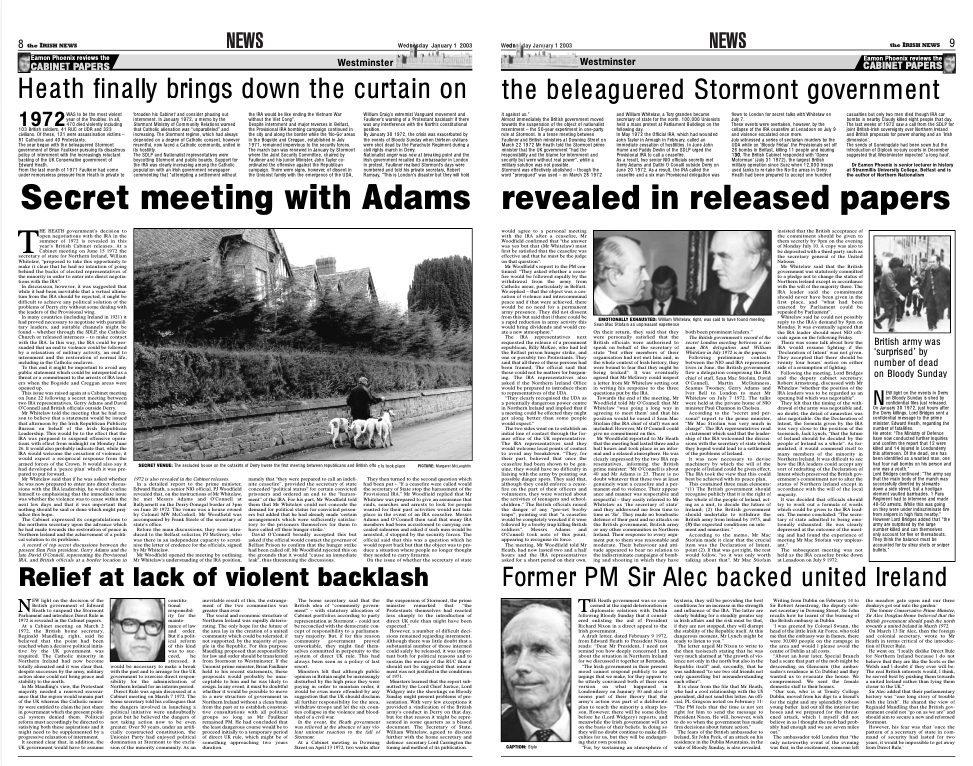
Heath finally brings down the curtain on the beleaguered Stormont government
1972 was to be the most violent year of the Troubles. In all, 470 died violently including 103 British soldiers, 41 RUC or UDR and 323 civilians. Of these, 121 were assassination victims 81 Catholics and 40 Protestants.
The year began with the beleaguered Stormont government of Brian Faulkner pursuing its disastrous policy of internment with the increasingly reluctant backing of the UK Conservative government of Edward Heath.
From the last month of 1971 Faulkner had come under remorseless pressure from Heath in private to ‘broaden his Cabinet’ and consider phasing out internment. In January 1972, a memo by the Stormont Ministry of Community Relations warned that Catholic alienation was “unparalleled” and increasing.
The Stormont regime, which had always depended on a degree of Catholic consent, however resentful, now faced a Catholic community, united in its hostility.
The SDLP and Nationalist representatives were boycotting Stormont and public boards. Support for the IRA was clearly increasing among the Catholic population with an Irish government newspaper commenting that “attempting a settlement without the IRA would be like ending the Vietnam War without the Viet Cong”.
Despite internment and major reverses in Belfast, the Provisional IRA bombing campaign continued in the city and along the border while the ‘No-Go’ areas in the Bogside and Creggan, established in July 1971, remained impervious to the security forces.
The march ban was renewed in January by Stormont where the Joint Security Committee, chaired by Faulkner and his junior Minister, John Taylor coordinated the offensive against the Republican campaign. There were signs, however, of dissent in the Unionist family with the emergence of the UDA,
William Craig’s extremist Vanguard movement and Faulkner’s warning of a ‘Protestant backlash’ if there was any interference with the North’s constitutional position.
By January 30 1972, the crisis was exacerbated by the events of Bloody Sunday when thirteen civilians were shot dead by the Parachute Regiment during a civil rights march in Derry.
Nationalist anger was now at breaking point and the Irish government recalled its ambassador in London in protest. Faulkner realised Stormont’s days were numbered and told his private secretary, Robert Ramsay, “This is London’s disaster but they will hold it against us”.
Almost immediately, the British government moved towards the suspension of the object of nationalist resentment – the 50-year experiment in one-party rule at Stormont.
In a tense meeting between Faulkner and British ministers at Downing Street on March 22 1972, Prime Minister Edward Heath told the Stormont leader that the UK government “had the responsibility and the blame for internment and security but were without real power,” while a military solution was not possible.
Stormont was effectively abolished – though the word “prorogued” was used – on March 28 1972. William Whitelaw, a Tory grandee, became Secretary of State for Northern Ireland. The following day, 100,000 Unionists held a mass protest at Parliament Buildings.
In May 1972 the Official IRA, which had wounded John Taylor in Armagh in February, called an immediate cessation of hostilities. In June John Hume and Paddy Devlin of the SDLP urged the Provisional IRA to call a ceasefire.
As a result, two senior NIO officials secretly met Gerry Adams and Daithi Ó Conaill outside Derry on June 20 1972. The IRA then announced a ceasefire, and a six-man Provisional delegation was flown to London for secret talks with Whitelaw on July 7.
The ceasefire collapsed at Lenadoon on July 9, and violence escalated once more. July witnessed a series of sectarian murders by the UDA, while on “Bloody Friday” the Provisionals detonated 26 bombs in Belfast, killing 11 people and injuring 130.
The British Cabinet responded with “Operation Motorman” (July 31 1972), the largest British military operation since Suez. Some 12,000 troops, supported by tanks, re-took the No-Go areas in Derry. Heath had been prepared to accept 100 casualties, but only two men died – though IRA car bombs in nearby Claudy killed eight people that day.
The last weeks of 1972 saw calls from the SDLP for joint British-Irish sovereignty over Northern Ireland and British proposals for power-sharing and an “Irish dimension.” The seeds of Sunningdale had been sown, though the introduction of Diplock no-jury courts in December suggested that Westminster expected “a long haul.”
Secret meeting with Adams revealed in released papers
THE HEATH government’s decision to open negotiations with the IRA in the summer of 1972 is revealed in this year’s British Cabinet releases. At a Cabinet meeting on June 15 1972 the secretary of state for Northern Ireland, William Whitelaw, “proposed to take this opportunity to make it clear that he had no intention of going behind the backs of elected representatives of the minority in order to enter into direct negotiations with the IRA”.
In discussion, however, it was suggested that while it had been inevitable that a virtual ultimatum from the IRA should be rejected, it might be difficult to achieve any political solution of the problems of Derry city without some dealing with the leaders of the Provisional wing.
In many countries (including Ireland in 1921) it had proved necessary to negotiate with paramilitary leaders, and suitable channels might be found – whether through the SDLP, the Catholic Church or released internees – to make contact with the IRA. In this way, the IRA could be persuaded that an end to violence could be followed by a relaxation of military activity, an end to internment and the restoration of normal life, including in the Catholic enclaves.
To this end it might be important to avoid any public statement which could be interpreted as a threat or a commitment to the arrests of IRA leaders when the Bogside and Creggan areas were opened up.
This issue was raised again at a Cabinet meeting on June 22 following a secret meeting between two IRA representatives, Gerry Adams and David O’Connell and British officials outside Derry.
Mr Whitelaw told the meeting that he had reason to believe that a statement would be issued that afternoon by the Irish Republican Publicity Bureau on behalf of the Irish Republican Leadership. This would be to the effect that the IRA was prepared to suspend offensive operations with effect from midnight on Monday June 26. It would also probably indicate that, while the IRA would welcome the cessation of violence, it would expect a reciprocal response from the armed forces of the Crown. It would also say it had developed a ‘peace plan’ which it was prepared to put forward.
Mr Whitelaw said that if he was asked whether he was now prepared to enter into direct discussions with the IRA leadership, he would confine himself to emphasising that the immediate issue was whether the violence was to cease within the next few days and that it was important that nothing should be said or done which might prejudice this hope.
The Cabinet expressed its congratulations to the northern secretary upon the advance which he had made towards the restoration of peace in Northern Ireland and the achievement of a political solution to its problems.
A record of top secret discussions between the present Sinn Fein president, Gerry Adams and the late David O’Connell, representing the Provisional IRA, and British officials at a border location in 1972 is also revealed in the Cabinet releases.
In a detailed report to the prime minister, Edward Heath, a senior NIO official, PJ Woodfield revealed that, on the instructions of Mr Whitelaw, he met Messrs Adams and O’Connell at Ballyarnett on the Derry-Donegal border at 3pm on June 20 1972. The venue was a house owned by Colonel MW McCorkell. Mr Woodfield was accompanied by Frank Steele of the secretary of state’s office.
Before the main discussions, they were introduced to the Belfast solicitor, PJ McGrory, who was there in an independent capacity to scrutinise the letter of credence for the officials, signed by Mr Whitelaw.
Mr Woodfield opened the meeting by outlining Mr Whitelaw’s understanding of the IRA position, namely that “they were prepared to call an indefinite ceasefire”, provided the secretary of state conceded “political status” for certain convicted prisoners and ordered an end to the “harassment” of the IRA.
For his part, Mr Woodfield told them that Mr Whitelaw could not concede the demand for political status for convicted prisoners but added that he had already made ‘certain arrangements which were sufficiently satisfactory to the prisoners themselves for them to have called off their hunger strike.’
David O’Connell broadly accepted this but asked if the official would contact the governor of Belfast Prison to confirm that the hunger strike had been called off. Mr Woodfield rejected this on the grounds that it would “cause an immediate leak”, thus threatening the discussions.
They then turned to the second question which had been put – “If a ceasefire were called would the secretary of State stop the harassment of the Provisional IRA.” Mr Woodfield replied that Mr Whitelaw was prepared to give an assurance that raids, searches and arrests to look for people wanted for their past activities would not take place in the event of an IRA ceasefire.
Messrs Adams and O’Connell then said that many IRA members had been accustomed to carrying concealed sidearms and asked if such men would be arrested, if stopped by the security forces. The official said that this was a question which he would report back but that the object was to produce a situation where people no longer thought they needed to carry firearms.
On the issue of whether the secretary of state would agree to a personal meeting with the IRA after a ceasefire, Mr Woodfield confirmed that “the answer was yes but that (Mr Whitelaw) must first be satisfied that the ceasefire was effective and that he must be the judge on that question.”
Mr Woodfield’s report to the Prime Minister continued: “They asked whether a ceasefire would be followed rapidly by the withdrawal of the army from Catholic areas, particularly in Belfast. We replied that the object was a cessation of violence and intercommunal peace, and if that were achieved, there would be no need for a permanent army presence. They did not dissent from this but said that if there could be a rapid reduction in army activity this would bring dividends and create a new atmosphere.”
The IRA representatives next requested the release of a prominent republican, Billy McKee, who had led the Belfast prison hunger strike, and one or possibly two Protestants. They said that all three of these persons had been framed. The officials replied that these could not be matters for bargaining.
The IRA representatives also asked if the Northern Ireland Office would be prepared to introduce them to representatives of the UDA. “They clearly recognised the UDA as a potentially dangerous power centre in Northern Ireland and implied that if a meeting could be effected they might get along better than some people would expect.”
The two sides went on to establish an initial line of contact through the former office of the UK representative. The IRA representatives said they would welcome local points of contact to avoid any breakdown.
“They, for their part, believed that once the ceasefire had been shown to be genuine, they would have no difficulty in liaising with the army by pointing out possible danger spots. They said that, although they could enforce a ceasefire on the part of their officers and volunteers, they were worried about the activities of teenagers and schoolchildren.”
The British officials raised the danger of any “pre-set booby traps,” pointing out that “a ceasefire would be completely wrecked if it were followed by a booby trap killing British soldiers.” Messrs Adams and O’Connell took note of this point, appearing to recognise its force.
The meeting, Mr Woodfield told Mr Heath, had lasted two and a half hours. On their return, the IRA representatives said they were personally satisfied that the British officials were authorised to speak on behalf of the Secretary of State “but other members of their organisation had not met him and, in the whole context of Irish history, they were bound to fear that they might be being tricked.”
It was eventually agreed that Mr McGrory could inspect a letter from Mr Whitelaw setting out in writing his response to the three questions put by the IRA. Towards the end of the meeting, Mr Woodfield told Mr O’Connell that Mr Whitelaw “was going a long way in agreeing to meet them” and that his position would be eased if Sean Mac Stiofain, the IRA chief of staff, was not included. However, Mr O’Connell could give no commitment on this.
Mr Woodfield reported to Mr Heath that the meeting had lasted three and a half hours and took place in an informal and relaxed atmosphere. He was clearly impressed by the two IRA representatives, informing the British prime minister: “Mr O’Connell is about 40 and Mr Adams is 23. There is no doubt whatever that these two at least genuinely want a ceasefire and a permanent end to violence. Their appearance and manner was respectable and respectful – they easily referred to Mr Whitelaw as ‘the secretary of state’ and they addressed me from time to time as ‘Sir’.
They made no bombastic defence of their past and no attacks on the British government, British army or any other communities in Northern Ireland. Their response to every argument put to them was reasonable and moderate. Their behaviour and attitude appeared to bear no relation to the indiscriminate campaigns of bombing and shooting in which they have both been prominent leaders.”
The British government’s record of the secret London meeting between a six-man IRA delegation and William Whitelaw in July 1972 is in the papers.
Following preliminary contacts between the NIO and IRA representatives in June, the British government flew a delegation comprising the IRA chief of staff, Sean Mac Stiofain, David O’Connell, Martin McGuinness, Seamus Twomey, Gerry Adams and Ivor Bell to London to meet Mr Whitelaw on July 7 1972. The talks were held at the private home of NIO minister Paul Channon in Chelsea.
According to the “secret and personal” report to the prime minister, “Mr Mac Stiofain was very much in charge.” The IRA representatives read a statement which said that the leadership of the IRA welcomed the discussions with the secretary of state, which they hoped would lead to a settlement of the problems of Ireland.
It was now necessary to devise machinery by which the will of the people of Ireland could be given effect. The IRA took the view that this could best be achieved with its peace plan. This contained three main elements: (1) the British government should recognise publicly that it is the right of the whole of the people of Ireland, acting as a unit, to decide the future of Ireland; (2) the British government should undertake to withdraw the British army from Ireland by 1975; and (3) conditions on internment and amnesties.
According to the memo, Mr Mac Stiofain made it clear that the crucial item was the Declaration of Intent, point (2). If that was got right, the rest would follow, “so it was only worth talking about that.” Mr Mac Stiofain insisted that the British acceptance of the commitment should be given to them secretly by 9pm on the evening of Monday July 10. A copy was also to be deposited with a third party such as the secretary general of the United Nations.
Mr Whitelaw said that the British government was statutorily committed to a pledge not to change the status of Northern Ireland except in accordance with the will of the majority there. The IRA leader said the commitment should never have been given in the first place, and “what had been enacted by Parliament could be repealed by Parliament.”
Whitelaw said he could not possibly reply to the IRA’s demand by 9pm on Monday. It was eventually agreed that the IRA leader should meet NIO officials again on the following Friday.
There was some talk about how the IRA would resume fighting if the “Declaration of Intent” was not given. They accepted that there should be 24 hours’ notice on either side of a resumption of fighting.
Following the meeting, Lord Bridges and the deputy cabinet secretary, Robert Armstrong, discussed with Mr Whitelaw “whether the position of the IRA leaders was to be regarded as an opening bid which was negotiable.” They felt that the timing of the withdrawal of the army was negotiable and, no doubt, the detail of amnesties was also negotiable. On the Declaration of Intent, the formula given by the IRA was very close to the position of the taoiseach, Jack Lynch, “that the future of Ireland should be decided by the people of Ireland as a whole.” As formulated, it would commend itself to many members of the minority in Northern Ireland.
It was difficult to see how the IRA leaders could accept any sort of redrafting of the Declaration of Intent which preserved the British government’s commitment not to alter the status of Northern Ireland except in accordance with the will of the local majority. It was decided that officials should try to work out a formula of words which could be given to the IRA leaders.
The memo concluded: “The secretary of state admitted to being emotionally exhausted. He was clearly depressed at the outcome of the meeting and had found the experience of meeting Mr Mac Stiofain very unpleasant.”
The subsequent meeting was not held as the IRA ceasefire broke down at Lenadoon on July 9 1972.
Relief at lack of violent backlash
NEW light on the decision of the British government of Edward Heath to suspend the Stormont Parliament and introduce Direct Rule in 1972 is revealed in the Cabinet papers.
At a Cabinet meeting on March 2 1972, the British home secretary, Reginald Maudling, right, said he believed that the point had been reached when a decisive political initiative by the UK government was required. The Catholic minority in Northern Ireland had now become totally alienated and it was clear that, despite successes by the army, military action alone could not bring peace and stability to the north.
In Mr Maudling’s view, the Protestant majority needed a renewed reassurance that the region would remain part of the UK whereas the Catholic minority were entitled to claim the just share in government which the present political system denied them. Political reform must accordingly be directed to satisfying both these aspirations and it might need to be supplemented by a progressive relaxation of internment.
It seemed clear that, in addition, the UK government would have to assume constitutional responsibility for the maintenance of law and order. But if a political reform of this kind was to succeed, he stressed, it would be necessary to make a break with the past and to arrange for the UK government to exercise direct responsibility for the administration of Northern Ireland for an interim period.
Direct Rule was again discussed at a Cabinet meeting on March 7 1972. The home secretary told his colleagues that the dangers involved in launching a political initiative were undoubtedly great but he believed the dangers of not taking action now to be even greater. Over 50 years, under an artificially constructed constitution, the Unionist Party had enjoyed political domination at Stormont to the exclusion of the minority community. As an inevitable result of this, the estrangement of the two communities was greater than ever.
The social and economic structure of Northern Ireland was rapidly deteriorating. The only hope for the future of the area lay in the creation of a united community which could be tolerated, if not supported, by the majority of people in the Republic. For this purpose Maudling proposed that responsibility for law and order should be transferred from Stormont to Westminster. If the Unionist prime minister, Brian Faulkner held to his recent statements, these proposals would probably be unacceptable to him and he was likely to resign.
In any event, it must be doubtful whether it would be possible to move to a new structure of government in Northern Ireland without a clean break from the past or to establish constructive consultations with all political groups so long as Mr Faulkner remained PM. He had concluded that the least dangerous course would be to proceed initially to a temporary period of direct UK rule, which might be of something approaching two years duration.
The home secretary said that the British idea of “community government” – with statutory allocation of Cabinet portfolios according to party representation at Stormont – could not be reconciled with the democratic concept of responsibility to a parliamentary majority. But, if for this reason community government proved unworkable, they might find themselves committed in perpetuity to the system of direct UK rule. This had always been seen as a policy of last resort.
Ministers felt that although public opinion in Britain might be increasingly disturbed by the high price they were paying in order to maintain order, it would be even more offended by any suggestion that the UK should disclaim all further responsibility for the area, withdraw troops and let the six counties collapse in the violence and bloodshed of a civil war.
In the event, the Heath government was relieved at the absence of any violent unionist reaction to the fall of Stormont.
At a Cabinet meeting in Downing Street on April 13 1972, two weeks after the suspension of Stormont, the prime minister remarked that “the Protestants themselves had reacted less sharply to the introduction of direct UK rule than might have been expected.”
However, a number of difficult decisions remained regarding internment. Although there was little doubt that a substantial number of those interned could safely be released, it was important both for political reasons and to sustain the morale of the RUC that it should not be suggested that internment was not justified in the conditions of 1971.
Ministers learned that the report submitted by the Lord Chief Justice, Lord Widgery into the shootings on Bloody Sunday might present problems of presentation. With very few exceptions it provided a vindication of the British army’s conduct in Derry on that day, but for that reason it might be represented in some quarters as a biased document. The Secretary of State, William Whitelaw, agreed to discuss further with the home secretary and defence secretary Lord Carrington the timing and method of its publication.
Bloody Sunday – Army ‘Surprised’ by Fatalities
New light on the events in Derry on Bloody Sunday is shed by confidential files just released.
On January 30 1972, just hours after the Derry killings, Lord Bridges sent a confidential message to the prime minister, Edward Heath, regarding the number of fatalities.
He wrote: “The Ministry of Defence have now conducted further inquiries and confirm the report that 12 were killed and 14 injured in Londonderry this afternoon. Of the dead, one has been identified as a wanted man, one had four nail bombs on his person and one was a youth.”
Lord Bridges continued: “The army say that the main body of the march was successfully diverted by stewards down a side street, but a hooligan element vaulted barricades. 1 Para Regiment had to intervene and made 40-50 arrests. While this was going on they were under indiscriminate fire from snipers in high flats nearby.”
However Lord Bridges added that “the army are surprised by the large number killed and can themselves only account for five or thereabouts. They think the balance must be accounted for by stray shots or sniper bullets.”
Former PM Sir Alec Backed a United Ireland
The Heath government was so concerned at the rapid deterioration in diplomatic relations with Dublin following Bloody Sunday that it considered enlisting the aid of President Richard Nixon in a direct appeal to the Irish government.
A draft letter, dated February 9 1972, from Edward Heath to President Nixon reads:
“Dear Mr President, I need not remind you how deeply concerned I am about the situation in Northern Ireland for we discussed it together at Bermuda. The Irish government in their present mood cannot respond publicly to any urgings that we make, for they appear to be utterly convinced both of their own version on what happened in Londonderry on January 30 and also it seems part of their theory that the army’s action was part of a deliberate plan to teach the minority a sharp lesson.
However, there will be some delay before he (Lord Widgery) reports, and meanwhile the Irish government will act on the basis of their beliefs. In doing so they will no doubt continue to make difficulties for us, but they will be endangering their own position.
For, by sustaining an atmosphere of hysteria, they will be providing the best conditions for an increase in the strength and influence of the IRA. The latter are clearly bidding for a steadily greater say in Irish affairs and the risk must be that, if they are not stopped, they will disrupt the stability of the Republic itself. At this dangerous moment, Mr Lynch might be ready to listen to you.”
The letter urged Mr Nixon to write to the taoiseach stating that he was very much alarmed at “the growth of violence not only in the north but also in the Republic itself” and, secondly, that he was saddened “to see two old friends not only quarrelling but misunderstanding each other.”
It is clear from the file that Mr Heath, who had a cool relationship with the US president, did not send this letter. An official, PL Gregson, noted on February 11: “The PM feels that the time is not yet right for him to send the message to President Nixon. He will, however, wish to do so when the government has made firm decisions about future action.”
The fears of the British ambassador to Ireland, Sir John Peck, of an attack on his residence in the Dublin Mountains in the wake of Bloody Sunday, are also revealed. Writing from Dublin on February 14 to Sir Robert Armstrong, the deputy cabinet secretary in Downing Street, Sir John recalls how he learnt of the burning of the British embassy in Dublin.
“I was greeted by Colonel Swann, the head of the little Irish Air Force, who told me that the embassy was in flames, there were 30,000 people on the rampage in the area and would I please avoid the centre of Dublin at all costs. About an hour later, Special Branch had a scare that part of the mob might be descending on Glencairn (the ambassador’s residence in Co Dublin) and they wanted us to evacuate the house.
We compromised. We sent the female domestic staff to their homes. Our son, who is at Trinity College Dublin, moved from his digs to a friend’s for the night and my splendidly robust young butler laid out all the interior fire hoses and we prepared for the threatened attack, which I myself did not believe in as I thought the mob had probably had enough and we are seven miles out.”
The ambassador told London that “the only noteworthy event of the evening was that, in the excitement, someone left the meadow gate open and our three donkeys got out into the garden.”
The former Conservative Prime Minister, Sir Alec Douglas-Home, believed that the British government should push the north towards a united Ireland in March 1972.
On March 13 Sir Alec, then the foreign and colonial secretary, wrote to Mr Heath in terms critical of the introduction of Direct Rule.
He went on: “I really dislike Direct Rule for Northern Ireland because I do not believe that they are like the Scots or the Welsh and I doubt if they ever will be. The real British interests would, I think, be served best by pushing them towards a united Ireland rather than tying them closer to the UK.”
Sir Alec added that their parliamentary history was “one long story of trouble with the Irish.” He shared the view of Reginald Maudling that the British government could not “go on as we are” and should aim to secure a new and reformed Stormont.
However, his fear was that “once the pattern of a secretary of state in command of security had lasted for two years, it would be impossible to get away from Direct Rule.”