

1969 State Papers (page 4)
January 04 2000
Publication Date
Unionists warn of Protestant uprising if Direct Rule imposed, Stormont concern at gag on rebuttals of Republic
State Paper Snippet
Unionists Warn of Protestant Uprising if Direct Rule Imposed
The Unionist government warned Whitehall of massive violence from the Protestant community if the Labour government attempted to impose direct rule in August 1969, according to this year’s cabinet releases.
The papers reveal that on Sunday August 3 1969, the secretary to the Northern Ireland cabinet, Mr H Black, contacted the Home Office in London.
Black informed officials that the northern government might be approaching the point when, with continued disorder in Belfast, “the police might no longer be able to contain the situation and we would have to seek the help of the army.”
The Stormont official asked that the British government should be alerted to this possibility so that any “prior approvals” could be obtained.
Later that evening, however, Black was informed by the Home Office that the British government was not prepared to give any prior approval in principle, and that the decision was based on the GOC’s assessment that the police could deal with the present situation alone.
The cabinet secretary informed the Stormont minister: “I was told that in view of the serious constitutional
consequences of the use of troops, it would be advisable for Northern Ireland to endure a quite considerable degree of disorder before involving military assistance.”
When Black asked the Home Office the precise nature of “the constitutional consequences”, he was informed that Home Secretary James Callaghan believed that “if he decided to put troops on the streets, he might be committing the UK government to take over the government of Northern Ireland.”
In a searching memo Black informed Stormont ministers: “To all this I felt it was necessary to express my astonishment that such penal consequences could be contemplated, that it had never occurred to us that the veiled hints at the Downing Street meetings about ‘review of the constitutional relationships’ had ever meant more than the possible removal of responsibility for law and order – an extreme enough step in all conscience – and that Northern Ireland ministers were bound to react vigorously against this attitude.”
In a warning to Whitehall, Black made the Unionist cabinet’s feelings crystal clear to Sir Philip Allen of the Home Office: “The UK authorities should consider the situation that might arise if, in fact, they did decide to exercise direct rule from Whitehall.
“There would, first of all, be a frightening reaction from the Protestant community which could make anything that has happened up to now seem like child’s play. A provisional government might be set up with extreme elements at its head and it was highly probable that wholesale sectarian strife would break out, not only in the streets, but in the factories.
“The action proposed by HMG was surely only proper in the case of a suspension of the Northern Ireland government, as envisaged by the home secretary in the event of troops being deployed in a peacekeeping role.”
It was agreed that those ministers concerned with “reform” should examine the possibility of accelerating its implementation and report back to the cabinet.
Turning to the impending Apprentice Boys demonstration in Derry on August 12, the PM said that, as a result of a meeting with the organisation’s representatives, he was satisfied that they wanted to cooperate with the government.
A full parade, well marshalled, seemed preferable to one of limited numbers which might include the least reliable element.
In further discussions, the Home Office agreed that the possibility of a takeover by Westminster of the functions of the Northern Ireland government was a rather remote possibility, but one that could not be excluded from consideration.
Two days later, on August 6 1969, the Stormont premier, Major Chichester-Clark, discussed the situation directly with the Home Secretary on the telephone. Mr Callaghan stated that HMG had no intention or desire to resume responsibility for Northern Ireland affairs.
The two situations in which this might arise were (a) in the event that progress on the reforms discussed at previous Downing Street meetings was not satisfactory and (b) the continued use of troops to control riot situations.
However, the home secretary stated that the Stormont government was to be congratulated on its progress in implementing reforms so far.
Stormont Concern at Gag on Rebuttals of Republic
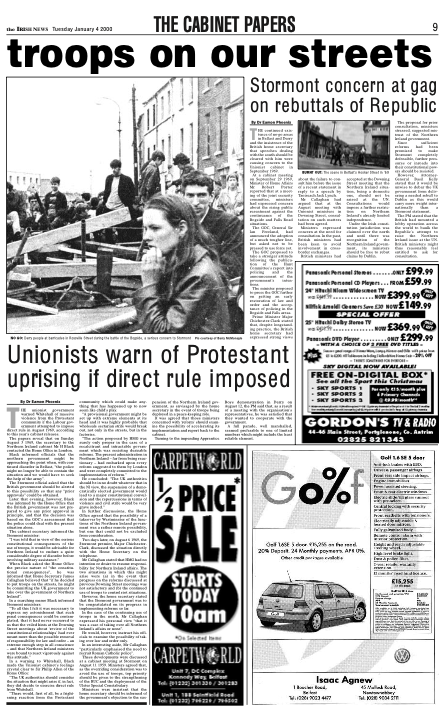
The continued existence of no-go areas in Belfast and Derry and the insistence of the British home secretary that speeches dealing with the south should be cleared with him were causing concern to the Unionist cabinet in September 1969.
At a cabinet meeting on September 29 1969, Minister of Home Affairs Robert Porter reported that at a meeting of the joint security committee, ministers had expressed concern about the rising public resentment against the continuance of the Bogside and Falls Road situations.
The GOC, General Sir Ian Freeland, had announced the adoption of a much tougher line, but asked not to be pressed to use force yet. The GOC proposed to take a stronger attitude following the publication of the Hunt Committee’s report into policing and the announcement of the government’s intentions.
The minister proposed to press the GOC further on getting an early restoration of law and order and the acceptance of policing in the Bogside and Falls areas.
Prime Minister Major Chichester-Clark stated that, despite longstanding practice, the British home secretary had expressed strong views about the failure to consult him before the issue of a recent statement in reply to a speech by Taoiseach Jack Lynch.
Mr Callaghan had argued that at the August meeting with Unionist ministers in Downing Street, consultation on such matters had been agreed.
Ministers expressed concern at the need for consultation. In the past, British ministers had been keen to avoid involvement in cross-border exchanges. British ministers had accepted at the Downing Street meeting that the Northern Ireland situation, being a domestic one, should not be raised at the UN. Consultations would impose a further restriction on Northern Ireland’s already limited independence.
Under the Irish constitution, jurisdiction was claimed over the north and until there was recognition of the Northern Ireland government, its ministers should be free to rebut claims by Dublin. The proposal for prior consultation, ministers stressed, suggested mistrust of the Northern Ireland government.
Since sufficient reforms had been promised to make Stormont completely defensible, further pressures or inroads into their constitutional powers should be resisted.
However, Attorney-General Basil Kelly stated that it would be unwise to debar the UK government from delivering a needed rebuff to Dublin as this would carry more weight internationally than a Stormont statement.
The PM stated that the British had mounted a lobby operation across the world to baulk the Republic’s attempt to raise the Northern Ireland issue at the UN. British ministers might thus reasonably feel entitled to ask for consultation.