

1968 State Papers (page 1)
January 01 1999
Publication Date
Standing at the crossroads, Derry march made Stormont ‘the focus of world opinion’, Craig warns of massive backlash by loyalists
State Paper Snippet
File releases
This week, the Public Record Office of Northern Ireland released to the public, under the 30-year rule, some 500 hundred cabinet files, mostly relating to 1968. A small number of files have been either fully or partially closed on grounds of sensitivity, public interest or the protection of individuals. Unusually, the record of the Northern Ireland cabinet for 1968 has been released in full.
The Northern Ireland Cabinet for 1968 was headed by Captain Terence O’Neill and included several figures destined to prominence in Ulster Unionist politics in the
1960s and 70s. These included Mr Brian Faulkner (Minister of Commerce), Mr William Craig (Minister of Home Affairs), Mr Herbert Kirk (Minister of Finance), Captain William Long (Minister of Education), Major James Chichester-Clark
(Minister of Agriculture), Mr William Morgan (Minister of Health and Social Services) and Major van Neill (Minister of Development). Mr Basil Kelly QC was Attorney General.
Standing at the crossroads
THE year 1968 was arguably the most critical year in Northern Ireland politics since the establishment of the state in 1921-22.
The year was shaped by the decision of the Northern Ireland Civil Rights Association (NICRA) to carry its campaign for “British rights for British subjects” to the streets of the north. Captain Terence O’Neill’s policy of symbolic gestures towards the minority and his attempts to end the 40-year “cold war” with the south had raised nationalist expectations which the Stormont government had failed to meet.
The year opened benignly with Captain O’Neill informing his cabinet of his “cordial reception” by the taoiseach, Jack Lynch, in Dublin on January 8. Within his cabinet, however, O’Neill’s reforming intentions faced the relentless opposition of his right wing, represented by Brian Faulkner, minister of commerce and William Craig, his minister of home affairs, while, outside, Ian Paisley was marshalling strong working-class opposition to the prime minister’s perceived “betrayal of Ulster’s Protestant heritage”.
In April 1968, NICRA held a public rally in Armagh to protest against Craig’s recent ban on the republican clubs. A month later, a hostile loyalist demonstration, carrying placards proclaiming “O’Neill Must Go” – pelted the prime minister’s car with eggs in Belfast. Events were moving inexorably towards violence and confrontation.
Much civil rights agitation centred on discrimination in housing by local unionist authorities. In Derry, the local republican club and left-wing Labour party, led by Eamonn McCann, had formed a housing action committee and began a programme of squatting and disruption of council meetings.
In June 1968, the unionist-controlled Dungannon rural council allocated a council house at Caledon, Co Tyrone to an unmarried girl who happened to be secretary to the local unionist candidate. The young nationalist MP for East Tyrone at Stormont, Austin Currie (now a Fine Gael TD), supported by local republicans, squatted in the house in protest. Mr Currie was eventually ejected by the RUC and charged.
This was the angry background to the first civil rights march on August 24, 1968. Some 2,500 people marched from Coalisland to Dungannon to protest against the discriminatory housing policies of the gerrymandered local council. A counterdemonstration by Paisley’s Ulster Protestant Volunteers served notice on NICRA and O’Neill that equality would not be attained without a struggle.
The “politics of the streets” had supplanted O’Neill’s “politics of expectation”. In September 1968, the civil rights movement notified the RUC of its intention to stage a protest march in Derry on October 5.
Derry city, with its gerrymandered unionist corporation and natural nationalist majority, was the living symbol of what nationalists and reformers perceived to be wrong with the northern state.
The local Apprentice Boys promptly announced a counter-demonstration, thus enabling the hardline Minister of Home Affairs William Craig to impose a ban on both marches. Informed of the decision, the nationalist leader Eddie McAteeq observed prophetically: “This may turn out to be the most dramatic mistake a Stormont minister has made in the last 50 years.”
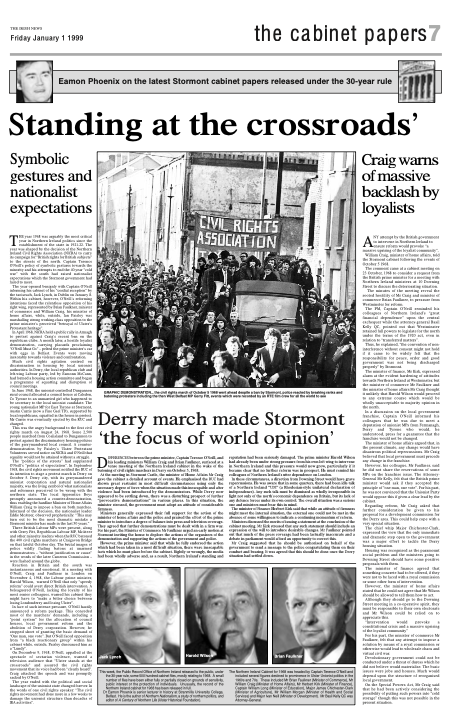
Three British Labour MPs were present, along with Gerry Fitt, Republican Labour MP, McAteer and other minority leaders when the RUC batoned the 400 civil rights marchers at Craigavon Bridge on that fateful October day. The brutal images of police wildly flailing batons at unarmed demonstrators – “without justification or cause” in the words of the later Cameron Commission – were flashed around the globe.
Reaction in Britain and the south was instantaneous and emotional. At a meeting with O’Neill, Craig and Faulkner in London on November 4, 1968, the Labour prime minister, Harold Wilson, warned O’Neill that only “speedy reform” could avert direct British intervention. A beleaguered O’Neill, lacking the loyalty of his most senior colleagues, warned his cabinet they might have to “make a bitter choice between losing Londonderry and losing Ulster”.
In face of such intense pressure, O’Neill hastily announced a reform package. This conceded most of the marchers’ demands, including a “point system” for the allocation of council houses, local government reform and the abolition of Derry corporation. However, he stopped short of granting the basic demand of “One man, one vote”. But O’Neill faced opposition from “a black reactionary group” within his cabinet while, outside, Paisley denounced him as a “Lundy”.
On December 9, 1968, O’Neill, appalled at the spectacle of sectarian violence, warned a television audience that “Ulster stands at the crossroads” and assured the civil rights movement that its voice had been “clearly heard”. Craig attacked the speech and was promptly sacked by O’Neill.
The year ended with the political and social landscape of the unionist state changed forever. In the words of one civil rights speaker: “The civil rights movement had done more in a few weeks to damage the unionist structure than decades of IRA activities”.
Derry march made Stormont ‘the focus of world opinion’
DIFFERENCES between the prime minister, Captain Terence O’Neill, and his leading ministers William Craig and Brian Faulkner, surfaced at a tense meeting of the Northern Ireland cabinet in the wake of the batoning of civil rights marchers in Derry on October 5,1968.
At the meeting in Stormont Castle, the minister of Home Affairs Mr Craig gave the cabinet a detailed account of events. He emphasised the RUC had shown great restraint in most difficult circumstances using only the necessary degree of force when the situation made this inescapable and after violence had been introduced by the demonstrators.
While Derry now appeared to be settling down, there was a disturbing prospect of further “provocative demonstrations” in various places. In this situation, the minister stressed, the government must adopt an attitude of considerable firmness.
Ministers generally expressed their full support for the action of the minister of home affairs and the police and praised the effort of the prime minister to introduce a degree of balance into press and television coverage. They agreed that further demonstrations must be dealt with in a firm way.
For his part, the Minister of Commerce Mr Faulkner urged an early motion at Stormont inviting the house to deplore the actions of the organisers of the demonstration and supporting the actions of the government and police.
However, the prime minister said that while he fully endorsed the action which had been taken in a most difficult situation, there were inescapable facts which he must place before the cabinet. Rightly or wrongly, the media had been wholly adverse and, as a result, Northern Ireland’s standing and reputation had been seriously damaged.
The prime minister Harold Wilson had already been under strong pressure from his own left wing to intervene in Northern Ireland and this pressure would now grow, particularly if it became clear that no further reform was in prospect. He must remind his colleagues of Northern Ireland’s utter dependence on London.
In these circumstances, a direction from Downing Street would have grave repercussions. He was aware that in some quarters, there had been idle talk of a Northern Ireland “UDI” (a Rhodesian style unilateral declaration of independence).
Any such talk must be dismissed as wholly irresponsible in light not only of the north’s economic dependence on Britain, but its lack of any defence forces under its own control. The overall situation was a serious one and ministers must bear this in mind.
The minister of Finance Herbert Kirk said that while an attitude of firmness might meet the internal situation, the external one could not be met in the absence of some willingness to indicate a continuing momentum of reform.
Ministers discussed the merits of issuing a statement at the conclusion of the cabinet meeting. Mr Kirk stressed that any such statement should include an expression of the will to introduce desirable changes. Mr Faulkner pointed out that much of the press coverage had been factually inaccurate and a debate in parliament would afford an opportunity to correct this.
Mr Craig suggested that he should be authorised on behalf of the government to send a message to the police congratulating them on their conduct and bearing. It was agreed that this should be done once the Derry situation had settled down.
Craig warns of massive backlash by loyalists
ANY attempt by the British government to intervene in Northern Ireland to ensure reform would provoke “a massive uprising of the loyalist community”, William Craig, minister of home affairs, told the Stormont cabinet following the events of October 5 1968.
The comment came at a cabinet meeting on 23 October, 1968 to consider a request from the British prime minister for a meeting with Northern Ireland ministers at 10 Downing Street to discuss the deteriorating situation.
The minutes of the meeting reveal the rooted hostility of Mr Craig and minister of commerce Brian Faulkner, to pressure from Westminster for reform.
The PM, Captain O’Neill reminded his colleagues of Northern Ireland’s “great financial dependence” upon the central exchequer while the attorney-general Basil Kelly QC, pointed out that Westminster retained full powers to legislate for the north under the terms of the 1920 act, even in relation to “transferred matters”.
Thus, he explained, “the convention of noninterference without consent might not hold if it came to be widely felt that the responsibility for peace, order and good government was not being discharged properly” by Stormont.
The minister of finance, Mr Kirk, expressed alarm at the evident hardening of attitudes towards Northern Ireland at Westminster, but the minister of commerce Mr Faulkner and the minister of home affairs Mr Craig thought it unlikely that Harold Wilson would proceed to any extreme course which would be wholly unacceptable to majority opinion in the north.
In a discussion on the local government franchise, Captain O’Neill informed his colleagues that he was due to meet a deputation of unionist MPs from Fermanagh, Derry and Tyrone who would, he understood, press for a guarantee that the franchise would not be changed.
The minister of home affairs argued that, in the present climate, any change would have disastrous political repercussions. Mr Craig believed that local government must precede any change in the franchise.
However, his colleague, Mr Faulkner, said he did not share the reservations of some MPs on the franchise issue. The Attorney-General Mr Kelly, felt that the British prime minister would ask if they accepted the principle of “one man, one vote”. For his part, he was not convinced that the Unionist Party would oppose this if given a clear lead by the cabinet.
Regarding reform, Mr Craig asked that further consideration be given to his proposal for a development commission for the Derry area. This could help cope with a very special situation.
The chief whip Major Chichester-Clark, expressed the view that the only immediate and dramatic step open to the government was a major effort to tackle the Derry housing situation.
Housing was recognised as the paramount social problem and the ministers going to Downing Street should have some positive proposals with them.
The minister of finance agreed that something concrete had to be offered, if they were not to be faced with a royal commission or some other form of intervention.
However, the minister of home affairs stated that he could not agree that Mr Wilson should be allowed to tell them how to act.
Although they should go to the Downing Street meeting in a co-operative spirit, they must be responsible to their own electorate and Mr Wilson could be relied on to appreciate this.
“Intervention would provoke a constitutional crisis and a massive uprising of the loyalist community”.
For his part, the minister of commerce Mr Faulkner, felt that any attempt to impose a solution by means of a royal commission or otherwise would lead to wholesale chaos and virtual civil war.
Devolutionary government could not be conducted under a threat of duress which he did not believe would materialise. The basic issues were jobs and houses. Much would depend upon the structure of reorganised local government.
On the Special Powers Act, Mr Craig said that he had been actively considering the possibility of putting such powers into “cold storage” though this was not possible in the present situation.