

1966 State Papers (page 2)
January 02 1997
Publication Date
Standing in the way of reform, Longford book had to get OK, Easter commemoration sparked ban demands, Murder and riots on streets in 1966, Hostility to Irish school
State Paper Snippet
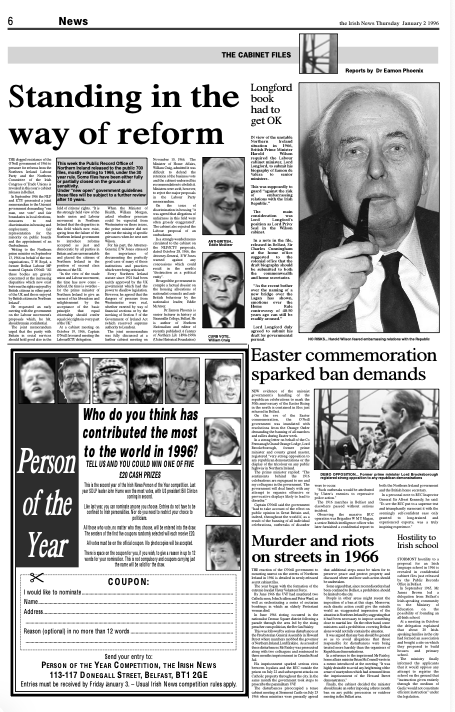
Standing in the way of reform
THE dogged resistance of the O’Neill government of 1966 to pressure far reforms from the Northern Ireland Labour Party and the Northern Committee of the Irish Congress of Trade Unions is revealed in this year’s cabinet releases in Belfast.
In September 1966 the NILP and ICTU presented a joint memorandum to the Unionist government demanding “one man, one vote” and fair boundaries in local elections, measures to end discrimination in housing and employment, fair representation far the minority on public boards and the appointment of an Ombudsman.
Writing to the Northern prime minister on September 13,1966 on behalf of the two organisations, T W Boyd, a former Belfast Labour MP warned Captain O’Neill: “All these bodies are gravely concerned at the increasing disparities which now exist between the rights enjoyed by British citizens in other parts of the UK and those enjoyed by British citizens in Northern Ireland”.
He requested an early meeting with the government on the Labour movement’s proposals which, he felt, should remain confidential.
The joint memorandum urged that the parity with Britain in social services should hold good also in the field of citizens’ rights.
“It is the strongly held view of the trade union and Labour movement in Northern Ireland that the disparities in this field which now exist, spring from the failure of the Northern Ireland government to introduce reforms accepted as just and democratic by all parties in Britain and are unwarrantable and placed the citizens of Northern Ireland in the position of second class citizens of the UK.
“In the view of the trade union and Labour movement, the time has now come -indeed, the time is overdue -for the prime minister of Northern Ireland to give an earnest of his liberalism and enlightenment by the acceptance of the basic principle that equal citizenship should confer equal civic rights in every part of the UK”
At a cabinet meeting on October 19, 1966, Captain O’Neill favoured meeting the Labour/ICTU delegation.
When the Minister of Health, William Morgan, asked whether pressure could be expected from Westminster on these issues, the prime minister did not rule out the raising of specific grievances what he next met Wilson.
For his part, the Attorney-General, E W Jones stressed the importance of documenting the perfectly good case of many of those institutions and practices which were being criticised.
Every Northern Ireland statute since 1921 had been tacitly approved by the UK government which had the power to disallow legislation. However; he agreed that the dangers of pressure from Westminster were real, whether exerted by way of financial sections or by the invoking of Section 5 of the Government of Ireland Act (which reserved supreme authority to London).
The joint memorandum was fully discussed at a further cabinet meeting on November 10, 1966. The Minister of Home Affairs, William Craig, admitted it was difficult to defend the retention of the business vote and the cabinet endorsed his recommendation to abolish it Ministers were swift, however; to reject the major proposals in the Labour Party memorandum.
On the issue of discrimination in housing “it was agreed that allegations of unfairness in this field were often grossly exaggerated”. The cabinet also rejected the Labour proposal of an ombudsman.
In a strongly-worded memo circulated to the cabinet on the NILP/ICTU proposals, dated October 28, 1966, the Attorney-General, EW Jones warned against any concessions which could result in the north’s “destruction as a political entity”.
He urged the government to compile a factual dossier on the housing allocations of nationalist councils and anti-British behaviour by the nationalist leader, Eddie McAteer.
File releases
This week the Public Record Office of Northern Ireland released to the public 700 files, mostly relating to 1966, under the 30 year rule. Some files have been either fully or partially closed on the grounds of sensitivity.
Under “new open” government guidelines these files will be subject to a further review after 10 years.
Longford book had to get OK
IN view of the unstable Northern Ireland situation in 1966, British Prime Minister Harold Wilson required the Labour cabinet minister, Lord Longford, to submit his biography of Eamon de Valera to senior ministers.
This was supposedly to guard “against the risk of embarrassing relations with the Irish Republic.”
The main consideration was Lord Longford’s position as Lord Privy Seal in the Wilson cabinet.
In a note in the file, released in Belfast, Sir Charles Cunningham at the home office suggested to the colonial office that the draft biography should be submitted to both the commonwealth and home secretaries.
“As the recent bother over the naming of a new bridge over the Lagan has shown, emotions over the Home Rule controversy of 40-50 years ago can still be readily aroused.”
Lord Longford duly agreed to submit his draft for governmental perusal.
Easter commemoration sparked ban demands
NEW evidence of the unionist government’s handling of the republican celebrations to mark the 50th anniversary of the Easter Rising in the north is contained in files just released in Belfast.
On the eve of the Easter commemoration, the O’Neill government was inundated with resolutions from the Orange Order demanding the banning of all marches and rallies during Easter week.
In a strong letter on behalf of the Co Fermanagh Grand Orange Lodge, Lord Brookeborough, former prime minister and county grand master; registered “very strong opposition to any republican demonstrations or the display of the tricolour on any public highway in Northern Ireland.
The prime minister replied: “The sentiments behind the 1916 celebrations are repugnant to me and my colleagues in the government. The government will deal firmly with any attempt to organise offensive or provocative displays likely to lead to disorder.”
Captain O’Neill said the government ‘had to take account of the effect on public opinion in Great Britain and, indeed, throughout the world if, as a result of the banning of all individual celebrations, outbreaks of disorder were to occur.
“Such outbreaks would be attributed by Ulster’s enemies to repressive police action.”
The 1916 marches in Belfast and elsewhere passed without serious incident.
Observing the massive RUC operation was Brigadier W M T Magan, a senior British intelligence officer who later furnished a confidential report to both the Northern Ireland government and the British home secretary.
In a personal note to RUC Inspector General Sir Albert Kennedy, he said: “To see the RUC put to a supreme test and triumphantly surmount it with the seemingly self-confident ease only granted to long-trained and experienced experts, was a truly inspiring experience.”
Murder and riots on streets in 1966
THE reaction of the O’Neill government to mounting unrest on the streets of Northern Ireland in 1966 is detailed in newly-released secret cabinet files.
The year began with the formation of the extreme loyalist Ulster Volunteer Force.
By June 1966 the UVF had murdered two Catholic men, John Scullion and Peter Ward, as well as orchestrating a series of sectarian bombings in which an elderly Protestant woman died.
In June 1966 rioting occurred in the nationalist Cromac Square district following a parade through the area led by the rising preacher cum politician, the Rev fan Paisley.
This was followed by serious disturbances at the Presbyterian General Assembly in Howard Street where marchers mobbed the governor of Northern Ireland, Lord Erskine. As a result of these disturbances Mr Paisley was prosecuted along with two colleagues and sentenced to three months imprisonment in Crumlin Road Jail.
His imprisonment sparked serious riots between loyalists and the RUC outside the prison on July 22 and subsequent attacks on Catholic property throughout the city. In the same month the government took steps to proscribe the paramilitary UVF.
The disturbances preoccupied a tense cabinet meeting at Stormont Castle on July 25 1966 when ministers were generally agreed that additional steps must be taken for to preserve peace and protect property and discussed where and how such action should be undertaken.
Some argued that, since recent disorders had been confined to Belfast, a prohibition should be limited to the city.
People in other areas might resent the imposition of a ban at this stage. Moreover, such drastic action could give the outside world an exaggerated impression of the situation in Northen Ireland by suggesting that it had been necessary to impose something close to martial law. On the other hand, some ministers said a prohibition covering Belfast alone would not fully contain the situation.
It was argued that any ban should be general so as to avoid allegations that those responsible for disturbances were being treated more harshly than the organisers of Republican demonstrations.
In a reference to the imprisoned Mr Paisley, home affairs minister Brian McConnell wrote in a memo introduced at the meeting: “It was highly desirable to avoid any heightening of the sense of martyrdom which had stemmed from the imprisonment of the Howard Street demonstrators.”
Finally, the cabinet decided the minister should make an order imposing a three month ban on any public procession or outdoor meeting in the Belfast area.
Hostility to Irish school
STORMONT hostility to a proposal for an Irish language school in 1966 is revealed in confidential cabinet files just released by the Public Records Office in Belfast
In September 1965, Mr James Brown led a delegation from Belfast’s Irish-speaking community to the Ministry of Education on the possibility of founding an all-Irish school.
At a meeting in October the delegation explained that about 20 Irishspeaking families in the city had formed an association and bought a site on which they proposed to build houses and primary school.
The ministry finally informed the applicants that it would oppose any attempt to register the school on the ground that “instruction given entirely through the medium of Gaelic would not constitute efficient instruction” under the legislation.