

1966 State Papers (page 1)
January 01 1997
Publication Date
UK Govt ‘tried to force O’Neill into reforms’, Year of decline for O’Neill as the UVF returned, Minister tried to break Catholic grip on schools, Much debate over university name, MP Cahir Healy was snubbed for QUB honour, Shortage of houses a threat to economy’
State Paper Snippet
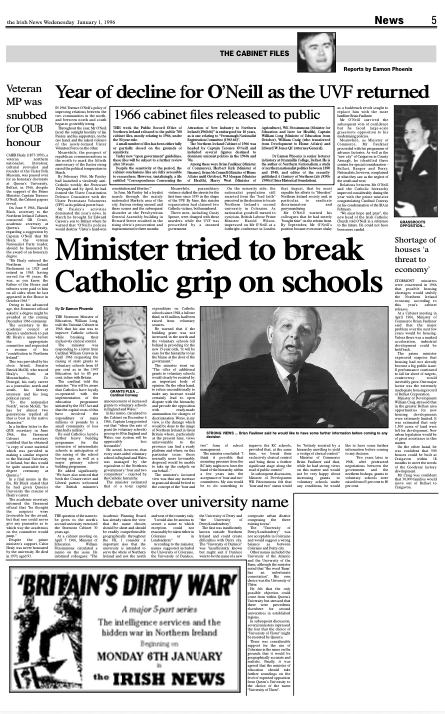
1966 cabinet files released to public
THIS week the Public Record Office of Northern Ireland released to the public 700 cabinet files, mostly relating to 1966, under the 30-year rule.
A small number of files has been either fully or partially closed on the grounds of sensitivity.
Under new “open government” guidelines, these files will be subject to a further review after 10 years.
Despite the sensitivity of the period, the cabinet conclusions files are fully accessible to researchers.
However, tantalisingly, a file entitled “Correspondence Concerning the Attraction of New Industry to Northern Ireland (1960-66)” is embargoed for 10 years, as is one relating to “Fermanagh Nationalist Registration Committee (1965-66)”.
The Northern Ireland Cabinet of 1966 was headed by Captain Terence O’Neill and included several figures destined to dominate unionist politics in the 1960s and 70s.
Among these were Brian Faulkner (Minister of Commerce), Herbert Kirk (Minister of Finance), Brian McConnell (Minister of Home Affairs until October), WJ Morgan (Minister of Health), Harry West (Minister of Agriculture), WK Fitzsimmons (Minister for Education and later for Health), Captain William Long (Minister of Education from October), William Craig (who transferred from Development to Home Affairs) and Edward W Jones QC (Attorney-General).
UK Govt ‘tried to force O’Neill into reforms’
DRAMATIC new evidence of British Labour government efforts to force the O’Neill government to introduce radical reforms is revealed in confidential files just released by the Public Record Office in Belfast.
It is clear that the unionist government regarded the threat of Westminster intervention as very real in 1966.
On August 5, 1966, the prime minister, Captain O’Neill, had a lengthy private meeting at Whitehall with Mr Harold Wilson, the British prime minister, and the Home Secretary, Roy Jenkins.
According to a report of the meeting furnished to the Stormont cabinet by Captain O’Neill:
“The discussion centred largely upon Paisleyism, its origins, present strength, financial resources and the measures taken to combat its violent tendencies. Captain O’Neill emphasised the extent to which the 1916 Rising celebrations had contributed to its present upsurge of support. Mr Wilson said that the Northern Ireland government had handled a difficult and delicate situation at Easter very well.”
Mr Wilson referred to the considerable number of Labour back-benchers who were uneasy about certain aspects of Northern Ireland affairs. In this they were supported by the Liberals and, indeed, by some elements of the Conservative Party.
As back-benchers became more restive during the middle of the government’s term of office, there was every expectation, the British prime minister warned, that the pressure for changes in Northern Ireland would grow and could well become irresistible.
It was necessary, therefore, that recent progress in Northern Ireland towards a more liberal atmosphere should continue and that a real effort should be made to meet some of the grievances which had been expressed — otherwise, Westminster would be forced to act.
Captain O’Neill explained the steps he had taken since becoming prime minister to bring about an atmosphere of reconciliation between opposing sections of the Northern Ireland community.
This was a necessary prerequisite to any concrete action of the kind contemplated at Westminster. Unfortunately, the 1916 celebrations had led to great disquiet among some elements of the Protestant community and there was a severe backlash which made it politically impossible to make further moves.
Captain O’Neill argued that it would be disastrous if Westminster were to intervene — indeed, to do so would be to invite a revival of the spirit and policies of 1912. However, the Home Secretary disputed the historical analogy, saying that in 1912 the issue was a refusal to be put out of the UK while in 1966 it was a question of Westminster assuming more direct responsibility.
The Home Secretary said it was important that any “pause” in the reform process should be of short duration. It would be most unfortunate if a temporary halt should be seen as a victory for the extremists.
Captain O’Neill told his colleagues that Mr Jenkins returned to this theme, emphasising that a return to unenlightened policies could mean Westminster “taking over.”
The question of discrimination in housing was raised by Mr Wilson with an inquiry on the steps that could be taken to remove complaints.
Year of decline for O’Neill as the UVF returned
IN 1966 Terence O’Neill’s policy of improving relations between the two communities in the north, and between north and south began to go terribly wrong.
Throughout the year, Mr O’Neill faced the outright hostility of Ian Paisley and his supporters, on the one hand, and the naked violence of the newly-formed Ulster Volunteer Force on the other
Meanwhile, the prospect of republican commemorations in the north to mark the fiftieth anniversary of the Easter rising raised the political temperature in March.
By February 1966, Mr Paisley had launched a virulently anti-Catholic weekly, the Protestant Telegraph and by April, he had formed the Ulster Constitution Defence Committee with the Ulster Protestant Volunteers (UPV) as its political power base.
Mr Paisley’s activities dominated the year’s news. In March he brought Sir Edward Carson’s son to Belfast where he warned that “O’Neill’s policies would destroy ‘Ulster’s hard-won constitution and liberties.”
In June, Mr Paisley led a loyalist march through the mainly nationalist Markets area of the city. Serious rioting ensued and these scenes and the subsequent disorder at the Presbyterian General Assembly building in Howard Street resulted in the rising cleric’s prosecution and imprisonment for three months.
Meanwhile, paramilitary violence stalked the streets for the first time since 1935 in the shape of the UVF. By June, this sinister organisation had claimed two Catholic victims, both murdered.
Three men, including Gusty Spence, were charged with these murders while the UVF was proscribed by a stunned government.
On the minority side, the nationalist population still smarted from the “bad faith” perceived in the decision to locate Northern Ireland’s second university in Coleraine.
As nationalist goodwill turned to cynicism, British Labour Prime Minister Harold Wilson, impressed on Mr O’Neill at a forthright conference in London that August, that he must expedite his efforts to “liberalise” Northern Ireland society and, in particular, to eradicate discrimination and gerrymandering.
Mr O’Neill warned his colleagues that he had merely ‘bought time” on the reform front By September, Mr O’Neill’s position became even more shaky as a backbench revolt sought to replace him with the more hardline Brian Faulkner.
Mr O’Neill survived the subsequent vote of confidence but he faced large-scale grassroots opposition to his modernising policies.
Meanwhile, as Minister of Commerce, Mr Faulkner proceeded with his programme of advance factories. As well as the “new city” of Craigavon in County Armagh, he identified three centres for special consideration – Belfast, Bangor and Derry. Nationalists, however complained at what they saw as the neglect of the south and west.
Relations between Mr O’Neill and the Catholic hierarchy improved considerably during the year with the prime minister congratulating Cardinal Conway on his condemnation of the IRA in February.
“We must hope and pray”, the new head of the Irish Catholic Church told O’Neill in a reference to the future. He could not have been more candid.
Minister tried to break Catholic grip on schools
THE Stormont Minister of Education, William Long, told the Unionist Cabinet in 1966 that his aim was to improve Catholic schools while breaking their exclusively clerical control.
The minister was responding to a letter from Cardinal William Conway in April 1966 requesting the raising of state grants to voluntary schools from 65 per cent as in the 1947 Education Act to 85 per cent, in line with Britain.
The cardinal told the minister: “You will be aware that Catholics have loyally co-operated with the implementation of the education programme initiated by the 1947 Act and that the capital costs of this have involved the expenditure of many millions of pounds by a small community of less than half a million.”
He said Catholics faced a further heavy building programme for the extension of intermediate schools in anticipation of the raising of the school leaving age, as well as a major primary school building programme.
He added significantly: “We have also noticed that both the Conservative and Liberal parties welcomed the British minister’s announcement of increased grants to voluntary schools in England and Wales.”
In his memo, circulated to the Cabinet on December 6 1966, Captain Long pointed out that “when the rate of grant (to voluntary schools) goes up to 80 in England and Wales, our system will be appreciably less favourable”.
He noted, however, that every state-aided voluntary school in England and Wales was managed by the equivalent of the Northern government’s “four and two committees” – rejected by the Catholic hierarchy.
The minister estimated that of a total capital expenditure on Catholic schools since 1948, a full one third, or £6 million, had been raised from voluntary sources.
He warned that if the building grant was not increased in the north and the voluntary schools fell behind in providing for the new 15-year-olds, “it will be easy for the hierarchy to lay the blame at the door of the government.”
The minister went on: “The offer of additional grants to voluntary schools would clearly be resisted by an important body of opinion. On the other hand, to refuse unconditionally to make any increase would certainly lead to open dispute with the hierarchy and provide the opposition with ready-made ammunition for charges of discrimination.
“Worse, in my view, is the damage which would be done to the image of Northern Ireland in Great Britain where, particularly at the present time, views unfavourable to the province can find a ready platform and where, on this particular issue, those normally more favourably disposed would be unable to take up the cudgels on our behalf…”
The minister’s favoured view was that any increase in grant aid should be tied to the concept of the “four and two” form of school management.
The minister concluded: “I think it possible that mounting pressure from the RC laity might now force the hand of the hierarchy within a few years into the acceptance of ‘four and two’ committees.
“My aim would be to do something to improve the RC schools, provided that, at the same time, we break their exclusively clerical control and bring them a further significant stage along the road of public control.”
In subsequent discussion, Minister of Development WK Fitzsimmons felt that “four and two” status would be “bitterly resisted by a hierarchy unwilling to yield a vestige of clerical control.”
Minister of Commerce Brian Faulkner said that, while he had strong views on this matter and would not be very happy about increasing grants to voluntary schools under any conditions, he would like to have some further information before coming to any decision.
Two years later, in 1968, after protracted negotiations between the government and the northern bishops, grants to voluntary schools were raised from 65 per cent to 80 per cent.
Much debate over university name
THE question of the name to be given to the north’s second university exercised the Stormont Cabinet 30 years ago.
At a cabinet meeting on April 7 1966, Minister of Education William
Fitzsimmons circulated a memo on the issue. He informed colleagues: “The
Academic Planning Board has already taken the view that the name chosen should be short and should be readily comprehensible geographically throughout the UK. I consider it important also that the university is intended to serve the whole of Northern Ireland and not the north and west of the country only.
“I would also be anxious to secure a name to which exception could not reasonably be taken either in Coleraine or in Londonderry.”
According to the minister, names suggested included the University of Coleraine, the University of Dunluce, the University of Derry and “the University of Derry/Londonderry”.
The first was insufficiently known outside Northern Ireland and could create difficulties with Derry city. The “University of Dunluce” was “insufficiently known but might suit if Dunluce were to be the name of a new composite urban district comprising the three existing towns”.
The “University of Derry/Londonderry” was not acceptable in Coleraine and would suggest a wrong balance as between Coleraine and Derry city.
Other names included the University of the Atlantic.
MP was snubbed for QUB honour
CAHIR Healy (1877-1970), a veteran northern nationalist, literateur, cultural revivalist and founder of the Ulster Folk Museum, was passed over for an honorary doctorate at Queen’s University, Belfast, in 1966, despite the support of the Prime Minister, Captain Terence O’Neill, the Cabinet papers reveal.
On June 9 1966, Harold Black, secretary to the Northern Ireland Cabinet, contacted GR Cowie, academic secretary at Queen’s University, regarding a suggestion by Captain O’Neill that Mr Healy, the veteran Nationalist Party leader, should be honoured by the award of an honorary degree.
“Mr Healy entered the Northern Ireland Parliament in 1925 and retired in 1965, having served for 40 years. He was, as you know, the Father of the House and tributes were paid to him on all sides when he last appeared in the House in October 1965.
Shortage of houses a threat to economy’
STORMONT ministers were concerned in 1966 that possible housing shortages would stultify the Northern Ireland economy, according to this year’s cabinet releases.
At a Cabinet meeting in April 1966, Minister of Commerce Brian Faulkner said that the major problem over the next few years would be housing. Unless there was a marked acceleration, industrial development could be held back.
The prime minister expressed surprise that housing had not already become a big public issue. If performance continued to fall far short of targets, controversy would inevitably grow. One major factor was the extremely inadequate housing record of Belfast Corporation.
Minister of Development William Craig stressed that in the greater Belfast area opportunities for new housing developments were extremely limited. It was estimated that only 1,500 acres of land were left for development. New urban legislation would be of great assistance in this matter.
On the other hand, he was confident that 500 houses could be built at Craigavon within 18 months to meet the needs of the Goodyear factory development.
Mr Craig was confident that 30,000 families would move out of Belfast to Craigavon.