

1964 State Papers (page 1)
January 02 1995
Publication Date
London shies from civil rights issue, O'Neill sets tone with bold economic plan, Cabinet Step to Recognise ICTU,
State Paper Snippet
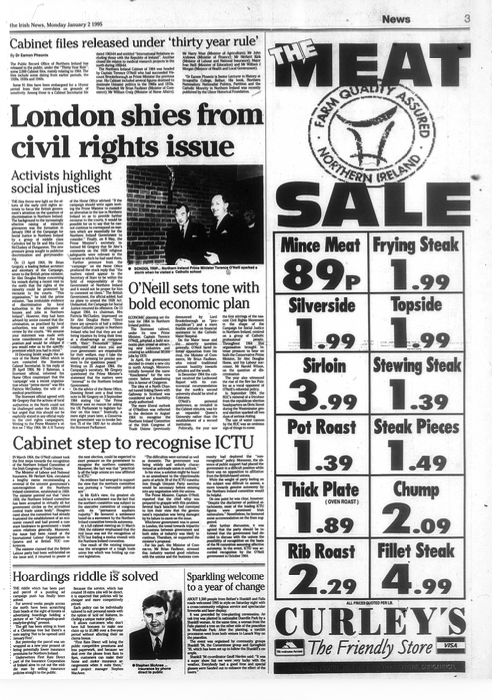
Cabinet files released under ‘Thirty Year Rule’
THE Public Record Office of Northern Ireland has released to the public, under the “Thirty Year Rule”, some 2,000 Cabinet files, mainly relating to 1964. The files include some dating from earlier periods, the 1920s, 1930s and 1940s.
Some 91 files have been embargoed for a 10-year period from their cover dates on grounds of sensitivity. Among these is a Cabinet Secretariat file dated 1963-64 and entitled “International Relations including those with the Republic of Ireland.” Another closed file relates to medical research projects in the North during 1959-64.
The Northern Ireland Cabinet of 1964 was headed by Captain Terence O’Neill who had succeeded Viscount Brookeborough as Prime Minister the previous year.
His Cabinet included several figures destined to dominate Unionist politics in the 1960s and 1970s. These included: Mr Brian Faulkner (Minister of Commerce); Mr William Craig (Minister of Home Affairs); Mr Harry West (Minister of Agriculture); Mr John Andrews (Minister of Finance); Mr Herbert Kirk (Minister of Labour and National Insurance); Major Ivan Neill (Minister of Education); and Mr William J. Morgan (Minister of Health and Local Government).
– Dr Eamon Phoenix is Senior Lecturer in History at Stranmillis College, Belfast. His book, Northern Nationalism: Nationalist Politics, Partition and the Catholic Minority in Northern Ireland, was recently published by the Ulster Historical Foundation.
London shies from civil rights issue
THE files throw new light on the efforts of the early civil rights activists to focus the British government’s attention on the question of discrimination in Northern Ireland. The background to the increasingly effective raising of minority grievances was the formation in January 1964 of the Campaign for Social Justice in Northern Ireland by a group of middle class Catholics led by Dr and Mrs. Conn McCluskey of Dungannon. The new pressure group sought to publicise discrimination and gerrymandering.
On 13 April 1964, Mr Brian Gregory, a leading Belfast architect and secretary of the Campaign, wrote to the British Prime Minister, Sir Alec Douglas Home, concerning his remark during a recent visit to the North that the rights of the minority could be protected by recourse to the courts. “This organisation,” he told the Prime Minister, “has irrefutable evidence of discrimination by local authorities in the allocation of houses and jobs in Northern Ireland.”
However, they had been advised by senior counsel that discrimination, as practised by local authorities, was not capable of review by the courts. “We assume your statement was made with some consideration of the legal position and would be obliged if you would refer us to the specific provision which you had in mind.”
10 Downing Street sought the advice of the Home Office which in turn contacted the Stormont Cabinet Secretariat. In his reply of 29 April 1964, Mr J. Bateman, a Stormont official, informed his Home Office counterpart that the campaign was a recent organisation who’s “prime mover” was Mrs. Patricia McCluskey, the wife of a medical practitioner.
The Stormont official agreed with Mr Gregory that the actions of local authorities in the North could not be challenged under the 1920 Act, but urged that this should not be explicitly stated in any official reply to the civil rights campaigners.
Writing to the Prime Minister’s office on 7 May 1964, Mr A. H. Turney of the Home Office advised: “If the campaign should write again inviting the Prime Minister to consider an alteration in the law in Northern Ireland so as to provide further recourse to the courts, it would be possible for us to say that he cannot continue to correspond on matters which are essentially for the Northern Ireland Government to consider.
“Finally, on 8 May, the Prime Minister’s secretary informed Mr Gregory that Sir Alec’s comments on the 1920 religious safeguards were relevant in the context in which he had used them.
Further pressure from the Campaign on the Home Office produced the stock reply that “the matters raised appear to the Secretary of State to be within the field of responsibility of the Government of Northern Ireland and it would not be proper for him to comment on them.” The British Government, the official added, had no plans to amend the 1920 Act. Undaunted, the Campaign for social Justice resumed its offensive. On 13 August 1964, its chairman, Mrs. Patricia McCluskey, impressed on Sir Alec Douglas Home: “Since there are upwards of half a million Roman Catholic people in Northern Ireland who feel that they are suffering injustice by living their lives at a disadvantage as compared with their Protestant fellow countrymen, and since you and your government are responsible for their welfare, may I take the liberty of pressing for precise answers to the questions posed.”
Writing as Campaign secretary, Mr Gregory questioned the Prime Minister’s statement that the matters were “internal” to the Northern Ireland Government.
On 25 August 1964, on the advice of the Home Office, Downing Street sent a final terse note to Mr Gregory on 3 September 1964 stating that “the Prime Minister sees no reason for asking the UK Parliament to legislate further on this issue.” Ironically, a mere eight years later, a Conservative government was to invoke Section 75 of the 1920 Act to abolish the Stormont Parliament.
O’Neill sets tone with bold economic plan
ECONOMIC planning set the tone for 1964 in Northern Ireland politics.
The Stormont Cabinet, under its new Prime Minister, Captain Terence O’Neill, adopted a bold economic plan aimed at attracting new industries and creating an additional 30,000 jobs by 1970.
In April, the government decided to create a new city in North Armagh. Ministers initially favoured the name “Knockmena” for the new Centre before abandoning this in favour of Craigavon.
The idea of a North Channel tunnel linking Down with Galloway in Scotland was considered and a feasibility study authorised.
The more liberal outlook of O’Neillism was reflected in the decision in August 1964 to recognise the Northern Ireland Committee of the Irish Congress of Trade Unions (previously denounced by Lord Brookeborough as “pro-republican”) and a more flexible attitude on financial assistance to the Catholic Mater Hospital.
On the Mater issue and the minority question generally, O’Neill faced internal opposition from his rival, the Minister of Commerce, Mr Brian Faulkner, who voiced traditional Unionist hostility towards Catholics and the South.
In December 1964, the Cabinet received the Lockwood Report with its controversial recommendation that the North’s second university should be sited at Coleraine.
O’Neill’s personal preference, as revealed in the Cabinet minutes, was for an expanded Queen’s University rather than the establishment of a second institution.
Politically, the year saw the first stirrings of the nascent Civil Rights Movement in the shape of the Campaign for Social Justice in Northern Ireland, centred on a group of Catholic professional people. Throughout 1964 this organisation brought intense pressure to bear on both the Conservative Prime Minister, Sir Alec Douglas-Home, and his Labour successor, Mr Harold Wilson, on the question of discrimination.
The year also witnessed the rise of the Rev. Ian Paisley as a vocal opponent of O’Neill’s reformist policy.
In September 1964, the RUC’s removal of a tricolour from the republican election headquarters on Divis Street during the Westminster general election sparked off two days of serious rioting.
The use of water cannon by the RUC was an ominous sign of things to come.
Cabinet Step to Recognise ICTU
IN March 1964, the O’Neill cabinet took the first steps towards the recognition of the Northern Ireland Committee of the Irish Congress of Trade Unions.
The Minister of Labour and National Insurance, Mr Herbert Kirk, circulated a lengthy memo recommending a reversal of the unionist government’s non-recognition of the Northern Ireland committee, established in 1959. The minister pointed out that “since 1959, the Northern Ireland committee has been accepted in virtually all but government circles as the accredited central trade union body”.
Disagreement about the committee had already frustrated the establishment of an economic council and had proved a constant hindrance to government-trade union relations generally. Moreover, the issue had been raised at the International Labour Organisation in Geneva and at British TUC conferences.
The minister claimed that the British Labour party had been well-briefed on the issue and, if returned to power at the next election, could be expected to exert pressure on the government to recognise the Northern Committee. Moreover, the fact was that “practically all the large unions are now affiliated to ICTU.”
No evidence had emerged to support the view that the northern committee was pursuing a “nationalist political aim”.
In Mr Kirk’s view, the greatest obstacle to a settlement was the fact that the Northern Committee was subject to the executive committee of congress with its “permanent southern majority.” He favoured a settlement based on a movement by the Northern Ireland Committee towards autonomy.
At a full Cabinet meeting on 11 March 1964, the Minister emphasised that the real issue was not the recognition of ICTU but finding a modus vivendi with the Northern Ireland committee.
One result of the existing impasse was the emergence of a tough trade union line which was holding up current legislation.
“The difficulties were national as well as domestic. The government was being widely and unfairly characterised as anti-trade union in outlook.”
In his view, a solution might be found in an amendment to the objectionable parts of article 39 of the ICTU constitution though Unionist Party sanction would be necessary before entering into any negotiation with the unions.
The Prime Minister, Captain O’Neill, reported that the chief whip was prepared to grapple with this problem. Several backbenchers had conveyed to him their view that the government’s reputation was being damaged by its failure to move on the issue.
Whichever government was in power in London, the trend towards tripartite discussions between government and both sides of industry was likely to continue. Therefore, he supported the Minister’s proposal.
For his part, the Minister of Commerce, Mr Brian Faulkner, stressed that industry wanted good relations with the unions and the business community had deplored the “non-recognition” policy. Moreover, the absence of public support had placed the government in a difficult position while there was no opposition to affiliation from the British-based unions.
While the weight of party feeling on the subject was difficult to assess, a move towards genuine autonomy by the Northern Ireland committee would be helpful.
On one point he was clear, however. “Despite the disclaimer of political attachments, most of the leading ICTU figures were prominent Irish nationalists.” Nonetheless, he favoured some accommodation on the lines suggested.
After further discussion, it was agreed that the party should be informed that the government had decided to discuss with the unions the possibility of recognition on the basis of the NI committee assuming effective autonomy. In the event, ICTU was accorded recognition by the O’Neill government in October 1964.