

1962 State Papers (page 1)
January 01 1993
Publication Date
1962 Cabinet secrets, Cardinal's plan for federal Ireland, Protests at unity 'slight' by an African official, Grievances failed to sway Britain, Worry over 'sacrifice' of entry to the EEC
State Paper Snippet
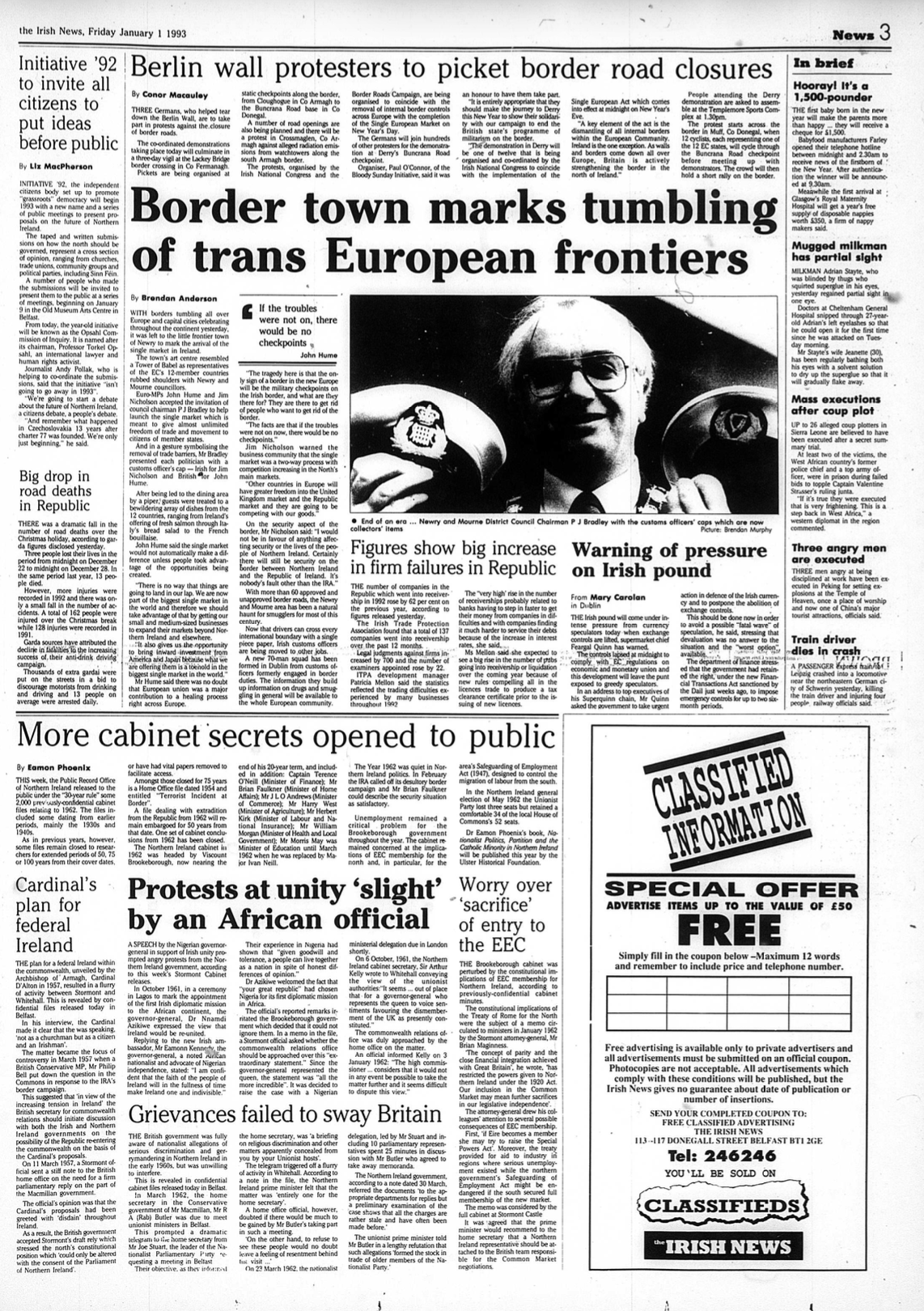
More Cabinet Secrets Opened to Public
This week, the Public Record Office of Northern Ireland released to the public under the “30-year rule” some 2,000 previously confidential Cabinet files relating to 1962. The files included some dating from earlier periods, mainly the 1930s and 1940s.
As in previous years, however, some files remain closed to researchers for extended periods of 50, 75 or 100 years from their cover dates, or have had vital papers removed to facilitate access.
Amongst those closed for 75 years is a Home Office file dated 1954 and entitled “Terrorist Incident at Border.”
A file dealing with extradition from the Republic from 1962 will remain embargoed for 50 years from that date. One set of cabinet conclusions from 1962 has been closed.
The Northern Ireland cabinet in 1962 was headed by Viscount Brookeborough, now nearing the end of his 20-year term, and included in addition: Captain Terence O’Neill (Minister of Finance); Mr. Brian Faulkner (Minister of Home Affairs); Mr. J.L.O. Andrews (Minister of Commerce); Mr. Harry West (Minister of Agriculture); Mr. Herbert Kirk (Minister of Labour and National Insurance); Mr. William Morgan (Minister of Health and Local Government); Mr. Morris May was Minister of Education until March 1962 when he was replaced by Major Ivan Neill.
The year 1962 was quiet in Northern Ireland politics. In February the IRA called off its desultory border campaign and Mr. Brian Faulkner could describe the security situation as satisfactory.
Unemployment remained a critical problem for the Brookeborough government throughout the year. The Cabinet remained concerned at the implications of EEC membership for the North and, in particular, for the area’s Safeguarding of Employment Act (1947), designed to control the migration of Labour from the South.
In the Northern Ireland general election of May 1962, the Unionist Party lost three seats but retained a comfortable 34 of the local House of Commons’s 52 seats.
Dr. Eamon Phoenix’s book, Nationalist Politics, Partition and the Catholic Minority in Northern Ireland, will be published this year by the Ulster Historical Foundation.
Cardinal’s Plan for Federal Ireland
THE plan for a federal Ireland within the Commonwealth, unveiled by the Archbishop of Armagh, Cardinal D’Alton, in 1957, resulted in a flurry of activity between Stormont and Whitehall. This is revealed by confidential files released today in Belfast.
In his interview, the Cardinal made it clear that he was speaking “not as a churchman but as a citizen and an Irishman.”
The matter became the focus of controversy in March 1957 when a British Conservative MP, Mr. Philip Bell, put down a question in the Commons in response to the IRA’s border campaign.
This suggested that “in view of the increasing tension in Ireland, the British Secretary for Commonwealth Relations should initiate discussion with both the Irish and Northern Ireland governments on the possibility of the Republic re-entering the Commonwealth on the basis of the Cardinal’s proposals.”
On 11 March 1957, a Stormont official sent a stiff note to the British Home Office on the need for a firm parliamentary reply on the part of the Macmillan government.
The official’s opinion was that the Cardinal’s proposals had been greeted with “disdain” throughout Ireland.
As a result, the British government accepted Stormont’s draft reply, which stressed the North’s constitutional position, which “could only be altered with the consent of the Parliament of Northern Ireland.”
Protests at Unity ‘Slight’ by an African Official
A speech by the Nigerian Governor General in support of Irish unity prompted angry protests from the Northern Ireland government, according to this week’s Stormont Cabinet releases.
In October 1961, in a ceremony in Lagos to mark the appointment of the first Irish diplomatic mission to the African continent, the Governor General, Dr. Nnamdi Azikiwe, expressed the view that Ireland would be re-united.
Replying to the new Irish ambassador, Mr. Eamonn Kennedy, the Governor General, a noted African nationalist and advocate of Nigerian independence, stated: “I am confident that the faith of the people of Ireland will, in the fullness of time, make Ireland one and indivisible.”
Their experience in Nigeria had shown that “given goodwill and tolerance, a people can live together as a nation in spite of honest differences of opinion.”
Dr. Azikiwe welcomed the fact that “your great republic” had chosen Nigeria for its first diplomatic mission in Africa.
The official’s reported remarks irritated the Brookeborough Government, which decided that it could not ignore them. In a memo in the file, a Stormont official asked whether the Commonwealth Relations Office should be approached over this “extraordinary statement.” Since the Governor-General represented the Queen, the statement was “all the more incredible.” It was decided to raise the case with a Nigerian ministerial delegation due in London shortly.
On 6 October 1961, the Northern Ireland Cabinet Secretary, Sir Arthur Kelly, wrote to Whitehall conveying the view of the Unionist authorities: “It seems… out of place that for a Governor-General who represents the Queen to voice sentiments favouring the dismemberment of the UK as presently constituted.”
The Commonwealth Relations Office was duly approached by the Home Office on the matter.
An official informed Kelly on 3 January 1962: “The High Commissioner… considers that it would not in any event be possible to take the matter further and it seems difficult to dispute this view.”
Grievances Failed to Sway Britain
THE British government was fully aware of nationalist allegations of serious discrimination and gerrymandering in Northern Ireland in the early 1960s, but was unwilling to interfere.
This is revealed in confidential Cabinet files released today in Belfast.
In March 1962, the Home Secretary in the Conservative government of Mr. Macmillan, Mr. R. A. (Rab) Butler, was due to meet Unionist Ministers in Belfast.
This prompted a dramatic telegram to the Home Secretary from Mr. Joe Stuart, the leader of the Nationalist Parliamentary Party, requesting a meeting in Belfast.
Their objective, as they informed the Home Secretary, was a briefing on religious discrimination and other matters “apparently concealed from you by your Unionist hosts.”
The telegram triggered off a flurry of activity in Whitehall. According to a note in the file, the Northern Ireland Prime Minister felt that the matter was entirely one for the Home Secretary.
A Home Office official, however, doubted if there would be much to be gained by Mr. Butler’s taking part in such a meeting.
“On the other hand, to refuse to see these people would no doubt leave a feeling of resentment behind the visit.”
On 23 March 1962, the Nationalist delegation, led by Mr. Stuart and including 10 parliamentary representatives, spent 25 minutes in discussion with Mr. Butler, who agreed to take away memoranda.
The Northern Ireland government, according to a note dated 30 March, referred the documents to the appropriate departments for replies, but “a preliminary examination of the case shows that all the charges are rather stale and have often been made before.”
The Unionist Prime Minister told Mr. Butler in a lengthy refutation that such allegations formed “the stock in trade of older members of the Nationalist Party.”
Worry Over ‘Sacrifice’ of Entry to the EEC
The Brookeborough Cabinet was perturbed by the constitutional implications of EEC membership for Northern Ireland, according to previously confidential cabinet minutes.
The constitutional implications of the Treaty of Rome for the North were the subject of a memo circulated to ministers in January 1962 by the Stormont Attorney-General, Mr. Brian Maginness.
“The concept of parity and the close financial integration achieved with Great Britain,” he wrote, “has restricted the powers given to Northern Ireland under the 1920 Act. Our inclusion in the Common Market may mean further sacrifices in our legislative independence.”
The Attorney-General drew his colleagues’ attention to several possible consequences of EEC membership.
First, “if Éire becomes a member she may try to raise the Special Powers Act. Moreover, the treaty provided for aid to industry in regions where serious unemployment existed, while the Northern government’s Safeguarding of Employment Act might be endangered if the South secured full membership of the new market.”
The memo was considered by the full cabinet at Stormont Castle. It was agreed that the Prime Minister would recommend to the Home Secretary that a Northern Ireland representative should be attached to the British team responsible for the Common Market negotiations.