

1961 State Papers (page 3)
January 03 1992
Publication Date
British mission thought partition line ‘refreshing’, Lemass ‘a realist’ according to Home Office note, Lay-offs at shipyard pose a political threat, Brookeborough tells Whitehall, Unionists slate journalist, Ministry analyses IRA border attacks
State Paper Snippet
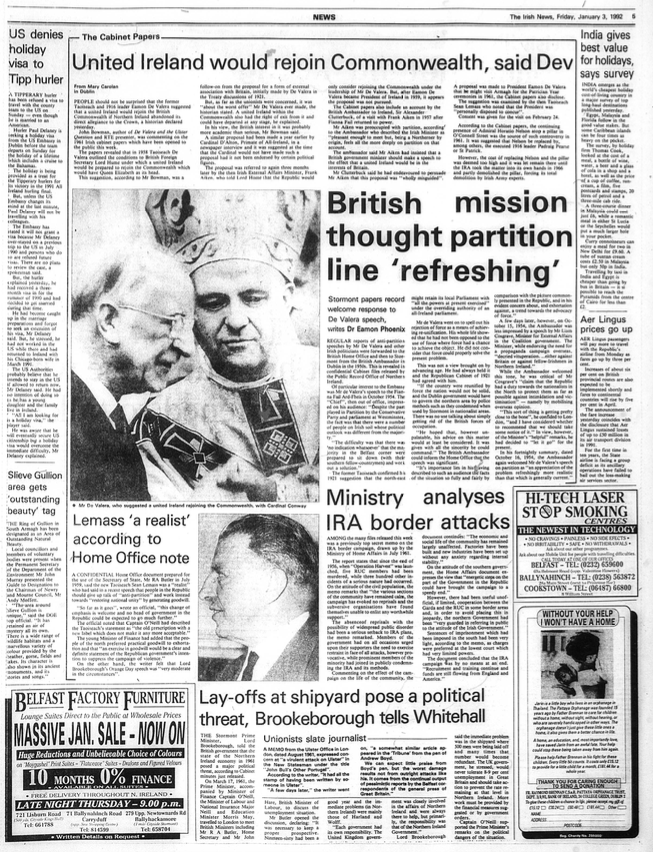
British mission thought partition line ‘refreshing’
Stormont papers record welcome response to De Valera speech, writes Dr Eamon Phoenix
REGULAR reports of anti-partition speeches by Mr De Valera and other Irish politicians were forwarded to the British Home Office and then to Stormont from the British Ambassador in Dublin in the 1950s. This is revealed in confidential Cabinet files released by the Public Record Office of Northern Ireland.
Of particular interest to the Embassy was Mr De Valera’s speech to the Fianna Fail Ard-Fheis in October 1954. The “Chief”, then out of office, impressed on his audience: “Despite the part played in Partition by the Conservative Party and Parliament at Westminster, the fact was that there were a number of people on Irish soil whose political outlook was different from the majority.”
“The difficulty was that there was ‘no indication whatsoever’ that the majority in the Belfast corner were prepared to sit down (with their southern fellow-countrymen) and work out a solution.”
The former Taoiseach confirmed his 1921 suggestion that the North-east might retain its local Parliament with “all the powers at present exercised” under the overriding authority of an all-Ireland parliament.
Mr De Valera went on to spell out his rejection of force as a means of achieving re-unification. His whole life showed that he had not been opposed to the use of force where force had a chance to achieve the object. He did not consider that force could properly solve the present problem.
This was not a view brought on by advancing age. He had always held it, and the Republican Cabinet of 1921 had agreed with him.
“If the country were reunified by force, the nation would not be solid, and the Dublin government would have to govern the Northern area by police methods such as they condemned when used by Stormont in nationalist areas. There was no use talking about simply getting rid of the British forces of occupation.
“He hoped that, however unpalatable, his advice on this matter would at least be considered. It was given with all the sincerity he could command. “The British Ambassador could inform the Home Office that the speech was significant.
“Its importance lies in his having described to such an audience the facts of the situation so fully and fairly by comparison with the picture commonly presented in the Republic, and in his evident concern about, and exhortation against, a trend towards the advocacy of force.”
A few days later, however, on October 15, 1954, the Ambassador was less impressed by a speech by Mr Liam Cosgrave, Minister for External Affairs in the Coalition government. The Minister, while endorsing the need for a propaganda campaign overseas, “decried vituperation… either against Britain or against fellow-Irishmen in Northern Ireland.”
While the Ambassador welcomed this tone, he was critical of Mr Cosgrave’s “claim that the Republic had a duty towards the nationalists in the North to protect them as far as possible against intimidation and victimisation”—namely by mobilising overseas opinion.
“This sort of thing is getting pretty close to the bone,” he confided to London, “and I have considered whether to recommend that we should take some notice of it.” In view, however, of the Minister’s “helpful” remarks, he had decided to “let it go” for the present.
In his fortnightly summary, dated October 16, 1954, the Ambassador again welcomed Mr De Valera’s speech on partition as “an appreciation of the problem refreshingly more realistic than that which is generally current.”
Lemass ‘a realist’ according to Home Office note
A CONFIDENTIAL Home Office document prepared for the use of the Secretary of State, Mr R. A. Butler, in July 1959, said the new Taoiseach, Sean Lemass, was a “realist” who had said in a recent speech that people in the Republic should give up talk of “anti-partition” and work instead towards “restoring national unity” by generating goodwill.
“So far as it goes,” wrote an official, “this change of emphasis is welcome, and no head of government in the Republic could be expected to go much further.”
The official noted that Captain O’Neill had described the Taoiseach’s statement as “the old prescription with a new label which does not make it any more acceptable.”
The young Minister of Finance had added that the people of the North preferred practical goodwill to exhortation and that “an exercise in goodwill would be a clear and definite statement of the Republican government’s intention to suppress the campaign of violence.”
On the other hand, the writer felt that Lord Brookeborough’s Orange Day speech was “very moderate in the circumstances.”
Lay-offs at shipyard pose a political threat, Brookeborough tells Whitehall
THE Stormont Prime Minister, Lord Brookeborough, told the British Government that the state of the Northern Ireland economy in 1961 posed a major political threat, according to Cabinet minutes just released.
On March 17, 1961, the Prime Minister, accompanied by Minister of Finance Captain O’Neill, the Minister of Labour and National Insurance Major Neill, and Education Minister Morris May, travelled to London to meet British Ministers including Mr R. A. Butler, Home Secretary, and Mr John Hare, British Minister of Labour, to discuss the unemployment situation.
Mr Butler opened the discussion, declaring: “It was necessary to keep a proper perspective. Nineteen-sixty had been a good year and the immediate problems (in Northern Ireland) were mainly those of Harland and Wolff.
“Each government had its own responsibility. The United Kingdom Government was closely involved in the affairs of Northern Ireland and were always there to help, but primarily, the responsibility was that of the Northern Ireland Government.”
Lord Brookeborough said the immediate problem was in the shipyard, where 500 men were being laid off and many times that number would become redundant. The UK Government, he stressed, would never tolerate 8–9 per cent unemployment in Great Britain and should take action to prevent the rate remaining at that level in Northern Ireland. More work must be provided by the financial measures suggested or by government orders.
Captain O’Neill supported the Prime Minister’s remarks on the political dangers of the situation.
Unionists slate journalist
A MEMO from the Ulster Office in London, dated August 1961, expressed concern at “a virulent attack on Ulster” in the New Statesman under the title John Bull’s Other Portugal.
According to the writer, “It had all the stamp of having been written by someone in Ulster.”
“A few days later,” the writer went on, “a somewhat similar article appeared in the Tribune from the pen of Andrew Boyd.
We can expect little praise from Boyd’s pen, but the worst damage results not from outright attacks like his. It comes from the continual output of pessimistic reports by the Belfast correspondents of the general press of Great Britain.”
Ministry analyses IRA border attacks
AMONG the many files released this week was a previously top secret memo on the IRA border campaign, drawn up by the Ministry of Home Affairs in July 1961.
The report states that since the end of 1956, when “Operation Harvest” was launched, five RUC members had been murdered, while three hundred other incidents of a serious nature had occurred. On the attitude of the civil population, the memo remarks that “the various sections of the community have remained calm, the campaign has evoked no reprisals, and the subversive organisations have found themselves unable to enlist any worthwhile support.”
The absence of reprisals, with the possibility of widespread public disorder, had been a serious setback to IRA plans, the memo remarked. Members of the government had on all occasions urged upon their supporters the need to exercise restraint in face of all attacks, however provocative, while prominent members of the minority had joined in publicly condemning the IRA and its methods.
Commenting on the effect of the campaign on the life of the community, the document continues: “The economic and social life of the community has remained largely unaffected. Factories have been built and new industries have been set up without any anxiety regarding internal stability.”
On the attitude of the Southern government, the Home Affairs document expresses the view that “energetic steps on the part of the Government in the Republic could have brought the campaign to a speedy end.”
However, there had been useful unofficial, if limited, cooperation between the Garda and the RUC in some border areas and, in order to avoid placing this in jeopardy, the northern Government had been “very guarded in referring in public to the attitude of the Irish Government.”
Sentences of imprisonment which had been imposed in the South had been very light, according to the memo, as charges were preferred at the lowest court which had very limited powers.
The document concluded that the IRA campaign was by no means at an end. “Recruitment and training continue and funds are still flowing from England and America.”