

1961 State Papers (page 1)
January 01 1992
Publication Date
Kennedy victory scared Unionists, Appointee Rejected in Favour of a Catholic, 1961 documents released, The Stormont Cabinet 1961, Shipyard told 'no special treatment', Cross- border trade offer prompted political dilemma
State Paper Snippet
1961 documents released
Government documents which have been kept secret for the past 30 years have been opened to public scrutiny. Dr. Eamon Phoenix examines their importance and puts them in their historical context.
1961 was marked in the North by the continuation, at an increasingly desultory level, of the IRA border campaign, code-named “Operation Harvest.” Bereft of any real minority support, the campaign was to end abruptly in February 1962.
Despite the deaths of two RUC men during the year, Minister of Home Affairs Brian Faulkner was sufficiently confident in April to release the last batch of internees.
Unemployment remained high in the declining traditional industries. In the first nine months of 1961, 10,000 men were laid off in Belfast shipyard alone. Notwithstanding these difficulties and the closure of several major linen concerns, the Conservative government of Harold Macmillan firmly ruled out any hope of special treatment for the North’s ailing economy.
This year also saw the initiation of a major house-building programme designed to tackle a long-standing social problem.
On the political front, the Brookeborough Cabinet watched with some trepidation the accession of President John F. Kennedy to the White House, fearing a revival of the diplomatic campaign against Partition. At the same time, ministers considered the implications of any British entry into the Common Market for Northern Ireland’s constitutional position, expressing particular fears at proposals for the free movement of Labour.
The Stormont Cabinet
The Northern Ireland Cabinet in 1960 was headed by Viscount Lord Brookeborough (Prime Minister since 1943) and included in addition: Captain Terence O’Neill (Minister of Finance):Mr. Brian Faulkner (Minister of Home Affairs):Mr. J.L.O. Andrews (Minister of Commerce):Mr. Morris (Minister of Education):Mr. Harry West (Commencing Cabinet career as Minister of Agriculture):Mr. William Morgan (Minister of Health and Local Government) Major Ivan Neill (Minister of Labour and National Insurance).
Appointee Rejected in Favour of a Catholic
The hardline Stormont Minister of Home Affairs, Sir Dawson Bates, refused, in 1940, to uphold the appointment of a Protestant candidate to a medical position in Belfast Union Hospital.
His reason was that a rejected candidate, a leading Catholic doctor and MP for Queen’s University, was better qualified.
In July 1940, Sir Dawson wrote to the Prime Minister, Viscount Craigavon, explaining that the Commissioners at their recent meeting had appointed Dr. Reginald Hall to a vacant position in the Fever Department of the Union Hospital.
However, “when the papers in connection with Dr. Hall’s appointment were submitted to my Ministry for approval, it was realised that as Dr. Hall had qualified as recently as 1936, the Ministry would have some difficulty in standing over this appointment.”
Accordingly, the Commissioners were asked to submit the names and qualifications of the other applicants.
“Having carefully perused these,” Sir Dawson informed the Prime Minister, “the Ministry, without hesitation, came to the conclusion that the only suitable candidate was Dr. F. McSorley.”
As a result, the Minister summoned the Commissioners to Stormont where they were informed that he could not approve their recommendation.
In reply to the deputation’s claim that Dr. Hall had had a “brilliant” academic career, “we pointed out that for the vacant position we considered a person not only of brilliance but of experience should be appointed and, furthermore, Dr. Hall was a dermatologist and had no special qualification for this particular post.
“We also pointed out that Dr. McSorley had special qualifications in infectious disease, having obtained his MD degree… and that having these special qualifications it was very difficult for the Ministry to approve the appointment of Dr. Hall.”
In the upshot, the Minister arranged that the Commissioners should ask the appointee to withdraw his candidature. This, he told Craig, was “being done with the object of relieving the Ministry of any criticism of having had to turn down the advice of our officials.”
Dr. McSorley was duly appointed, but the post was to remain a contentious one long after his death. In 1959, the issue of ensuring at least one Catholic consultant at Belfast City Hospital (the former Union Hospital) was the subject of intense lobbying by the Irish Government and the Northern Nationalist Party.
On October 23, 1959, the creation of a vacancy for a consultant at the hospital was raised by the Irish Ambassador in London, Mr. McCann, in an interview with an official at the Commonwealth Relations Office in Downing Street.
According to a memo in Stormont Cabinet files, the ambassador referred to “a very delicate matter.” He explained that Dr. Kean, consultant at the Belfast City Hospital for some years, had just retired.
“Dr. Kean was the only Roman Catholic consultant in Belfast. He followed in this post Dr. McSorley, also a Roman Catholic. There is a strong Roman Catholic candidate to succeed Dr. Kean, namely Dr. Donaghy, a member of the Senate and a well-known practitioner. Roman Catholic circles in Belfast very much hope that he may be selected, but they have been disturbed by rumours that on this occasion a Protestant is likely to be chosen for the post.
“If this were to happen, there would be no Roman Catholic consultant in Belfast at all.” In these circumstances, Ambassador McCann explained, some of the Catholic community had appealed to the Irish Government “to make representations to Stormont” in the matter. “This, of course,” Mr. McCann said, “the Government could not do.”
The Irish Government felt, however, that “a private word” might “influence” the authorities in Belfast towards the selection of a Catholic for the post.
In conclusion, the ambassador expressed the hope that Whitehall would “fully understand the delicacy of his position; his Government certainly did not wish to be interfering in maters outside their proper sphere.”
A note of this discussion was forwarded by Sir Austin Strutt of the Home Office in Whitehall to A. J. Kelly, the Stormont Cabinet Secretary, on the same day.
The issue was raised at a private meeting between Lord Brookeborough and his Minister of Health and Local Government, Mr. J. L. O. Andrews, and a Nationalist deputation led by Senator J. G. Lennon and including Senator P. F. McGill, Mr. Cahir Healy, MP, Mr. Joe Stewart, MP, and Mr. Roderick O’Connor, MP.
The deputation “expressed their concern that the consultant post should be filled by a Roman Catholic and argued the claims of Dr. Donaghy.”
They added that “it would be most unfortunate if it were not filled by a co-religionist in view of the fact that only eight consultant posts out of a total of 470 were held by Roman Catholics.”
In conclusion, the Nationalists “stressed that their position as public representatives would become very difficult” if this particular appointment did not go to a Catholic.
The Minister of Health agreed, on the suggestion of Lord Brookeborough, to consider the points raised by the deputation.
A final note on the file dated February 1960 suggests that the Stormont government acceded to the Nationalists’ request; it reads simply:
“City Hospital: latest – Minister has dropped a hint to Hospital’s Authority.”
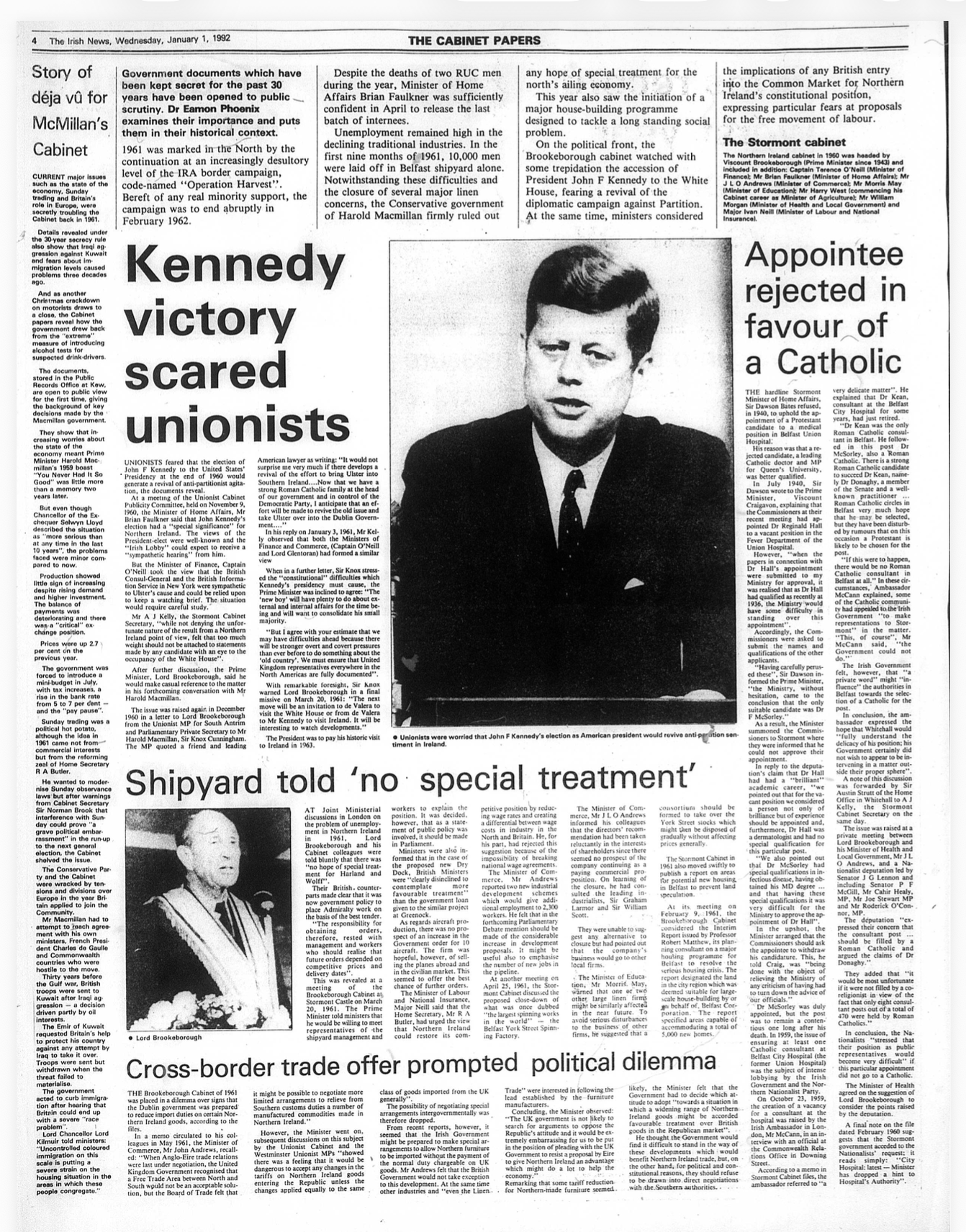
Kennedy Victory Scared Unionists
UNIONISTS feared that the election of John F. Kennedy to the United States Presidency at the end of 1960 would generate a revival of anti-partitionist agitation, the documents reveal.
At a meeting of the Unionist Cabinet Publicity Committee, held on November 9, 1960, the Minister of Home Affairs, Mr. Brian Faulkner, said that John Kennedy’s election had a “special significance” for Northern Ireland. The views of the President-elect were well known and the “Irish Lobby” could expect to receive a “sympathetic hearing” from him.
But the Minister of Finance, Captain O’Neill, took the view that the British Consul-General and the British Information Service in New York were sympathetic to Ulster’s cause and could be relied upon to keep a watching brief. The situation would require careful study.
Mr. A. J. Kelly, the Stormont Cabinet Secretary, “while not denying the unfortunate nature of the result from a Northern Ireland point of view, felt that too much weight should not be attached to statements made by any candidate with an eye to the occupancy of the White House.”
After further discussion, the Prime Minister, Lord Brookeborough, said he would make casual reference to the matter in his forthcoming conversation with Mr. Harold Macmillan.
The issue was raised again in December 1960 in a letter to Lord Brookeborough from the Unionist MP for South Antrim and Parliamentary Private Secretary to Mr. Harold Macmillan, Sir Knox Cunningham. The MP quoted a friend and leading American lawyer as writing: “It would not surprise me very much if there develops a revival of the effort to bring Ulster into Southern Ireland… Now that we have a strong Roman Catholic family at the head of our government and in control of the Democratic Party, I anticipate that an effort will be made to revive the old issue and take Ulster over into the Dublin Government…”
In his reply on January 3, 1961, Mr. Kelly observed that both the Ministers of Finance and Commerce (Captain O’Neill and Lord Glentoran) had formed a similar view.
When, in a further letter, Sir Knox stressed the “constitutional” difficulties which Kennedy’s presidency must cause, the Prime Minister was inclined to agree: “The ‘new boy’ will have plenty to do about external and internal affairs for the time being and will want to consolidate his small majority.
“But I agree with your estimate that we may have difficulties ahead because there will be stronger overt and covert pressures than ever before to do something about the ‘old country’. We must ensure that United Kingdom representatives everywhere in the North Americas are fully documented.”
With remarkable foresight, Sir Knox warned Lord Brookeborough in a final missive on March 20, 1961:
“The next move will be an invitation to de Valera to visit the White House or from de Valera to Mr. Kennedy to visit Ireland. It will be interesting to watch developments.”
The President was to pay his historic visit to Ireland in 1963.
Shipyard told ‘no special treatment’
At joint ministerial discussions in London on the problem of unemployment in Northern Ireland in 1961, Lord Brookeborough and his Cabinet colleagues were told bluntly that there was “no hope of special treatment for Harland and Wolff.”
Their British counterparts made clear that it was now government policy to place Admiralty work on the basis of the best tender.
“The responsibility for obtaining orders, therefore, rested with management and workers who should realise that future orders depended on competitive prices and delivery dates.”
This was revealed at a meeting of the Brookeborough Cabinet at Stormont Castle on March 20, 1961. The Prime Minister told ministers that he would be willing to meet representatives of the shipyard management and workers to explain the position. It was decided, however, that as a statement of public policy was involved, it should be made in Parliament.
Ministers were also informed that in the case of the proposed new dry dock, British ministers were “clearly disinclined to contemplate more favourable treatment” than the government loan given to the similar project at Greenock.
As regards aircraft production, there was no prospect of an increase in the government order for ten aircraft. The firm was hopeful, however, of selling the planes abroad and in the civilian market. This seemed to offer the best chance of further orders.
The Minister of Labour and National Insurance, Major Neill, said that the Home Secretary, Mr. R. A. Butler, had urged the view that Northern Ireland could restore its competitive position by reducing wage rates and creating a differential between wage costs in industry in the North and Britain. He, for his part, had rejected this suggestion because of the impossibility of breaking national wage agreements.
The Minister of Commerce, Mr. Andrews, reported two new industrial development schemes which would give additional employment to 2,300 workers. He felt that in the forthcoming Parliamentary debate, mention should be made of the considerable increase in development proposals. It might be useful also to emphasise the number of new jobs in the pipeline.
At another meeting on April 25, 1961, the Stormont Cabinet discussed the proposed close-down of what was once dubbed “the largest spinning works in the world” — the Belfast York Street Spinning Factory.
The Minister of Commerce, Mr. J. L. O. Andrews, informed his colleagues that the directors’ recommendation had been taken reluctantly in the interests of shareholders, since there seemed no prospect of the company continuing as a paying commercial proposition. On learning of the closure, he had consulted the leading industrialists, Sir Graham Larmor and Sir William Scott.
They were unable to suggest any alternative to closure but had pointed out that the company’s business would go to other local firms.
The Minister of Education, Mr. Morris May, warned that one or two other large linen firms might be similarly affected in the near future. To avoid serious disturbances to the business of other firms, he suggested that a consortium should be formed to take over the York Street stocks which might then be disposed of gradually without affecting prices generally
The Stormont Cabinet in 1961 also moved swiftly to publish a report on areas for potential new housing in Belfast to prevent land speculation.
At its meeting on February 9, 1961, the Brookeborough Cabinet considered the Interim Report issued by Professor Robert Matthew, its planning consultant, on a major housing programme for Belfast to resolve the serious housing crisis. The report designated the land in the city region which was deemed suitable for large-scale house-building on behalf of Belfast Corporation. The report specified areas capable of accommodating a total of 5,000 new homes
Cross- border trade offer prompted political dilemma
The Brookeborough Cabinet of 1961 was placed in a dilemma over signs that the Dublin Government was prepared to reduce import duties on certain Northern Ireland goods, according to the files.
In a memo circulated to his colleagues in May 1961, the Minister of Commerce, Mr. John Andrews, recalled: “When Anglo-Eire trade relations were last under negotiation, the United Kingdom Government recognised that a Free Trade Area between North and South would not be an acceptable solution, but the Board of Trade felt that it might be possible to negotiate more limited arrangements to relieve from Southern customs duties a number of manufactured commodities made in Northern Ireland.”
However, the Minister went on, subsequent discussions on this subject by the Unionist Cabinet and the Westminster Unionist MPs “showed there was a feeling that it would be dangerous to accept any changes in the tariffs on Northern Ireland goods entering the Republic unless the changes applied equally to the same class of goods imported from the UK generally.”
The possibility of negotiating special arrangements inter-governmentally was therefore dropped.
From recent reports, however, it seemed that the Irish Government might be prepared to make special arrangements to allow Northern furniture to be imported without the payment of the normal duty chargeable on UK goods. Mr. Andrews felt that the British Government would not take exception to this development. At the same time, other industries and “even the linen trade” were interested in following the lead established by the furniture manufacturers.
Concluding, the Minister observed: “The UK Government is not likely to search for arguments to oppose the Republic’s attitude, and it would be extremely embarrassing for us to be put in the position of pleading with the UK Government to resist a proposal by Eire to give Northern Ireland an advantage which might do a lot to help the economy.”
Remarking that some tariff reduction for Northern-made furniture seemed likely, the Minister felt that the Government had to decide which attitude to adopt “towards a situation in which a widening range of Northern Ireland goods might be accorded favourable treatment over British goods in the Republican market.”
He thought the Government would find it difficult to stand in the way of these developments which would benefit Northern Ireland trade, but, on the other hand, for political and constitutional reasons, they should refuse to be drawn into direct negotiations with the Southern authorities.