

1960 State Papers (page 1)
January 01 1991
Publication Date
Brookeborough's secret contacts, Unemployment mars low key 1960, Stormont feared stigma, Bitter reaction to De Valera's visit, Ulster Theatre grant rejected, 'Spirit of 1916 on the wane in south', Devlin secretarial appointment prompts inquiry, Vatican link worried cabinet
State Paper Snippet
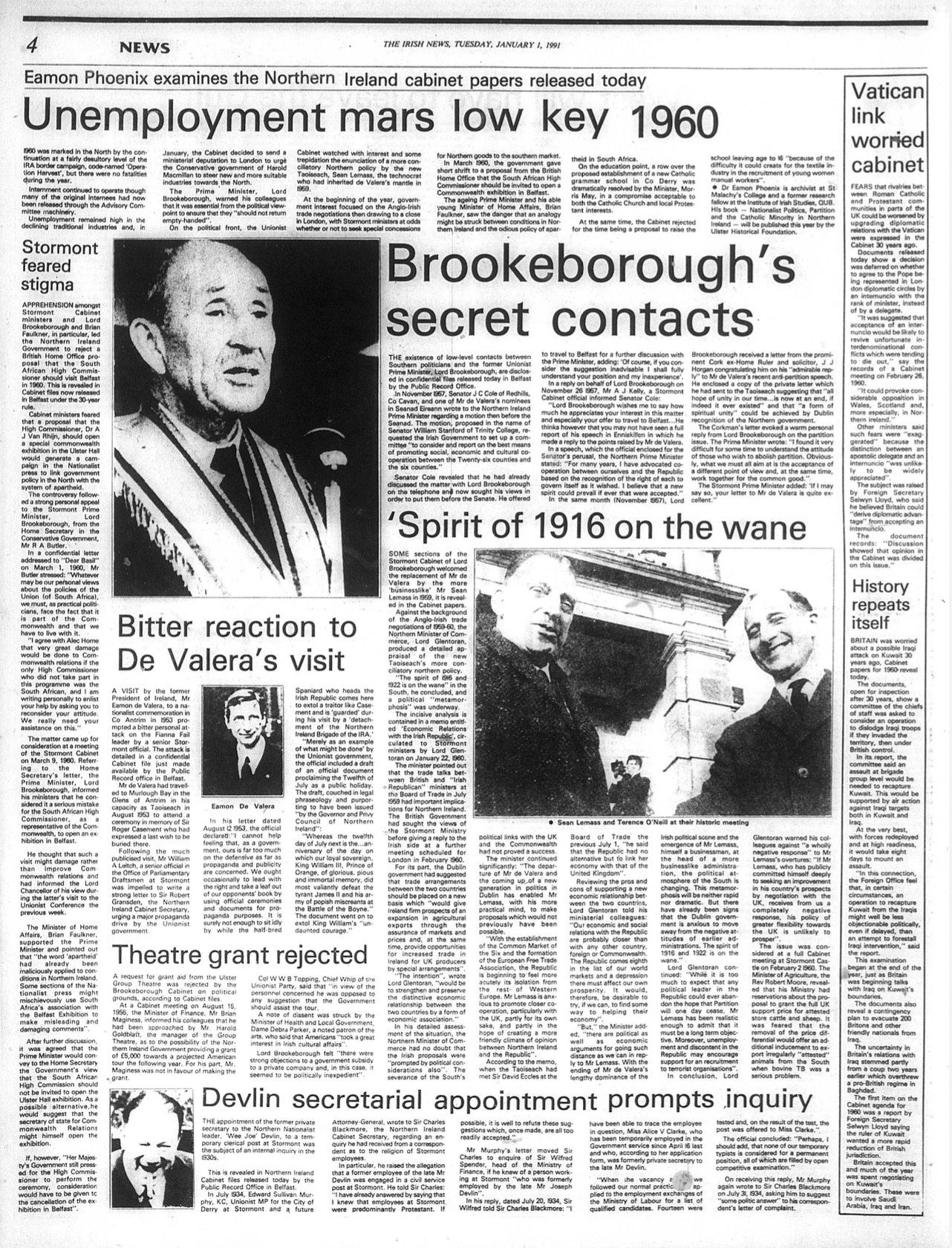
Unemployment mars low key 1960
1960 was marked in the North by the continuation at a fairly desultory level of the IRA border campaign, code-named ‘Operation Harvest’ but there were no fatalities during the year.
Internment continued to operate though many of the original internees had now been released through the Advisory Committee machinery.
Unemployment remained high in the declining traditional industries and, in January, the Cabinet decided to send a ministerial deputation to London to urge the Conservative government of Harold Macmillan to steer new and more suitable industries towards the North.
The Prime Minister, Lord Brookeborough, warned his colleagues that it was essential from the political viewpoint to ensure that they “should not return empty-handed”.
On the political front, the Unionist Cabinet watched with interest and some trepidation the enunciation of a more conciliatory Northern policy by the new Taoiseach, Sean Lemass, the technocrat who had inherited de Valera’s mantle in 1969.
At the beginning of the year, government interest focused on the Anglo-Irish trade negotiations then drawing to a close in London, with Stormont ministers at odds whether or not to seek special concessions for Northern goods to the southern market.
In March I960, the government gave short shrift to a proposal from the British Home Office that the South African High Commissioner should be invited to open a Commonwealth exhibition in Belfast.
The ageing Prime Minister and his able young Minister of Home Affairs, Brian Faulkner, saw the danger that an analogy might be struck between conditions in Northern Ireland and the odious policy of apartheid in South Africa.
On the education point, a row over the proposed establishment of a new Catholic grammar school in Co Derry was dramatically resolved by the Minister, Morris May, in a compromise acceptable to both the Catholic Church and local Protes tant interests.
At the same time, the Cabinet rejected for the time being a proposal to raise the school leaving age to 16 “because of the difficulty it could create for the textile industry in the recruitment of young women manual workers”.
• Dr Eamon Phoenix is archivist at St Malachy’s College and a former research fellow at the Institute of Irish Studies, QUB. His book – Nationalist Politics, Partition and the Catholic Minority in Northern Ireland — will be published this year by the Ulster Historical Foundation.
Stormont feared stigma
APPREHENSION amongst Stormont Cabinet ministers and Lord Brookeborough and Brian Faulkner, in particular, led the Northern Ireland Government to reject a British Home Office proposal that the South African High Commissioner should visit Belfast in 1960. This is revealed in Cabinet files now released in Belfast under the 30-year rule.
Cabinet ministers feared that a proposal that the High Commissioner, Dr A J Van Rhijn, should open a special commonwealth exhibition in the Ulster Hall would generate a campaign in the Nationalist press to link government policy in the North with the system of apartheid.
The controversy followed a strong personal appeal to the Stormont Prime Minister, Lord Brookeborough, from the Home Secretary in the Conservative Government, Mr R A Butler.
In a confidential letter addressed to “Dear Basil” on March 1, I960, Mr Butler stressed: “Whatever may be our personal views about the policies of the Union (of South Africa), we must, as practical politicians, face the fact that it is part of the Commonwealth and that we have to live with it.
“I agree with Alec Home that very great damage would be done to Commonwealth relations if the only High Commissioner who did not take part in this programme was the South African, and I am writing personally to enlist your help by asking you to reconsider your attitude. We really need your assistance on this.”
The matter came up for consideration at a meeting of the Stormont Cabinet on March 9, 1960. Referring to the Home Secretary’s letter, the Prime Minister, Lord Brookeborough, informed his ministers that he considered it a serious mistake for the South African High Commissioner, as a representative of the Commonwealth, to open an exhibition in Belfast.
He thought that such a visit might damage rather than improve Commonwealth relations and had informed the Lord Chancellor of his view during the latter’s visit to the Unionist Conference the previous week.
The Minister of Home Affairs, Brian Faulkner, supported the Prime Minister and pointed out that “the word ‘apartheid’ had already been maliciously applied to conditions in Northern Ireland. Some sections of the Nationalist press might mischievously use South Africa’s association with the Belfast Exhibition to make misleading and damaging comments”.
After further discussion, it was agreed that the Prime Minister would convey to the Home Secretary the Government’s view that the South African High Commission should not be invited to open the Ulster Hall exhibition. As a possible alternative, he would suggest that the secretary of state for Commonwealth Relations might himself open the exhibition.
If, however, “Her Majesty’s Government still pressed for the High Commissioner to perform the ceremony, consideration would have to be given to the cancellation of the exhibition in Belfast”.
Bitter reaction to De Valera’s visit
A VISIT by the former President of Ireland, Mr Eamon de Valera, to a nationalist commemoration in Co Antrim in 1953 prompted a bitter personal attack on the Fianna Fail leader by a senior Stormont official. The attack is detailed in a confidential Cabinet file just made available by the Public Record office in Belfast.
Mr de Valera had travelled to Murlough Bay in the Glens of Antrim in his capacity as Taoiseach in August 1953 to attend a ceremony in memory of Sir Roger Casement who had expressed a last wish to be buried there.
Following the much-publicised visit, Mr William A Leitch, a senior official in the Office of Parliamentary Draftsmen at Stormont was impelled to write a strong letter to Sir Robert Gransden, the Northern Ireland Cabinet Secretary, urging a major propaganda drive by the Unionist government.
In his letter dated August 12 1953, the official declared: “I cannot help feeling that, as a government, ours is far too much on the defensive as far as propaganda and publicity are concerned. We ought occasionally to lead with the right and take a leaf out of our opponents’ book by using official ceremonies and documents for propaganda purposes. It is surely not enough to sit idly by while the half-bred Spaniard who heads the Irish Republic comes here to extol a traitor like Casement and is ‘guarded’ during his visit by a ’detachment of the Northern Ireland Brigade of the IRA.’
“Merely as an example of what might be done’ by the Unionist government, the official included a draft of an official document proclaiming the Twelfth of July as a public holiday. The draft, couched in legal phraseology and purporting to have been issued “by the Governor and Privy Council of Northern Ireland”.
“Whereas the twelfth day of July next is the…anniversary of the day on which our loyal sovereign. King William III, Prince of Orange, of glorious, pious and immortal memory, did most valiantly defeat the tyrant James II and his army of popish miscreants at the Battle of the Boyne.” The document went on to extol King William’s “undaunted courage.”
Theatre grant rejected
A request for grant aid from the Ulster Group Theatre was rejected by the Brookeborough Cabinet on political grounds, according to Cabinet files.
At a Cabinet meeting on August 15. 1955, the Minister of Finance, Mr Brian Maginess, informed his colleagues that he had been approached by Mr Harolo Goldblatt, the manager of the Group Theatre, as to the possibility of the Northern Ireland Government providing a grant of £5,000 towards a projected American tour the following year. For his part, Mr, Maginess was not in favour of making the grant.
Col W W B Topping, Chief Whip of the Unionist Party, said that “in view of the personnel concerned he was opposed to any suggestion that the Government should assist the tour.
A note of dissent was struck by the Minister of Health and Local Government, Dame Debra Parker, a noted patron of the arts, who said that Americans “took a great interest in Irish cultural affairs”.
Lord Brookeborough felt “there were strong objections to a government subsidy to a private company and, in this case, it seemed to be politically inexpedient”.
Brookeborough’s secret contacts
THE existence of low-level contacts between Southern politicians and the former Unionist Prime Minister, Lord Brookeborough, are disclosed in confidential files released today in Belfast by the Public Record Office.
In November 1967, Senator J C Cole of Redhills, Co Cavan, and one of Mr de Valera’s nominees in Seanad Eireann wrote to the Northern Ireland Prime Minister regarding a motion then before the Seanad. The motion, proposed in the name of Senator William Stanford of Trinity College, requested the Irish Government to set up a committee “to consider and report on the best means of promoting social, economic and cultural cooperation between the Twenty-six counties and the six counties.”
Senator Cole revealed that he had already discussed the matter with Lord Brookeborough on the telephone an| now sought his views in order to put them before the Senate. He offered to travel to Belfast for a further discussion with the Prime Minister, adding: ‘Of course, if you consider the suggestion inadvisable I shall fully understand your position and my inexperience’.
In a reply on behalf of Lord Brookeborough on November 26 1957, Mr A J Kelly, a Stormont Cabinet official informed Senator Cole:
“Lord Brookeborough wishes me to say how much he appreciates your interest in this matter and especially your offer to travel to Belfast…He thinks however that you may not have seen a full report of his speech in Enniskillen in which he made a reply to the points raised by Mr de Valera.
In a speech, which the official enclosed for the Senator’s perusal, the Northern Prime Minister stated: “For many years, I have advocated cooperation between ourselves and the Republic based on the recognition of the right of each to govern itself as it wished. I believe that a new spirit could prevail if ever that were accepted.”
In the same month (November 1957), Lord Brookeborough received a letter from the prominent Cork ex-Home Ruler and solicitor, J J Horgan congratulating him on his “admirable reply” to Mr de Valera’s recent anti-partition speech.
He enclosed a copy of the private letter which he had sent to the Taoiseach suggesting that “all hope of unity in our time…is now at an end, if indeed it ever existed” and that “a form of spiritual unity” could be achieved by Dublin recognition of the Northern government.
The Corkman’s letter evoked a warm personal reply from Lord Brookeborough on the partition issue. The Prime Minister wrote: “I found it very difficult for some time to understand the attitude of those who wish to abolish partition. Obviously, what we must all aim at is the acceptance of a different point of view and, at the same time, work together for the common good.”
The Stormont Prime Minister added: If I may say so, your letter to Mr de Valera is quite excellent.”
‘Spirit of 1916 on the wane
SOME sections of the Stormont Cabinet of Lord Brookeborough welcomed the replacement of Mr de Valera by the more ‘businesslike’ Mr Sean Lemass in 1959, it is revealed in the Cabinet papers.
Against the background of the Anglo-Irish trade negotiations of 1959-60, the Northern Minister of Commerce, Lord Glentoran, produced a detailed appraisal of the new Taoiseach’s more conciliatory northern policy.
“The spirit of 1916 and 1922 is on the wane” in the South, he concluded, and a political “metamorphosis” was underway.
The incisive analysis is contained in a memo entitled ‘Economic Relations with the Irish Republic’, circulated to Stormont ministers by Lord Glentoran on January 22, I960.
The minister pointed out that the trade talks between British and “Irish Republican” ministers at the Board of Trade in July 1959 had important implications for Northern Ireland. The British Government had sought the views of the Stormont Ministry before giving a reply to the Irish side at a further meeting scheduled for London in February I960.
For its part, the Dublin government had suggested that trade arrangements between the two countries should be placed on a new basis which “would give Ireland firm prospects of an expansion in agricultural exports through the assurance of markets and prices and. at the same time, provide opportunities for increased trade in Ireland for UK producers by special arrangements”.
“The intention”, wrote Lord Glentoran, “would be to strengthen and preserve the distinctive economic relationship between the two countries by a form of economic association.”
In his detailed assessment of the situation, the Northern Minister of Commerce had no doubt that the Irish proposals were “prompted by political considerations also”. The severance of the South’s political links with the UK and the Commonwealth had not proved a success.
The minister continued significantly: “The departure of Mr de Valera and the coming up of a new generation in politics in Dublin has enabled Mr Lemass, with his more practical mind, to make proposals which would not previously have been possible.
“With the establishment of the Common Market of the Six and the formation of the European Free Trade Association, the Republic is beginning to feel more acutely its isolation from the rest of Western Europe. Mr Lemass is anxious to promote closer cooperation, particularly with the UK, partly for its own sake, and partly in the hope of creating a more friendly climate of opinion between Northern Ireland and the Republic”.
According to the memo, when the Taoiseach had met Sir David Eccles at the Board of Trade the previous July 1, “he said that the Republic had no alternative but to link her economy with that of the United Kingdom”.
Reviewing the pros and cons of supporting a new economic relationship between the two countries. Lord Glentoran told nis ministerial colleagues: “Our economic and social relations with the Republic are probably closer than with any other country, foreign or Commonwealth. The Republic comes eighth in the list of our world markets and a depression there must affect our own prosperity. It would, therefore, be desirable to try, if we can, to find some way to helping their economy”.
“But,” the Minister added. “there are political as well as economic arguments for going such distance as we can in reply to Mr Lemass. With the ending of Mr de Valera’s lengthy dominance of the Irish political scone and the emergence of Mr Lemass, himself a businessman, at the head of a more businesslike administration, the political atmosphere of the South is changing. This metamorphosis will be neither rapid nor dramatic. But there have already been signs that the Dublin government is anxious to move away from the negative attitudes of earlier administrations. The spirit of 1916 and 1922 is on the wane.”
Lord Glentoran continued: “While it is too much to expect that any political leader in the Republic could ever abandon the hope that Partition will one day cease. Mr Lemass has been realistic enough to admit that it must be a long term objective. Moreover, unemployment and discontent in the Republic may encourage support for an recruitment to terrorist organisations”.
In conclusion. Lord Glentoran warned his colleagues against “a wholly negative response” to Mr Lemass’s overtures: “If Mr Lemass, who has publicly committed himself deeply to seeking an improvement in his country’s prospects by negotiation with the UK, receives from us a completely negative response, his policy of greater flexibility towards the UK is unlikely to
The issue was considered at a full Cabinet meeting at Stormont Castle on February 21960. The Minister of Agriculture, the Rev Robert Moore, revealed that his Ministry had reservations about the proposal to grant the full UK support price for attested store cattle and sheep. It was feared that the removal of the price differential would offer an additional inducement to export irregularly “attested” animals from the South when bovine TB was a serious problem.
Devlin secretarial appointment prompts inquiry
THE appointment of the former private secretary to the Northern Nationalist leader, Wee Joe’ Devlin, to a temporary clerical post at Stormont was the subject of an internal inquiry in the 1930s.
This is revealed in Northern Ireland Cabinet files released today by the Public Record Office in Belfast.
In July 1934, Edward Sullivan Murphy, KC, Unionist MP for the City of Derry at Stormont and a future Attorney-General, wrote to Sir Charles Blackmore, the Northern Ireland Cabinet Secretary, regarding an enquiry he had received from a correspondent as to the religion of Stormont employees.
In particular, he raised the allegation that a former employee of the late Mr Devlin was engaged in a civil service post at Stormont. He told Sir Charles: “I have already answered by saying that I knew that employees at Stormont were predominantly Protestant. If possible, it is well to refute these suggestions which, once made, are all too readily accepted.”
Mr Murphy’s letter moved Sir Charles to enquire of Sir Wilfred Spender, head of the Ministry of Finance, if he knew of a person working at Stormont “who was formerly employed by the late Mr Joseph Devlin”.
In his reply, dated July 20, 834, Sir Wilfred told Sir Charles Blackmore: “I have been able to trace the employee in question, Miss Alice V Clarke, who has been temporarily employed in the Government service since April 16 last and who, according to her application form, was formerly private secretary to the late Mr Devlin.
“When the vacancy [appeared] we followed our normal practice and applied to the employment exchanges of the Ministry of Labour for a list, of qualified candidates. Fourteen were tested and, on the result of the test, the post was offered to Miss Clarke.”
The official concluded: “Perhaps, I should add, that none of our temporary typists is considered for a permanent position, all of which are filled by open competitive examination.”
On receiving this reply, Mr Murphy again wrote to Sir Charles Blackmore on July 31, 834, asking him to suggest “some politic answer” to his correspondent’s letter of complaint.
Vatican link worried cabinet
FEARS that rivalries between Roman Catholic and Protestant communities in parts of the UK could be worsened by upgrading diplomatic relations with the Vatican were expressed in the Cabinet 30 years ago.
Documents released today show a decision was deferred on whether to agree to the Pope being represented in London diplomatic circles by an internuncio with the rank of minster, instead of by a delegate.
“It was suggested that acceptance of an inter-nuncio would be likely to revive unfortunate inter-denominational conflicts which were tending to die out,” say the records of a Cabin meeting on February 26,
“It could provoke considerable opposition in Wales, Scotland and, more especially, in Northern Ireland. ”
Other ministers said such fears were “exaggerated” because the distinction between an apostolic delegate and an internuncio “was unlikely to be widely appreciated”.
The subject was raised by Foreign Secretary Selwyn Lloyd, who said he believed Britain could “derive diplomatic advantage” from accepting an internuncio.
The document records: ‘‘Discussion showed that opinion in the Cabinet was divided on this issue.”