

1956 State Papers (page 1)
January 02 1987
Publication Date
Brewing trouble over IRA border attacks, Tory pressure helped defeat allowance move, Anger at BBC bias, Gun-running headache for Army guards, Dublin Bill led to major outcry, Theatre request got the thumbs down, Putting the ‘case for Ulster’, MPs sought move on SF, Dodging the refugee problem
State Paper Snippet
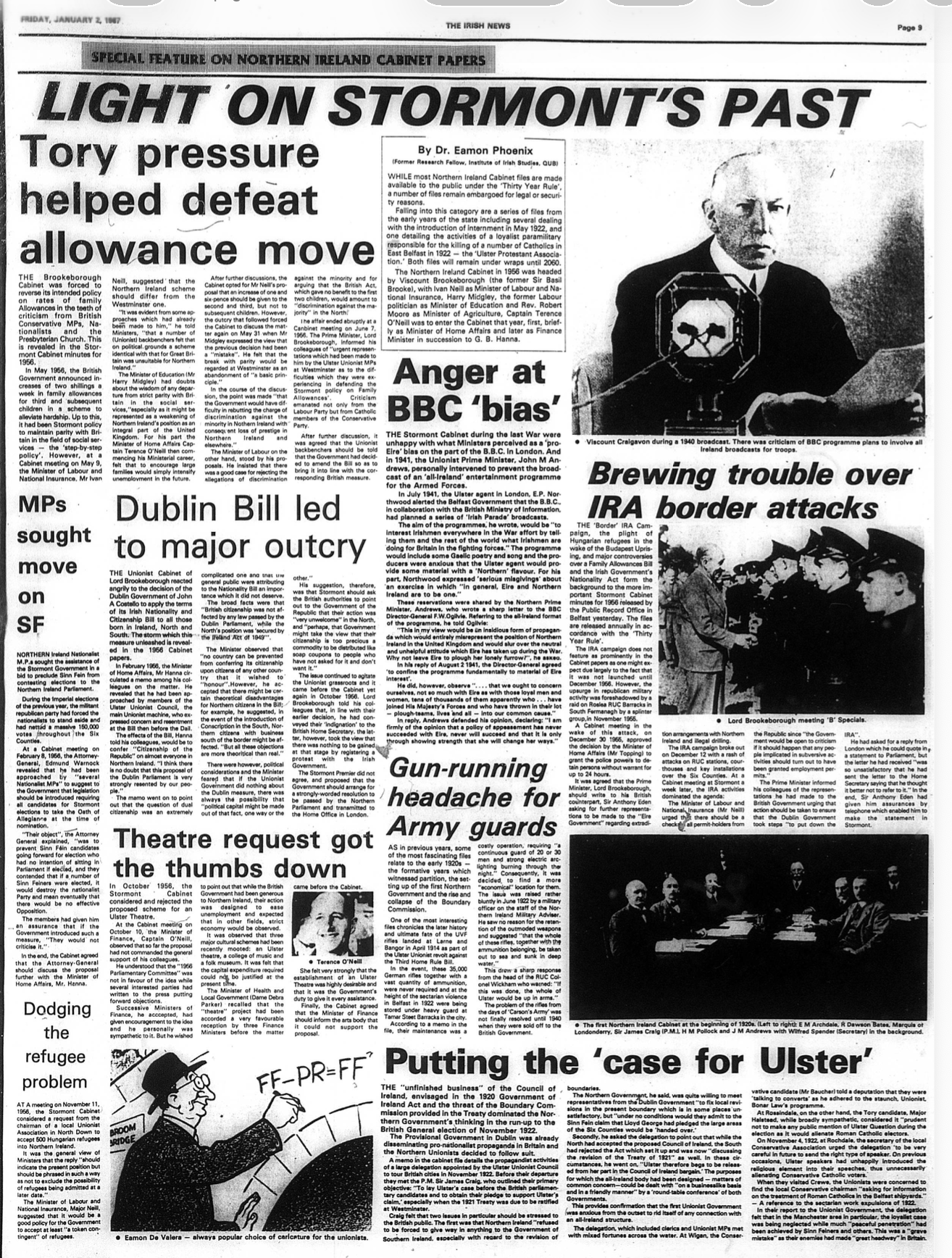
Brewing trouble over IRA border attacks
THE ‘Border’ IRA Campaign, the plight of Hungarian refugees in the wake of the Budapest Uprising, and major controversies over a Family Allowances Bill and the Irish Government’s Nationality Act form the background to the more important Stormont Cabinet minutes for 1956 released by the Public Record Office in Belfast yesterday. The files are released annually in accordance with the ‘Thirty Year Rule’.
The IRA campaign does not feature as prominently in the Cabinet papers as one might expect due largely to the fact that it was not launched until December 1966. However, the upsurge in republican military activity was foreshadowed by a raid on Roslea RUC Barracks in South Fermanagh by a splinter group, in November 1958.
A Cabinet meeting in the wake of this attack, on December 30 1955, approved the decision by the Minister of Home Affairs (Mr Topping) to grant the police powers to detain persons without warrant for up to 24 hours.
It was agreed that the Prime Minister, Lord Brookeborough, should write to his British counterpart, Sir Anthony Eden asking for further representations to be made to the “Eire Government” regarding extradition arrangements with Northern Ireland and illegal drilling.
The IRA campaign broke out on December 12 with a rash of attacks on RUC stations, courthouses and key Installations over the Six Counties. At a Cabinet meeting at Stormont a week later, the IRA activities dominated the agenda:
The Minister of Labour and National Insurance (Mr Neill) urged that there should be a check on all permit-holders from the Republic since “the Government would be open to criticism if it should happen that any people implicated in subversive activities should turn out to have been granted employment permits.”
The Prime Minister Informed his colleagues of the representations he had made to the British Government urging that action should be taken to ensure that the Dublin Government took steps “to put down the IRA”.
He had asked for a reply from London which he could quote in a statement to Parliament, but the letter he had received “was so unsatisfactory that he had sent the letter to the Home Secretary saying that he thought it better not to refer to it.”
In the end, Sir Anthony Eden had given him assurances by telephone which enabled him to make the statement In Stormont.
Tory pressure helped defeat allowance move
THE Brookeborough Cabinet was forced to reverse its intended policy on rates of family Allowances in the teeth of criticism from British Conservative MPs, Nationalists and the Presbyterian Church. This is revealed in the Stormont Cabinet minutes for 1956.
In May 1956, the British Government announced increases of two shillings a week In family allowances for third and subsequent children in a scheme to alleviate hardship. Up to this, it had been Stormont policy to maintain parity with Britain in the field of social services – the ‘step-by-step policy’.
However, at a Cabinet meeting on May 9, the Minister of Labour and National Insurance. Mr Ivan Neill, suggested’ that the Northern Ireland scheme should differ from the Westminster one.
“It was evident from some approaches which had already been made to him,” he told Ministers, “that a number of (Unionist) backbenchers felt that on political, grounds a scheme identical with that for Great Britain was unsuitable for Northern Ireland.”
The Minister of Education (Mr Harry Midgley) had doubts about the wisdom of any departure from strict parity with Britain In the social services,” especially as it might be represented as a weakening of Northern Ireland’s position as an integral part of the United Kingdom.
For his part the Minister of Home Affairs Captain Terence O’Neill then commencing his Ministerial career, felt that to encourage large families would simply intensify unemployment in the future.
After further discussions, the Cabinet opted for Mr Neill’s proposal that an increase of one and six-pence should be given to the second and third, but not to subsequent children. However, the outcry that followed forced the Cabinet to discuss the matter again on May 31 when Mr Midgley expressed the view that the previous decision had been a “mistake”. He felt that the break with parity would be regarded at Westminster as an abandonment of “a basic principle.”
In the course of the discussion, the point was made “that the Government would have difficulty in rebutting the charge of discrimination against the minority in Nothem Ireland with’ consequent loss of prestige in Northern Ireland and elsewhere.”
The Minister of Labour on the other hand, stood by his proposals. He insisted that there was a good case for rejecting the allegations of discrimination against the minority and for arguing that the British Act, which gave no benefit to the first two children, would amount to “discrimination against the majority” in the North.
The affair ended abruptly at a Cabinet meeting on June 7, 1956. The Prime Minister, Lord Brookeborough, informed his colleagues of “urgent representations which had been made to him by the Ulster Unionist MPs at Westminster as to the difficulties which they were experiencing in defending the Stormont policy on Family Allowances’.
Criticism emanated not only from the Labour Party but from Catholic members of the Conservative Party.
After further discussion, it was agreed that the Unionist backbenchers should be told that the Government had decided to amend the Bill so as to bring it into line with the corresponding British measure.
New files release
By Dr. Eamon Phoenix
(Former Research Fellow, Institute of Irish Studies. QUB)
WHILE most Northern Ireland Cabinet files are made available to the public under the ‘Thirty Year Rule’, a number of files remain embargoed for legal or security reasons.
Falling into this category are a series of files from the early years of the state including several dealing with the introduction of internment lii May 1922, and one detailing the activities of a loyalist paramilitary responsible for the killing of a number of Catholics in East Belfast in 1922 — the ‘Ulster Protestant Association.’ Both files will remain under wraps until 2060.
The Northern Ireland Cabinet in 1956 was headed by Viscount Brookeborough (the former Sir Basil Brooke), with Ivan Neill as Minister of Labour and National Insurance, Harry Midgley, the former Labour politician as Minister of Education and Rev. Robert Moore as Minister of Agriculture, Captain Terence O’Neill was to enter the Cabinet that year, first, briefly as Minister of Home Affairs and later as Finance Minister in succession to G. B. Hanna.
Anger at BBC ‘bias’
THE Stormont Cabinet during the last War were unhappy with what Ministers perceived as a pro Eire’ bias on the part of the B.B.C. in London. And in 1941, the Unionist Prime Minister, John M Andrews, personally intervened to prevent the broadcast of an all- Ireland’ entertainment programme for the Armed Forces.
In July 1941, the Ulster agent in London, E.P. Northwood alerted the Belfast Government that the B.B.C., In collaboration with the British Ministry of Information, had planned a series of ‘Irish Parade’ broadcasts.
The aim of the programmes, he wrote, would be “to Interest Irishmen everywhere in the War effort by telling them and the rest of the world what Irishmen are doing for Britain In the fighting forces.” The programme would Include some Gaelic poetry and song and the producers were anxious that the Ulster agent would provide some material with a ‘Northern’ flavour. For his part. Northwood expressed ‘serious misgivings’ about an exercise In which “in general, Eire and Northern Ireland are to be one.”
These reservations were shared by the Northern Prime Minister. Andrews, who wrote a sharp letter to the BBC Director-General F.W. Ogilvie. Referring to the all-Ireland format of the programme, he told Ogilvie:
“This In my view would be an insidious form of propaganda which would entirely misrepresent the position of Northern Ireland In the United Kingdom and would slur over the neutral and unhelpful attitude which Eire has taken up during the War. Why not leave Eire to plough her lonely furrow”, he asked.
In his reply of August 2 1941. the Director-General agreed to confine the programme fundamentally to material of Eire interest’.
He did, however, observe “….that we ought to concern ourselves, not so much with Eire as with those loyal men and women, tens of thousands of them apparently who … have joined His Majesty’s Forces and who have thrown In their lot – plough-teams, Ilves and all – into our common cause.”
In reply, Andrews defended his opinion, declaring: “I am firmly of the opinion that a policy of appeasement has never succeeded with Eire, never will succeed and that It Is only through showing strength that she will change her ways.”
Gun-running headache for Army guards
AS in previous years, some of the most fascinating files relate to the early 1920s – the formative years which witnessed partition, the setting up of the first Northern Government and the rise and collapse of the Boundary Commission.
One of the most interesting files chronicles the later history and ultimate fate of the UVF rifles landed at Larne and Bangor in April 1914 as part of the Ulster Unionist revolt against the Third Home Rule Bill.
In the event, these 35,000 German rifles together with a vast quantity of ammunition, were never required and at the height of the sectarian violence in Belfast in 1922 were being stored under heavy guard at Tamar Steet Barracks in the city.
According to a memo in the file, their maintenance was a costly operation, requiring “a continuous guard of 20 or 30 men and strong electric arc lighting burning through the night.” Consequently, it was decided, to find a more “economical” location for them.
The issue was raised rather bluntly in June 1922 by a military officer on the staff of the Northern Ireland Military Adviser. He saw no reason for the retention of the outmoded weapons and suggested “that the whole of these rifles, together with ammunition belonging, be taken out to sea and sunk in deep waters.”
This drew a sharp response from the head of the RUC Colonel Wickham who warned: “If this was done, the whole of Ulster would be up in arms.”
The problem of the rifles from the days of ‘Carson’s Army” was not finally resolved until 1940 when they were sold off to the British Government.
Dublin Bill led to major outcry
THE Unionist Cabinet of Lord Brookeborough reacted angrily to the decision of the Dublin Government of John A Costello to apply the terms of its Irish Nationality and Citizenship Bill to all those born in Ireland, North and South. The storm which this measure unleashed is revealed in the 1956 Cabinet papers.
In February 1966, the Minister of Home Affairs, Mr Hanna circulated a memo among his colleagues on the matter. He revealed that he had been approached by members of the Ulster Unionist Council, the main Unionist machine, who expressed concern and resentment at the Bill then before the Dail.
The effects of the Bill, Hanns told his colleagues, would be to confer “Citizenship of the Republic” on almost everyone in Northern Ireland. “I think there is no doubt that this proposal of the Dublin Parliament is very strongly resented by our people.”
The memo went on to point out that this question of dual citizenship was an extremely complicated one and that the general public were attributing to the Nationality Bill an importance which it did not deserve.
The broad facts were that “British citizenship was not affected by any law passed by the Dublin Parliament, while the North’s position was ‘secured by the Ireland Act of 1949″‘.
The Minister observed that “no country can be prevented from conferring Its citizenship upon citizens of any other country that It wished to “honour”. However, he accepted that there might be certain theoretical disadvantages for Northern citizens in the Bill for example, he suggested, in the event of the introduction of Conscription In the South, Northern citizens with business south of the border might be effected. “But all these objections are more theoretical than real.”
Thera were however, political consideration* and the Minister feared that if the Unionist Government did nothing about the Dublin measure, there was always the possibility that “political capital might be made out of that fact, one way or the other.
His suggestion, therefore, was that Stormont should ask the British authorities to point out to the Government of the Republic that their action was very unwelcome in the North and “perhaps, that Government might take the view that their citizenship is too precious a commodity to be distributed like soap coupons to people who have not asked for it and don’t want it.”
The issue continued to agitate the Unionist grassroots and it came before the Cabinet yet again in October 1966. Lord Brookeborough told his colleagues that, in line with their earlier decision, he had conveyed their ‘indignation’ to the British Home Secretary, the latter, however, took the view that there was nothing to be gained,, , at that stage by registering a protest with the Irish Government.
The Stormont Premier did not agree, and proposed that the Government should arrange for a strongly-worded resolution to be passed by the Northern Parliament and transmitted to the Home Office in London.
Theatre request got the thumbs down
In October 1956, the Stormont Cabinet considered and rejected the proposed scheme for an Ulster Theatre.
At the Cabinet meeting on October 10, the Minister of Finance, Captain O’Neill, observed that so far the proposal had not commanded the general support of his colleagues.
He understood that the “1956 Parliamentary Committee” was not in favour of the idea while several interested parties had written to the press putting forward objections.
Successive Ministers of Finance, he accepted, had given encouragement to the idea and he personally was sympathetic to it. But he wished to point out that while the British government had been generous to Northern Ireland, their action was designed to ease unemployment and expected that in other fields, strict economy would be observed.
It was observed that three major cultural schemes had been recently mooted: an Ulster theatre, a college of music and a folk museum. It was felt that the capital expenditure required could not be justified at the present time.
The Minister of Health and Local Government (Dame Debra Parker) recalled that the “theatre” project had been accorded a very favourable reception by three Finance Ministers before the matter came before the Cabinet.
She felt very strongly that the establishment of an Ulster Theatre was highly desirable and that it was the Government’s duty to give it every assistance.
Finally, the Cabinet agreed that the Minister of Finance should inform the arts body that it could not support the proposal.
Putting the ‘case for Ulster’
THE “unfinished business” of the Council of Ireland, envisaged in the 1920 Government of Ireland Act and the threat of the Boundary Commission provided in the Treaty dominated the Northern Government’s thinking In the run-up to the British General election of November 1922.
The Provisional Government in Dublin was already disseminating pro nationalist propaganda In Britain and the Northern Unionists decided to follow suit.
A memo in the cabinet file details the propagandist activities of a large delegation appointed by the Ulster Unionist Council to tour British cities In November 1922.
Before their departure they met the P.M. Sir James Craig, who outlined their primary objective: “To lay Ulster’s case before the British parliamentary candidates and to obtain their pledge to support Ulster’s claim’, especially when the 1921 Treaty was due to be ratified at Westminster.
Craig felt that two issues in particular should be stressed to the British public. The first was that Northern Ireland “refused to be forced to give way in anything to the Government of Southern Ireland, especially with regard to the revision of boundaries.
The Northern Government, he said, was quite willing to meet representatives from the Dublin Government “to fix local revisions in the present boundary which is in some places unsatisfactory, but “under no condition would they admit to the Sinn Fein claim that Lloyd George had pledged the large area of the Six Counties would be ‘handed over.’
Secondly, he asked the delegation to point out that while the North had accepted the proposed Council of Ireland, the South had rejected the Act which set it up and was now “discussing the revision of the Treaty of 1921” as well. In these circumstances, he went on. “Ulster therefore begs to be released from her part In the Council of Ireland bargain.’
The purposes for which the all-Ireland body had been designed – matters of common concern – could be dealt with “on a businesslike basis and in a friendly manner” by a ’round-table conference’ of both Governments.
This provides confirmation that the first Unionist Government (was anxious from the outset to rid Itself of any connection with an all-Ireland structure.
The delegation, which Included clerics and Unionist MPs met with mixed fortunes across the water. At Wigan, the Conser ative candidate (Mr Baucher) told a deputation that they were ‘talking to converts’ at he adhered to the staunch, Unionist, Bonar Law’s programme.
At Rossindale, on the other hand, the Tory candidate, Major Halstead, while broadly sympathetic, considered it “prudent not to make any public mention of Ulster Question during the election as it would alienate Roman Catholic electors.
On November 4,1922, at Rochdale, the secretary of the local Conservative Association urged the delegation to be very careful in future to send the right type of speaker. On previous occasions, Ulster speakers had unhappily introduced the religious element into their speeches, thus unnecessarily alienating Conservative Catholic voters.
When they visited Crewe, the Unionists were concerned to find the local Conservative chairman “asking for Information on the treatment of Roman Catholics in the Belfast shipyards.” – A reference to the sectarian work expulsions of 1922.
In their report to the Unionist Government the delegation felt that in the Manchester area in particular, the loyalist case was being neglected while much “peaceful penetration” had been achieved by Sinn Feiners and others. This was a “grave mistake” as their enemies had made “great headway” in Britain.
MPs sought move on SF
NORTHERN Ireland Nationalist M.P.s sought the assistance of the Stormont Government In a bid to preclude Sinn Fein from contesting elections to the Northern Ireland Parliament.
During the Imperial elections of the previous year, the militant republican party had forced the nationalists to stand aside end had netted a massive 160,000 votes throughout the Six Counties
At s Cabinet meeting on February 8,1966, the Attorney- General, Edmund Warnock revealed that he had been approached by “several Nationalist MPs” to suggest to the Government that legislation should be Introduced requiring all candidates for Stormont elections to take the Oath of Allegiance at the time of nomination.
“Their object”, the Attorney General explained, “was to prevent Sinn Fein candidates going forward for election who had no Intention of sitting in Parliament If elected, and they contended that if a number of Sinn Felners were elected, it would destroy the nationalist Party and mean eventually that there would be no effective Opposition.
The members had given him an assurance that if the Government Introduced such a measure, “They would not criticise it.”
In the end, the Cabinet agreed that the Attorney-General should discuss the proposal further with the Minister of Home Affairs, Mr. Hanna.
Dodging the refugee problem
AT A meeting on November 11, 1956, the Stormont Cabinet considered e request from the chairman of a local Unionist Association in North Down to accept 600 Hungarian refugees into Northern Ireland.
It was the general view of Ministers that the reply “should indicate the present position but should be phrased in such a way as not to exclude the possibility of refugees being admitted et a later date.”
The Minister of Labour and National Insurance, Major Neill, suggested that it would be a good policy for the Government to accept at least “a token contingent” of refugees.