On This Day / May 7, 1971

Go Back

Reproduced with permission from The Irish News.

19710507

Reference Date

19710507

Publication Date

Summary: On This Day – 7th June 1971, John Hume warned of the dangers of sectarianism while church leaders united with political leaders in condemning violence. Edited by Éamon Phoenix. 

Hume Warns of Dangers Ahead | On This Day – 7th June 1971

A WARNING that violence and sectarianism would bring ultimate disaster to NI and create problems which would take centuries to eradicate was given last night by Mr John Hume, MP.

‘No-one’, he said, addressing the SDLP in Derry, ‘could under-estimate the serious nature of the present situation.

‘Neither could anyone with any sense of responsibility fail to be aware of the necessity for public men to weigh their words and actions with care.’

Mr Hume said that the presence of British troops in NI to maintain law and order, and that forcing by the Westminster government of a reform programme on Stormont was a public admission that the Unionist government was incapable of governing NI in peace, justice and stability.

It was the duty of the British Government to declare the 1920 Act and the system of government created by it had been an abysmal failure and they should now show their willingness to create a new system in which sectarianism will be neutralised and in which all sections could participate at every level.

Mr Hume said that prior to August 1969, in spite of their forebodings as to what would happen, the members of the Opposition at Stormont made their views known privately to the Governments in London and Belfast.

Unfortunately, their sense of responsibility was not matched by those in power. Their advice was ignored.

Church Leaders Join PM Against Violence

IRISH Church leaders have backed up statements by the Stormont Premier, Mr Brian Faulkner and the Taoiseach, Mr Jack Lynch, condemning the latest wave of explosions and violence in NI.

The Churchmen, including Cardinal Conway and the Church of Ireland Primate, Archbishop George Simms, called on all Christian people to dissociate themselves completely from such actions which they condemned as ‘crimes against God’s law’.

Earlier Mr Faulkner said the wave of terrorist attacks ‘transcends political and religious differences’.

Meanwhile, the Minister of State at the Ministry of Home Affairs, Mr John Taylor said at Stormont that it had not been possible to establish how confidential RUC information had come into the possession of the Rev Ian Paisley, Protestant Unionist MP.

Mr Taylor said steps were being taken to prevent further leakages of confidential information outside the force.

(Éamon Phoenix editor’s note: As this report shows, as early as 1971 John Hume was already thinking in terms of a broad-based settlement which would replace the flawed 1920 Act with its sectarian headcount in favour of one in which every section of the community could participate.

Unfortunately, 3,600 people would die before such a system was finally achieved by consent.)

On This Day – 7th June 1971

Further Reading on Irish History:

List of other On This Day columns

Other resources: National Library of Ireland Irish News CAIN Archive

About Eamon Phoenix

About the Eamon Phoenix Foundation

19710507

Reference Date

19710507

Publication Date

Summary: On This Day – 7th June 1971, John Hume warned of the dangers of sectarianism while church leaders united with political leaders in condemning violence. Edited by Éamon Phoenix. 

Hume Warns of Dangers Ahead | On This Day – 7th June 1971

A WARNING that violence and sectarianism would bring ultimate disaster to NI and create problems which would take centuries to eradicate was given last night by Mr John Hume, MP.

‘No-one’, he said, addressing the SDLP in Derry, ‘could under-estimate the serious nature of the present situation.

‘Neither could anyone with any sense of responsibility fail to be aware of the necessity for public men to weigh their words and actions with care.’

Mr Hume said that the presence of British troops in NI to maintain law and order, and that forcing by the Westminster government of a reform programme on Stormont was a public admission that the Unionist government was incapable of governing NI in peace, justice and stability.

It was the duty of the British Government to declare the 1920 Act and the system of government created by it had been an abysmal failure and they should now show their willingness to create a new system in which sectarianism will be neutralised and in which all sections could participate at every level.

Mr Hume said that prior to August 1969, in spite of their forebodings as to what would happen, the members of the Opposition at Stormont made their views known privately to the Governments in London and Belfast.

Unfortunately, their sense of responsibility was not matched by those in power. Their advice was ignored.

Church Leaders Join PM Against Violence

IRISH Church leaders have backed up statements by the Stormont Premier, Mr Brian Faulkner and the Taoiseach, Mr Jack Lynch, condemning the latest wave of explosions and violence in NI.

The Churchmen, including Cardinal Conway and the Church of Ireland Primate, Archbishop George Simms, called on all Christian people to dissociate themselves completely from such actions which they condemned as ‘crimes against God’s law’.

Earlier Mr Faulkner said the wave of terrorist attacks ‘transcends political and religious differences’.

Meanwhile, the Minister of State at the Ministry of Home Affairs, Mr John Taylor said at Stormont that it had not been possible to establish how confidential RUC information had come into the possession of the Rev Ian Paisley, Protestant Unionist MP.

Mr Taylor said steps were being taken to prevent further leakages of confidential information outside the force.

(Éamon Phoenix editor’s note: As this report shows, as early as 1971 John Hume was already thinking in terms of a broad-based settlement which would replace the flawed 1920 Act with its sectarian headcount in favour of one in which every section of the community could participate.

Unfortunately, 3,600 people would die before such a system was finally achieved by consent.)

On This Day – 7th June 1971

Further Reading on Irish History:

List of other On This Day columns

Other resources: National Library of Ireland Irish News CAIN Archive

About Eamon Phoenix

About the Eamon Phoenix Foundation

19710507

Reference Date

May 7, 2021

Publication Date

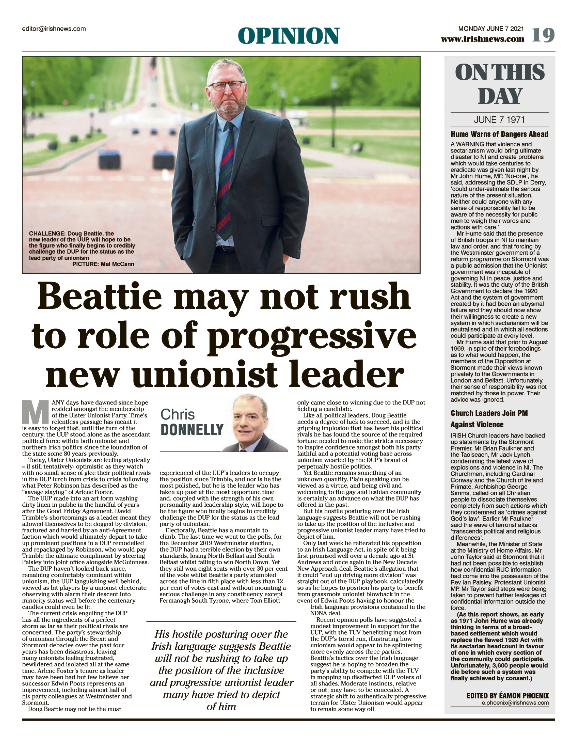
Thumbnail of PDF of Irish News page containing the Eamon Phoenix On This Day column dated 7th June 2021, detailing events reported on 7th June 1971

Summary: On This Day – 7th June 1971, John Hume warned of the dangers of sectarianism while church leaders united with political leaders in condemning violence. Edited by Éamon Phoenix. 

Hume Warns of Dangers Ahead | On This Day – 7th June 1971

A WARNING that violence and sectarianism would bring ultimate disaster to NI and create problems which would take centuries to eradicate was given last night by Mr John Hume, MP.

‘No-one’, he said, addressing the SDLP in Derry, ‘could under-estimate the serious nature of the present situation.

‘Neither could anyone with any sense of responsibility fail to be aware of the necessity for public men to weigh their words and actions with care.’

Mr Hume said that the presence of British troops in NI to maintain law and order, and that forcing by the Westminster government of a reform programme on Stormont was a public admission that the Unionist government was incapable of governing NI in peace, justice and stability.

It was the duty of the British Government to declare the 1920 Act and the system of government created by it had been an abysmal failure and they should now show their willingness to create a new system in which sectarianism will be neutralised and in which all sections could participate at every level.

Mr Hume said that prior to August 1969, in spite of their forebodings as to what would happen, the members of the Opposition at Stormont made their views known privately to the Governments in London and Belfast.

Unfortunately, their sense of responsibility was not matched by those in power. Their advice was ignored.

Church Leaders Join PM Against Violence

IRISH Church leaders have backed up statements by the Stormont Premier, Mr Brian Faulkner and the Taoiseach, Mr Jack Lynch, condemning the latest wave of explosions and violence in NI.

The Churchmen, including Cardinal Conway and the Church of Ireland Primate, Archbishop George Simms, called on all Christian people to dissociate themselves completely from such actions which they condemned as ‘crimes against God’s law’.

Earlier Mr Faulkner said the wave of terrorist attacks ‘transcends political and religious differences’.

Meanwhile, the Minister of State at the Ministry of Home Affairs, Mr John Taylor said at Stormont that it had not been possible to establish how confidential RUC information had come into the possession of the Rev Ian Paisley, Protestant Unionist MP.

Mr Taylor said steps were being taken to prevent further leakages of confidential information outside the force.

(Éamon Phoenix editor’s note: As this report shows, as early as 1971 John Hume was already thinking in terms of a broad-based settlement which would replace the flawed 1920 Act with its sectarian headcount in favour of one in which every section of the community could participate.

Unfortunately, 3,600 people would die before such a system was finally achieved by consent.)

On This Day – 7th June 1971

Further Reading on Irish History:

List of other On This Day columns

Other resources: National Library of Ireland Irish News CAIN Archive

About Eamon Phoenix

About the Eamon Phoenix Foundation

On This Day is a daily column in the Irish News looking back either 50 or 100 years. The column was compiled by Dr Éamon Phoenix from the mid 1980s until autumn, 2022. The Foundation is very grateful to the Irish News for giving permission to reproduce Eamon’s columns. Funding gratefully received from Ireland’s Department of Foreign Affairs and the Magill Trust.

Visit Irish News

* The Foundation has worked hard to recreate Eamon’s distinctive voice through AI. Since this is an emerging technology, occasional imperfections may be audible.