On This Day / January 7, 1921
Go BackReproduced with permission from The Irish News.
19210107
Reference Date
19210107
Publication Date
Summary: On This Day – 7th January 1921, the Government of Ireland Act came under fierce attack as the “worst form of partition”, condemned as a permanent settlement imposing lasting minority rule on Northern nationalists. Edited by Éamon Phoenix.
‘Worst Form of Partition’ | On This Day – 7th January 1921
AS amended, re-amended and revised by one-sixth of the English House of Commons, the text of the Government of Ireland Act, 1920 fills 81 pages. Section Two of Clause 76 reads: ‘The Government of Ireland Act [the Third Home Rule Act of 1914] is hereby repealed as from the passing of this Act’.
Thus the main object of the authors of the new Act was accomplished when the King’s signature was affixed to it.
The revised Partition Act is worse than the original proposals – if it is possible to discriminate between the vileness of the first atrocity and the last.
Partition on a permanent basis is provided far more ingeniously than the framers of the Bill contemplated.
As the main provisions of the Act are familiar to everyone, we need not dwell on its shortcomings – apart from the vital issue of Partition which it raises at once.
The British government can plunder this country more thoroughly and securely than ever… once the Act comes into operation.
The cost of establishing the worthless two Assemblies – especially the expense attending the foundation of entirely new legal and administrative systems in this corner of Ireland – must necessarily be crushing…
What directly concerns all Ireland is the effect of this mad and criminal gamble in political chicanery on the future of their common country – socially, economically, politically and nationally.
Edmund Burke, in famous phrases, described the Penal Code of Laws [passed by the Ascendancy-based Irish Parliament after 1691] in the following terms in 1792:
‘It was a complete system, full of coherence and consistency… It was a machine of wise and elaborate contrivance and as well fitted for the oppression, impoverishment and degradation of a people, and the debasement of them… as ever proceeded from the perverted ingenuity of man.’
Burke’s words can be truly applied to the Government of Ireland Act, 1920. It has been designed to succeed where the Penal Code failed – to disrupt and destroy the historic nation which had survived and triumphed over its enemies during a struggle of 750 years.
(Eamon Phoenix editor’s note: For Joe Devlin, Nationalist MP and chairman of the Irish News, the darkening shadow of partition and perpetual Unionist rule seemed unreal.
A decade earlier, the 400,000 northern Nationalists, in common with Nationalist Ireland, had confidently expected an all-Ireland Home Rule Parliament within the empire.
For Devlin, the 1920 Act, establishing a Unionist-controlled parliament without minority safeguards meant ‘permanent partition’ and permanent minority status for northern Catholics.
For a decade more the rival sections nationalism – Republican and constitutionalist – would blame each other as well as De Valera and Collins for their fate.)
On This Day – 7th January 1921
Further Reading on Irish History:
List of other On This Day columns
Other resources: National Library of Ireland Irish News CAIN Archive
19210107
Reference Date
19210107
Publication Date
Listen Along in Éamons Voice
Summary: On This Day – 7th January 1921, the Government of Ireland Act came under fierce attack as the “worst form of partition”, condemned as a permanent settlement imposing lasting minority rule on Northern nationalists. Edited by Éamon Phoenix.
‘Worst Form of Partition’ | On This Day – 7th January 1921
AS amended, re-amended and revised by one-sixth of the English House of Commons, the text of the Government of Ireland Act, 1920 fills 81 pages. Section Two of Clause 76 reads: ‘The Government of Ireland Act [the Third Home Rule Act of 1914] is hereby repealed as from the passing of this Act’.
Thus the main object of the authors of the new Act was accomplished when the King’s signature was affixed to it.
The revised Partition Act is worse than the original proposals – if it is possible to discriminate between the vileness of the first atrocity and the last.
Partition on a permanent basis is provided far more ingeniously than the framers of the Bill contemplated.
As the main provisions of the Act are familiar to everyone, we need not dwell on its shortcomings – apart from the vital issue of Partition which it raises at once.
The British government can plunder this country more thoroughly and securely than ever… once the Act comes into operation.
The cost of establishing the worthless two Assemblies – especially the expense attending the foundation of entirely new legal and administrative systems in this corner of Ireland – must necessarily be crushing…
What directly concerns all Ireland is the effect of this mad and criminal gamble in political chicanery on the future of their common country – socially, economically, politically and nationally.
Edmund Burke, in famous phrases, described the Penal Code of Laws [passed by the Ascendancy-based Irish Parliament after 1691] in the following terms in 1792:
‘It was a complete system, full of coherence and consistency… It was a machine of wise and elaborate contrivance and as well fitted for the oppression, impoverishment and degradation of a people, and the debasement of them… as ever proceeded from the perverted ingenuity of man.’
Burke’s words can be truly applied to the Government of Ireland Act, 1920. It has been designed to succeed where the Penal Code failed – to disrupt and destroy the historic nation which had survived and triumphed over its enemies during a struggle of 750 years.
(Eamon Phoenix editor’s note: For Joe Devlin, Nationalist MP and chairman of the Irish News, the darkening shadow of partition and perpetual Unionist rule seemed unreal.
A decade earlier, the 400,000 northern Nationalists, in common with Nationalist Ireland, had confidently expected an all-Ireland Home Rule Parliament within the empire.
For Devlin, the 1920 Act, establishing a Unionist-controlled parliament without minority safeguards meant ‘permanent partition’ and permanent minority status for northern Catholics.
For a decade more the rival sections nationalism – Republican and constitutionalist – would blame each other as well as De Valera and Collins for their fate.)
On This Day – 7th January 1921
Further Reading on Irish History:
List of other On This Day columns
Other resources: National Library of Ireland Irish News CAIN Archive
19210107
Reference Date
January 7, 2021
Publication Date
Listen Along in Éamons Voice *
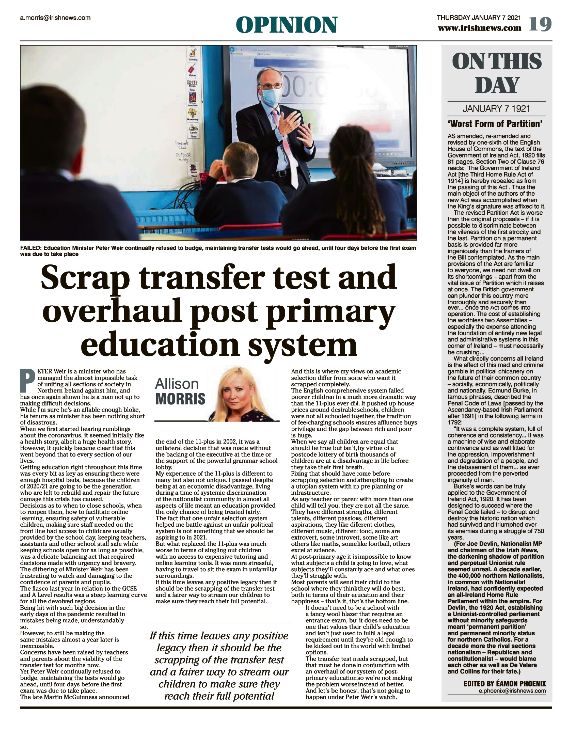
Summary: On This Day – 7th January 1921, the Government of Ireland Act came under fierce attack as the “worst form of partition”, condemned as a permanent settlement imposing lasting minority rule on Northern nationalists. Edited by Éamon Phoenix.
‘Worst Form of Partition’ | On This Day – 7th January 1921
AS amended, re-amended and revised by one-sixth of the English House of Commons, the text of the Government of Ireland Act, 1920 fills 81 pages. Section Two of Clause 76 reads: ‘The Government of Ireland Act [the Third Home Rule Act of 1914] is hereby repealed as from the passing of this Act’.
Thus the main object of the authors of the new Act was accomplished when the King’s signature was affixed to it.
The revised Partition Act is worse than the original proposals – if it is possible to discriminate between the vileness of the first atrocity and the last.
Partition on a permanent basis is provided far more ingeniously than the framers of the Bill contemplated.
As the main provisions of the Act are familiar to everyone, we need not dwell on its shortcomings – apart from the vital issue of Partition which it raises at once.
The British government can plunder this country more thoroughly and securely than ever… once the Act comes into operation.
The cost of establishing the worthless two Assemblies – especially the expense attending the foundation of entirely new legal and administrative systems in this corner of Ireland – must necessarily be crushing…
What directly concerns all Ireland is the effect of this mad and criminal gamble in political chicanery on the future of their common country – socially, economically, politically and nationally.
Edmund Burke, in famous phrases, described the Penal Code of Laws [passed by the Ascendancy-based Irish Parliament after 1691] in the following terms in 1792:
‘It was a complete system, full of coherence and consistency… It was a machine of wise and elaborate contrivance and as well fitted for the oppression, impoverishment and degradation of a people, and the debasement of them… as ever proceeded from the perverted ingenuity of man.’
Burke’s words can be truly applied to the Government of Ireland Act, 1920. It has been designed to succeed where the Penal Code failed – to disrupt and destroy the historic nation which had survived and triumphed over its enemies during a struggle of 750 years.
(Eamon Phoenix editor’s note: For Joe Devlin, Nationalist MP and chairman of the Irish News, the darkening shadow of partition and perpetual Unionist rule seemed unreal.
A decade earlier, the 400,000 northern Nationalists, in common with Nationalist Ireland, had confidently expected an all-Ireland Home Rule Parliament within the empire.
For Devlin, the 1920 Act, establishing a Unionist-controlled parliament without minority safeguards meant ‘permanent partition’ and permanent minority status for northern Catholics.
For a decade more the rival sections nationalism – Republican and constitutionalist – would blame each other as well as De Valera and Collins for their fate.)
On This Day – 7th January 1921
Further Reading on Irish History:
List of other On This Day columns
Other resources: National Library of Ireland Irish News CAIN Archive
On This Day is a daily column in the Irish News looking back either 50 or 100 years. The column was compiled by Dr Éamon Phoenix from the mid 1980s until autumn, 2022. The Foundation is very grateful to the Irish News for giving permission to reproduce Eamon’s columns. Funding gratefully received from Ireland’s Department of Foreign Affairs and the Magill Trust.
* The Foundation has worked hard to recreate Eamon’s distinctive voice through AI. Since this is an emerging technology, occasional imperfections may be audible.