On This Day / January 12, 1921

Go Back

Reproduced with permission from The Irish News.

19210112

Reference Date

19210112

Publication Date

Summary: On This Day – 5th January 1921, official reprisals saw homes burned after an ambush in Cork, violence flared in Monaghan, and Eithne MacSwiney challenged bishops over threats to excommunicate IRA volunteers. Edited by Éamon Phoenix.

Official Burnings | On This Day – 5th January 1921

THE following official message was issued yesterday from Military Headquarters, Cork: ‘As a result of the ambush on the police at Midleton, it was decided by the Military Governor [General Strickland] that certain houses in the vicinity of the outrages were to be destroyed as the inhabitants were bound to have known of the ambush and attack, and they neglected to give any information to the authorities. …Previous to the burnings, notice was served on the persons affected, giving them one hour to clear out valuables but not furniture.’

A report from General Headquarters, Dublin confirms: ‘As a result of an ambush on police at Midleton, County Cork – a martial law area – one policeman was killed and two later died) and the houses of seven inhabitants…were destroyed by orders of the Military Governor’.

Police ambushed

BALLYBAY, a town of about 600 inhabitants in the centre of County Monaghan, was the scene of a brisk and fatal engagement between the Crown forces and civilians on Saturday night. It appears that the local police force had recently been strengthened by the addition of some Auxiliary policemen and about 9 p.m., Fire was suddenly opened on a police patrol from a number of gateways. The bodies of Constable Malone and also that of a young civilian named James Somerville were found on the street.

Attack on Bishop’s Ban on IRA

IN A remarkable letter addressed to the Bishops who have attacked the IRA, dated January 1st, Miss Eithne MacSwiney, sister of the late Lord Mayor of Cork, states: ‘The effect of the edict of ex-communication issued by the Bishop of Cork [Daniel Coholan] and approved by certain bishops, would be to drive the Catholic manhood in Ireland from the Catholic Church and, with them, their mothers, wives and children.

Their religion did not teach them it was a crime to fight for the freedom of their country and the ex-communication would not make them surrender the freedom of their country.’

The letter continues: ‘If the Bishops of the Catholic Church in Ireland attack the IRA and call acts of legitimate warfare by criminal names, they would… give the idea that the Catholic Church in Ireland was a supporter of evil English government.’

(Eamon Phoenix editor’s note: De Valera’s return to Ireland from the US at Christmas 1920 did not signal any reduction in violence.

As IRA ambushes and British reprisals continued, the threat by some bishops to excommunicate IRA activists prompted a sister of the late Lord Mayor of Cork to warn of the possible alienation of ordinary Catholics from a ‘pro-British’ Church.

In fact, the bishops were divided on this issue.)

On This Day – 5th January 1921

Further Reading on Irish History:

Bishop Daniel Cohalan

List of other On This Day columns

Other resources: National Library of Ireland Irish News CAIN Archive

About Eamon Phoenix

About the Eamon Phoenix Foundation

19210112

Reference Date

19210112

Publication Date

Summary: On This Day – 5th January 1921, official reprisals saw homes burned after an ambush in Cork, violence flared in Monaghan, and Eithne MacSwiney challenged bishops over threats to excommunicate IRA volunteers. Edited by Éamon Phoenix.

Official Burnings | On This Day – 5th January 1921

THE following official message was issued yesterday from Military Headquarters, Cork: ‘As a result of the ambush on the police at Midleton, it was decided by the Military Governor [General Strickland] that certain houses in the vicinity of the outrages were to be destroyed as the inhabitants were bound to have known of the ambush and attack, and they neglected to give any information to the authorities. …Previous to the burnings, notice was served on the persons affected, giving them one hour to clear out valuables but not furniture.’

A report from General Headquarters, Dublin confirms: ‘As a result of an ambush on police at Midleton, County Cork – a martial law area – one policeman was killed and two later died) and the houses of seven inhabitants…were destroyed by orders of the Military Governor’.

Police ambushed

BALLYBAY, a town of about 600 inhabitants in the centre of County Monaghan, was the scene of a brisk and fatal engagement between the Crown forces and civilians on Saturday night. It appears that the local police force had recently been strengthened by the addition of some Auxiliary policemen and about 9 p.m., Fire was suddenly opened on a police patrol from a number of gateways. The bodies of Constable Malone and also that of a young civilian named James Somerville were found on the street.

Attack on Bishop’s Ban on IRA

IN A remarkable letter addressed to the Bishops who have attacked the IRA, dated January 1st, Miss Eithne MacSwiney, sister of the late Lord Mayor of Cork, states: ‘The effect of the edict of ex-communication issued by the Bishop of Cork [Daniel Coholan] and approved by certain bishops, would be to drive the Catholic manhood in Ireland from the Catholic Church and, with them, their mothers, wives and children.

Their religion did not teach them it was a crime to fight for the freedom of their country and the ex-communication would not make them surrender the freedom of their country.’

The letter continues: ‘If the Bishops of the Catholic Church in Ireland attack the IRA and call acts of legitimate warfare by criminal names, they would… give the idea that the Catholic Church in Ireland was a supporter of evil English government.’

(Eamon Phoenix editor’s note: De Valera’s return to Ireland from the US at Christmas 1920 did not signal any reduction in violence.

As IRA ambushes and British reprisals continued, the threat by some bishops to excommunicate IRA activists prompted a sister of the late Lord Mayor of Cork to warn of the possible alienation of ordinary Catholics from a ‘pro-British’ Church.

In fact, the bishops were divided on this issue.)

On This Day – 5th January 1921

Further Reading on Irish History:

Bishop Daniel Cohalan

List of other On This Day columns

Other resources: National Library of Ireland Irish News CAIN Archive

About Eamon Phoenix

About the Eamon Phoenix Foundation

19210112

Reference Date

January 5, 2021

Publication Date

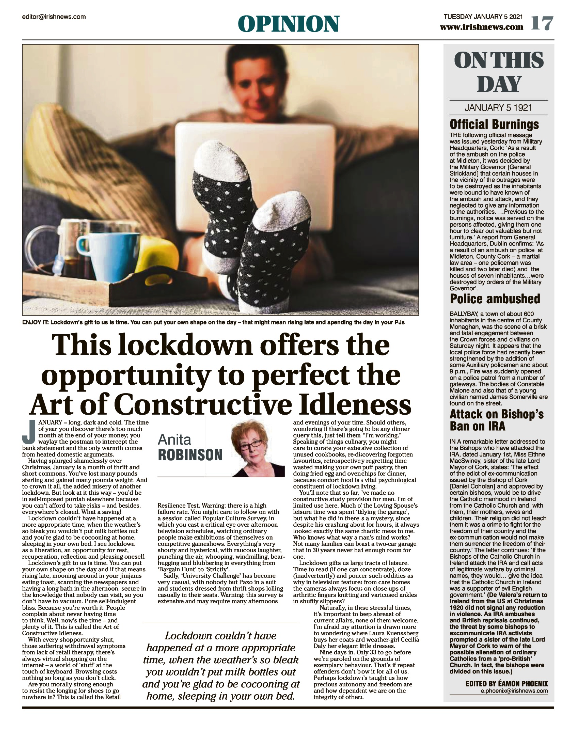
Thumbnail of PDF of Irish News page containing the Eamon Phoenix On This Day column dated 05.01.2021, detailing events reported on 05.01.1921

Summary: On This Day – 5th January 1921, official reprisals saw homes burned after an ambush in Cork, violence flared in Monaghan, and Eithne MacSwiney challenged bishops over threats to excommunicate IRA volunteers. Edited by Éamon Phoenix.

Official Burnings | On This Day – 5th January 1921

THE following official message was issued yesterday from Military Headquarters, Cork: ‘As a result of the ambush on the police at Midleton, it was decided by the Military Governor [General Strickland] that certain houses in the vicinity of the outrages were to be destroyed as the inhabitants were bound to have known of the ambush and attack, and they neglected to give any information to the authorities. …Previous to the burnings, notice was served on the persons affected, giving them one hour to clear out valuables but not furniture.’

A report from General Headquarters, Dublin confirms: ‘As a result of an ambush on police at Midleton, County Cork – a martial law area – one policeman was killed and two later died) and the houses of seven inhabitants…were destroyed by orders of the Military Governor’.

Police ambushed

BALLYBAY, a town of about 600 inhabitants in the centre of County Monaghan, was the scene of a brisk and fatal engagement between the Crown forces and civilians on Saturday night. It appears that the local police force had recently been strengthened by the addition of some Auxiliary policemen and about 9 p.m., Fire was suddenly opened on a police patrol from a number of gateways. The bodies of Constable Malone and also that of a young civilian named James Somerville were found on the street.

Attack on Bishop’s Ban on IRA

IN A remarkable letter addressed to the Bishops who have attacked the IRA, dated January 1st, Miss Eithne MacSwiney, sister of the late Lord Mayor of Cork, states: ‘The effect of the edict of ex-communication issued by the Bishop of Cork [Daniel Coholan] and approved by certain bishops, would be to drive the Catholic manhood in Ireland from the Catholic Church and, with them, their mothers, wives and children.

Their religion did not teach them it was a crime to fight for the freedom of their country and the ex-communication would not make them surrender the freedom of their country.’

The letter continues: ‘If the Bishops of the Catholic Church in Ireland attack the IRA and call acts of legitimate warfare by criminal names, they would… give the idea that the Catholic Church in Ireland was a supporter of evil English government.’

(Eamon Phoenix editor’s note: De Valera’s return to Ireland from the US at Christmas 1920 did not signal any reduction in violence.

As IRA ambushes and British reprisals continued, the threat by some bishops to excommunicate IRA activists prompted a sister of the late Lord Mayor of Cork to warn of the possible alienation of ordinary Catholics from a ‘pro-British’ Church.

In fact, the bishops were divided on this issue.)

On This Day – 5th January 1921

Further Reading on Irish History:

Bishop Daniel Cohalan

List of other On This Day columns

Other resources: National Library of Ireland Irish News CAIN Archive

About Eamon Phoenix

About the Eamon Phoenix Foundation

On This Day is a daily column in the Irish News looking back either 50 or 100 years. The column was compiled by Dr Éamon Phoenix from the mid 1980s until autumn, 2022. The Foundation is very grateful to the Irish News for giving permission to reproduce Eamon’s columns. Funding gratefully received from Ireland’s Department of Foreign Affairs and the Magill Trust.

Visit Irish News

* The Foundation has worked hard to recreate Eamon’s distinctive voice through AI. Since this is an emerging technology, occasional imperfections may be audible.