

On This Day / November 28, 1970
Go BackReproduced with permission from The Irish News.
19701128
Reference Date
19701128
Publication Date
Listen Along in Éamons Voice
Summary: On This Day – 28th November 1970, economists predict the Anglo-Irish Free Trade Agreement will soften the economic Border by 1975. Civil rights tensions deepened over a disputed Enniskillen march, while Derry City refused to play Linfield at Windsor Park amid security fears. Edited by Dr Éamon Phoenix.
No Border by 1975 | On This Day – 28th November 1970
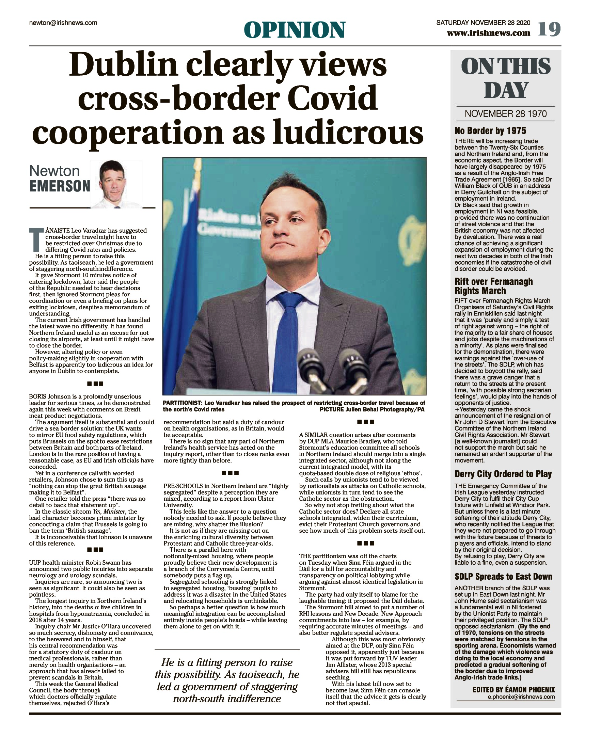
THERE will be increasing trade between the Twenty-Six Counties and Northern Ireland and, from the economic aspect, the Border will have largely disappeared by 1975 as a result of the Anglo-Irish Free Trade Agreement [1965].
So said Dr William Black of Q.U.B. in an address in Derry Guildhall on the subject of employment in Ireland.
Dr Black said that growth in employment in NI was feasible, provided there was no continuation of street violence and that the British economy was not affected by devaluation.
There was a real chance of achieving a significant expansion of employment during the next two decades in both of the Irish economies if the catastrophe of civil disorder could be avoided.
Rift over Fermanagh Rights March
Organisers of Saturday’s Civil Rights rally in Enniskillen said last night that it was ‘purely and simply a test of right against wrong – the right of the majority to a fair share of houses and jobs despite the machinations of a minority’.
As plans were finalised for the demonstration, there were warnings against the ‘over-use of the streets’.
The SDLP, which has decided to boycott the rally, said there was a grave danger that a return to the streets at the present time, ‘with possible strong sectarian feelings’, would play into the hands of opponents of justice.
Yesterday came the shock announcement of the resignation of Mr John D Stewart from the Executive Committee of the Northern Ireland Civil Rights Association.
Mr Stewart [a well-known journalist] could not support the march but said he remained an ardent supporter of the movement.
Derry City Ordered to Play
THE Emergency Committee of the Irish League yesterday instructed Derry City to fulfil their City Cup fixture with Linfield at Windsor Park.
But unless there is a last minute softening of their attitude Derry City, who recently notified the League that they were not prepared to go through with the fixture because of threats to players and officials, intend to stand by their original decision.
By refusing to play, Derry City are liable to a fine, even a suspension.
SDLP Spreads to East Down
ANOTHER branch of the SDLP was set up in East Down last night. Mr John Hume said sectarianism was a fundamental evil in NI fostered by the Unionist Party to maintain their privileged position. The SDLP opposed sectarianism.
(Éamon Phoenix editor’s note: By the end of 1970, tensions on the streets were matched by tensions in the sporting arena.
Economists warned of the damage which violence was doing to the local economy and predicted a gradual softening of the border due to improved Anglo-Irish trade links.)
On This Day – 28th November 1970
Further Reading on Irish History:
List of other On This Day columns
Other resources: National Library of Ireland Irish News CAIN Archive
19701128
Reference Date
19701128
Publication Date
Listen Along in Éamons Voice
Listen Along in Éamons Voice
Summary: On This Day – 28th November 1970, economists predict the Anglo-Irish Free Trade Agreement will soften the economic Border by 1975. Civil rights tensions deepened over a disputed Enniskillen march, while Derry City refused to play Linfield at Windsor Park amid security fears. Edited by Dr Éamon Phoenix.
No Border by 1975 | On This Day – 28th November 1970
THERE will be increasing trade between the Twenty-Six Counties and Northern Ireland and, from the economic aspect, the Border will have largely disappeared by 1975 as a result of the Anglo-Irish Free Trade Agreement [1965].
So said Dr William Black of Q.U.B. in an address in Derry Guildhall on the subject of employment in Ireland.
Dr Black said that growth in employment in NI was feasible, provided there was no continuation of street violence and that the British economy was not affected by devaluation.
There was a real chance of achieving a significant expansion of employment during the next two decades in both of the Irish economies if the catastrophe of civil disorder could be avoided.
Rift over Fermanagh Rights March
Organisers of Saturday’s Civil Rights rally in Enniskillen said last night that it was ‘purely and simply a test of right against wrong – the right of the majority to a fair share of houses and jobs despite the machinations of a minority’.
As plans were finalised for the demonstration, there were warnings against the ‘over-use of the streets’.
The SDLP, which has decided to boycott the rally, said there was a grave danger that a return to the streets at the present time, ‘with possible strong sectarian feelings’, would play into the hands of opponents of justice.
Yesterday came the shock announcement of the resignation of Mr John D Stewart from the Executive Committee of the Northern Ireland Civil Rights Association.
Mr Stewart [a well-known journalist] could not support the march but said he remained an ardent supporter of the movement.
Derry City Ordered to Play
THE Emergency Committee of the Irish League yesterday instructed Derry City to fulfil their City Cup fixture with Linfield at Windsor Park.
But unless there is a last minute softening of their attitude Derry City, who recently notified the League that they were not prepared to go through with the fixture because of threats to players and officials, intend to stand by their original decision.
By refusing to play, Derry City are liable to a fine, even a suspension.
SDLP Spreads to East Down
ANOTHER branch of the SDLP was set up in East Down last night. Mr John Hume said sectarianism was a fundamental evil in NI fostered by the Unionist Party to maintain their privileged position. The SDLP opposed sectarianism.
(Éamon Phoenix editor’s note: By the end of 1970, tensions on the streets were matched by tensions in the sporting arena.
Economists warned of the damage which violence was doing to the local economy and predicted a gradual softening of the border due to improved Anglo-Irish trade links.)
On This Day – 28th November 1970
Further Reading on Irish History:
List of other On This Day columns
Other resources: National Library of Ireland Irish News CAIN Archive
19701128
Reference Date
November 28, 2020
Publication Date
Listen Along in Éamons Voice *
Summary: On This Day – 28th November 1970, economists predict the Anglo-Irish Free Trade Agreement will soften the economic Border by 1975. Civil rights tensions deepened over a disputed Enniskillen march, while Derry City refused to play Linfield at Windsor Park amid security fears. Edited by Dr Éamon Phoenix.
No Border by 1975 | On This Day – 28th November 1970
THERE will be increasing trade between the Twenty-Six Counties and Northern Ireland and, from the economic aspect, the Border will have largely disappeared by 1975 as a result of the Anglo-Irish Free Trade Agreement [1965].
So said Dr William Black of Q.U.B. in an address in Derry Guildhall on the subject of employment in Ireland.
Dr Black said that growth in employment in NI was feasible, provided there was no continuation of street violence and that the British economy was not affected by devaluation.
There was a real chance of achieving a significant expansion of employment during the next two decades in both of the Irish economies if the catastrophe of civil disorder could be avoided.
Rift over Fermanagh Rights March
Organisers of Saturday’s Civil Rights rally in Enniskillen said last night that it was ‘purely and simply a test of right against wrong – the right of the majority to a fair share of houses and jobs despite the machinations of a minority’.
As plans were finalised for the demonstration, there were warnings against the ‘over-use of the streets’.
The SDLP, which has decided to boycott the rally, said there was a grave danger that a return to the streets at the present time, ‘with possible strong sectarian feelings’, would play into the hands of opponents of justice.
Yesterday came the shock announcement of the resignation of Mr John D Stewart from the Executive Committee of the Northern Ireland Civil Rights Association.
Mr Stewart [a well-known journalist] could not support the march but said he remained an ardent supporter of the movement.
Derry City Ordered to Play
THE Emergency Committee of the Irish League yesterday instructed Derry City to fulfil their City Cup fixture with Linfield at Windsor Park.
But unless there is a last minute softening of their attitude Derry City, who recently notified the League that they were not prepared to go through with the fixture because of threats to players and officials, intend to stand by their original decision.
By refusing to play, Derry City are liable to a fine, even a suspension.
SDLP Spreads to East Down
ANOTHER branch of the SDLP was set up in East Down last night. Mr John Hume said sectarianism was a fundamental evil in NI fostered by the Unionist Party to maintain their privileged position. The SDLP opposed sectarianism.
(Éamon Phoenix editor’s note: By the end of 1970, tensions on the streets were matched by tensions in the sporting arena.
Economists warned of the damage which violence was doing to the local economy and predicted a gradual softening of the border due to improved Anglo-Irish trade links.)
On This Day – 28th November 1970
Further Reading on Irish History:
List of other On This Day columns
Other resources: National Library of Ireland Irish News CAIN Archive
On This Day is a daily column in the Irish News looking back either 50 or 100 years. The column was compiled by Dr Éamon Phoenix from the mid 1980s until autumn, 2022. The Foundation is very grateful to the Irish News for giving permission to reproduce Eamon’s columns. Funding gratefully received from Ireland’s Department of Foreign Affairs and the Magill Trust.
* The Foundation has worked hard to recreate Eamon’s distinctive voice through AI. Since this is an emerging technology, occasional imperfections may be audible.