On This Day / February 23, 1921

Go Back

Reproduced with permission from The Irish News.

19210223

Reference Date

19210223

Publication Date

Summary: On This Day – 23rd February 1921, Roslea was sacked and burned following the shooting of a Unionist merchant, while the Archbishop of Canterbury voiced unease in the Lords over reprisals in Ireland. Edited by Éamon Phoenix.

 Fermanagh Village Sacked | On This Day – 23rd February 1921

OUR Newbliss [Co Monaghan] correspondent writes: Following the shooting of George Lester, a Unionist merchant of Roslea, County Fermanagh who was fired at and wounded on Monday morning by three disguised men, wild scenes were enacted that night when the inhabitants were terrorised by shooting into houses.

A large portion of the village was burned and a young man named Finegan, a member of the Ulster Volunteers from County Monaghan, lost his life by the accidental discharge of a rifle which he carried.

The trouble began about 10pm when a party of armed Volunteers from neighbouring districts entered the village and commenced firing shots.

A reign of terror prevailed and matters became worse when lorries of Ulster Specials arrived some time later. The houses of prominent Catholics were visited and shots fired through the windows.

Some of the terrified residents, getting out by the rear, fled to the hills and from there witnessed their houses bursting into flames. The first house set on fire was that of Philip Trainor which was burned out. Matthew Finnegan’s fine drapery establishment was the next to suffer. In all, ten houses were burned.

When seen yesterday, the once neat and picturesque little mountainside town was enveloped in a blue smoke and on entering, one saw here and there a mass of smouldering ruins with bewildered inhabitants discussing the alarming happenings of the previous night.

Mr Lester, who was shot and wounded, is now under treatment in Monaghan County Infirmary.

Roslea is a village of about 400 inhabitants, situated four miles from Clones, in County Fermanagh.

Archbishop of Canterbury ‘Uneasy’ Over Ireland

IN the House of Lords yesterday, the Archbishop of Canterbury said that while condemning the wickedness of the murderous gangs whom the forces of the Crown had to oppose in Ireland, he was bewildered at the regular reprisals that were undertaken, not at the order of any high Government authority, but by independent bodies of inadequately-disciplined men.

(The sack of Roslea on the Fermanagh-Monaghan border followed the wounding of a leading Loyalist by the IRA. It was an early warning of the violence which would flare along the new boundary as the IRA and the USC confronted each other.

The Roslea burnings by UVF provoked a series of reprisal burnings of Unionist farm-houses by the IRA. Finally, the spiral of tit-for-tat attacks was ended by a peace conference of the two sides in Clones.

Meanwhile the Church of England hierarchy joined Asquith in denouncing the depredations of the Crown forces in Ireland. By June, Bonar Law, the Deputy PM, could speak of ‘a small war which we are losing’.)

On This Day – 23rd February 1921

Further Reading on Irish History:

List of other On This Day columns

Other resources: National Library of Ireland Irish News CAIN Archive

About Eamon Phoenix

About the Eamon Phoenix Foundation

19210223

Reference Date

19210223

Publication Date

Summary: On This Day – 23rd February 1921, Roslea was sacked and burned following the shooting of a Unionist merchant, while the Archbishop of Canterbury voiced unease in the Lords over reprisals in Ireland. Edited by Éamon Phoenix.

 Fermanagh Village Sacked | On This Day – 23rd February 1921

OUR Newbliss [Co Monaghan] correspondent writes: Following the shooting of George Lester, a Unionist merchant of Roslea, County Fermanagh who was fired at and wounded on Monday morning by three disguised men, wild scenes were enacted that night when the inhabitants were terrorised by shooting into houses.

A large portion of the village was burned and a young man named Finegan, a member of the Ulster Volunteers from County Monaghan, lost his life by the accidental discharge of a rifle which he carried.

The trouble began about 10pm when a party of armed Volunteers from neighbouring districts entered the village and commenced firing shots.

A reign of terror prevailed and matters became worse when lorries of Ulster Specials arrived some time later. The houses of prominent Catholics were visited and shots fired through the windows.

Some of the terrified residents, getting out by the rear, fled to the hills and from there witnessed their houses bursting into flames. The first house set on fire was that of Philip Trainor which was burned out. Matthew Finnegan’s fine drapery establishment was the next to suffer. In all, ten houses were burned.

When seen yesterday, the once neat and picturesque little mountainside town was enveloped in a blue smoke and on entering, one saw here and there a mass of smouldering ruins with bewildered inhabitants discussing the alarming happenings of the previous night.

Mr Lester, who was shot and wounded, is now under treatment in Monaghan County Infirmary.

Roslea is a village of about 400 inhabitants, situated four miles from Clones, in County Fermanagh.

Archbishop of Canterbury ‘Uneasy’ Over Ireland

IN the House of Lords yesterday, the Archbishop of Canterbury said that while condemning the wickedness of the murderous gangs whom the forces of the Crown had to oppose in Ireland, he was bewildered at the regular reprisals that were undertaken, not at the order of any high Government authority, but by independent bodies of inadequately-disciplined men.

(The sack of Roslea on the Fermanagh-Monaghan border followed the wounding of a leading Loyalist by the IRA. It was an early warning of the violence which would flare along the new boundary as the IRA and the USC confronted each other.

The Roslea burnings by UVF provoked a series of reprisal burnings of Unionist farm-houses by the IRA. Finally, the spiral of tit-for-tat attacks was ended by a peace conference of the two sides in Clones.

Meanwhile the Church of England hierarchy joined Asquith in denouncing the depredations of the Crown forces in Ireland. By June, Bonar Law, the Deputy PM, could speak of ‘a small war which we are losing’.)

On This Day – 23rd February 1921

Further Reading on Irish History:

List of other On This Day columns

Other resources: National Library of Ireland Irish News CAIN Archive

About Eamon Phoenix

About the Eamon Phoenix Foundation

19210223

Reference Date

February 23, 2021

Publication Date

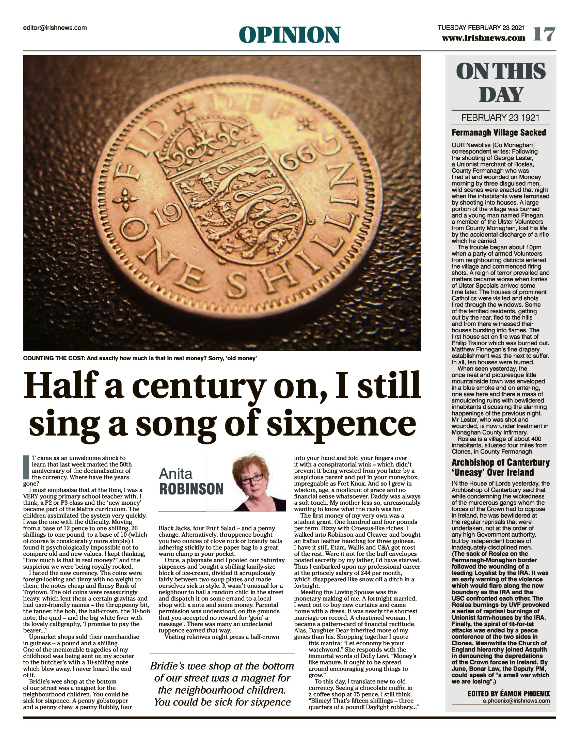
Thumbnail of PDF of Irish News page containing the Eamon Phoenix On This Day column dated 23rd February 2021, detailing events reported on 23rd February 1921

Summary: On This Day – 23rd February 1921, Roslea was sacked and burned following the shooting of a Unionist merchant, while the Archbishop of Canterbury voiced unease in the Lords over reprisals in Ireland. Edited by Éamon Phoenix.

 Fermanagh Village Sacked | On This Day – 23rd February 1921

OUR Newbliss [Co Monaghan] correspondent writes: Following the shooting of George Lester, a Unionist merchant of Roslea, County Fermanagh who was fired at and wounded on Monday morning by three disguised men, wild scenes were enacted that night when the inhabitants were terrorised by shooting into houses.

A large portion of the village was burned and a young man named Finegan, a member of the Ulster Volunteers from County Monaghan, lost his life by the accidental discharge of a rifle which he carried.

The trouble began about 10pm when a party of armed Volunteers from neighbouring districts entered the village and commenced firing shots.

A reign of terror prevailed and matters became worse when lorries of Ulster Specials arrived some time later. The houses of prominent Catholics were visited and shots fired through the windows.

Some of the terrified residents, getting out by the rear, fled to the hills and from there witnessed their houses bursting into flames. The first house set on fire was that of Philip Trainor which was burned out. Matthew Finnegan’s fine drapery establishment was the next to suffer. In all, ten houses were burned.

When seen yesterday, the once neat and picturesque little mountainside town was enveloped in a blue smoke and on entering, one saw here and there a mass of smouldering ruins with bewildered inhabitants discussing the alarming happenings of the previous night.

Mr Lester, who was shot and wounded, is now under treatment in Monaghan County Infirmary.

Roslea is a village of about 400 inhabitants, situated four miles from Clones, in County Fermanagh.

Archbishop of Canterbury ‘Uneasy’ Over Ireland

IN the House of Lords yesterday, the Archbishop of Canterbury said that while condemning the wickedness of the murderous gangs whom the forces of the Crown had to oppose in Ireland, he was bewildered at the regular reprisals that were undertaken, not at the order of any high Government authority, but by independent bodies of inadequately-disciplined men.

(The sack of Roslea on the Fermanagh-Monaghan border followed the wounding of a leading Loyalist by the IRA. It was an early warning of the violence which would flare along the new boundary as the IRA and the USC confronted each other.

The Roslea burnings by UVF provoked a series of reprisal burnings of Unionist farm-houses by the IRA. Finally, the spiral of tit-for-tat attacks was ended by a peace conference of the two sides in Clones.

Meanwhile the Church of England hierarchy joined Asquith in denouncing the depredations of the Crown forces in Ireland. By June, Bonar Law, the Deputy PM, could speak of ‘a small war which we are losing’.)

On This Day – 23rd February 1921

Further Reading on Irish History:

List of other On This Day columns

Other resources: National Library of Ireland Irish News CAIN Archive

About Eamon Phoenix

About the Eamon Phoenix Foundation

On This Day is a daily column in the Irish News looking back either 50 or 100 years. The column was compiled by Dr Éamon Phoenix from the mid 1980s until autumn, 2022. The Foundation is very grateful to the Irish News for giving permission to reproduce Eamon’s columns. Funding gratefully received from Ireland’s Department of Foreign Affairs and the Magill Trust.

Visit Irish News

* The Foundation has worked hard to recreate Eamon’s distinctive voice through AI. Since this is an emerging technology, occasional imperfections may be audible.