On This Day / February 17, 1921

Go Back

Reproduced with permission from The Irish News.

19210217

Reference Date

19210217

Publication Date

Summary: On This Day – 17th February 1921, a deadly ambush on a train at Upton, Cork, killed civilians and attackers alike, while Lloyd George moved to suppress the Cork city burning report, and police searches intensified in Antrim and Derry. Edited by Éamon Phoenix.

Slaughter on a Train | On This Day – 17th February 1921

NEWS of a train ambush at Upton, County Cork, resulting in the death of nine people, was received in Cork yesterday.

The train carried a large number of civilian passengers and about forty military.

As it was slowing down into Upton Station fire was opened from both sides of the line. The soldiers jumped out and returned fire.

Eight civilians, including a woman, were killed, six of the victims being passengers on the train and two members of the attacking party.

Lloyd George Suppresses Cork Report

Editorial

Mr Lloyd George met the challenges of Mr Asquith [former PM] and Mr J H Thomas [Labour] at Westminster yesterday with the truculence associated with the parliamentary performances of Sir Hamar Greenwood.

The ex-Premier referred to the non-publication of the Strickland Report [into the burning of Cork in December 1920].

The Premier intimated that the famous Report would not be published at all.

Nothing in the history of the British Parliament was more disgusting than his efforts to explain away this burking of a State document for which all the world had been waiting. Mr Lloyd George’s subterfuges were… contemptible.

Lord Buckmaster, an ex-Lord Chancellor, said: ‘It was now pretty plain that the forces of the Crown deliberately burnt down public and private buildings in Cork. … why is not that Report our property?

There was only one conceivable reason why it was not published and that was because it condemned the Government.’

Derry Prison Escape

The Derry police are scouring the city for Francis Carty, Sligo, the untried political prisoner who escaped from Derry Prison on Tuesday morning.

An examination of the prison shows that the escape was exceedingly daring.

An iron bar on the window of the cell had been sawn through and a rope enabled the prisoner to gain the top of the Jail wall.

North Antrim Mass-goers Searched

On Sunday the people who attended Mass at Loughguile [County Antrim] were held up on emerging from the church by a number of police who searched all the members, even old men and women.

On Sunday evening a number of little boys were engaged playing football near Magherahoney Catholic Church when the field was surrounded by police and all the players were placed against the hedge and searched. Nothing incriminating was found.

(Éamon Phoenix editor’s note: Lloyd George’s decision to suppress the official report on the burning of Cork was condemned by the London Times as ‘equivalent to a confession’. The Report condemned the Auxiliaries.

Both Lord Northcliffe, owner of the Times, and CP Scott, editor of the Manchester Guardian and close to Lloyd George, now condemned the PM’s coercive Irish policy.

On This Day – 17th February 1921

Further Reading on Irish History:

List of other On This Day columns

Other resources: National Library of Ireland Irish News CAIN Archive

About Eamon Phoenix

About the Eamon Phoenix Foundation

19210217

Reference Date

19210217

Publication Date

Summary: On This Day – 17th February 1921, a deadly ambush on a train at Upton, Cork, killed civilians and attackers alike, while Lloyd George moved to suppress the Cork city burning report, and police searches intensified in Antrim and Derry. Edited by Éamon Phoenix.

Slaughter on a Train | On This Day – 17th February 1921

NEWS of a train ambush at Upton, County Cork, resulting in the death of nine people, was received in Cork yesterday.

The train carried a large number of civilian passengers and about forty military.

As it was slowing down into Upton Station fire was opened from both sides of the line. The soldiers jumped out and returned fire.

Eight civilians, including a woman, were killed, six of the victims being passengers on the train and two members of the attacking party.

Lloyd George Suppresses Cork Report

Editorial

Mr Lloyd George met the challenges of Mr Asquith [former PM] and Mr J H Thomas [Labour] at Westminster yesterday with the truculence associated with the parliamentary performances of Sir Hamar Greenwood.

The ex-Premier referred to the non-publication of the Strickland Report [into the burning of Cork in December 1920].

The Premier intimated that the famous Report would not be published at all.

Nothing in the history of the British Parliament was more disgusting than his efforts to explain away this burking of a State document for which all the world had been waiting. Mr Lloyd George’s subterfuges were… contemptible.

Lord Buckmaster, an ex-Lord Chancellor, said: ‘It was now pretty plain that the forces of the Crown deliberately burnt down public and private buildings in Cork. … why is not that Report our property?

There was only one conceivable reason why it was not published and that was because it condemned the Government.’

Derry Prison Escape

The Derry police are scouring the city for Francis Carty, Sligo, the untried political prisoner who escaped from Derry Prison on Tuesday morning.

An examination of the prison shows that the escape was exceedingly daring.

An iron bar on the window of the cell had been sawn through and a rope enabled the prisoner to gain the top of the Jail wall.

North Antrim Mass-goers Searched

On Sunday the people who attended Mass at Loughguile [County Antrim] were held up on emerging from the church by a number of police who searched all the members, even old men and women.

On Sunday evening a number of little boys were engaged playing football near Magherahoney Catholic Church when the field was surrounded by police and all the players were placed against the hedge and searched. Nothing incriminating was found.

(Éamon Phoenix editor’s note: Lloyd George’s decision to suppress the official report on the burning of Cork was condemned by the London Times as ‘equivalent to a confession’. The Report condemned the Auxiliaries.

Both Lord Northcliffe, owner of the Times, and CP Scott, editor of the Manchester Guardian and close to Lloyd George, now condemned the PM’s coercive Irish policy.

On This Day – 17th February 1921

Further Reading on Irish History:

List of other On This Day columns

Other resources: National Library of Ireland Irish News CAIN Archive

About Eamon Phoenix

About the Eamon Phoenix Foundation

19210217

Reference Date

February 17, 2021

Publication Date

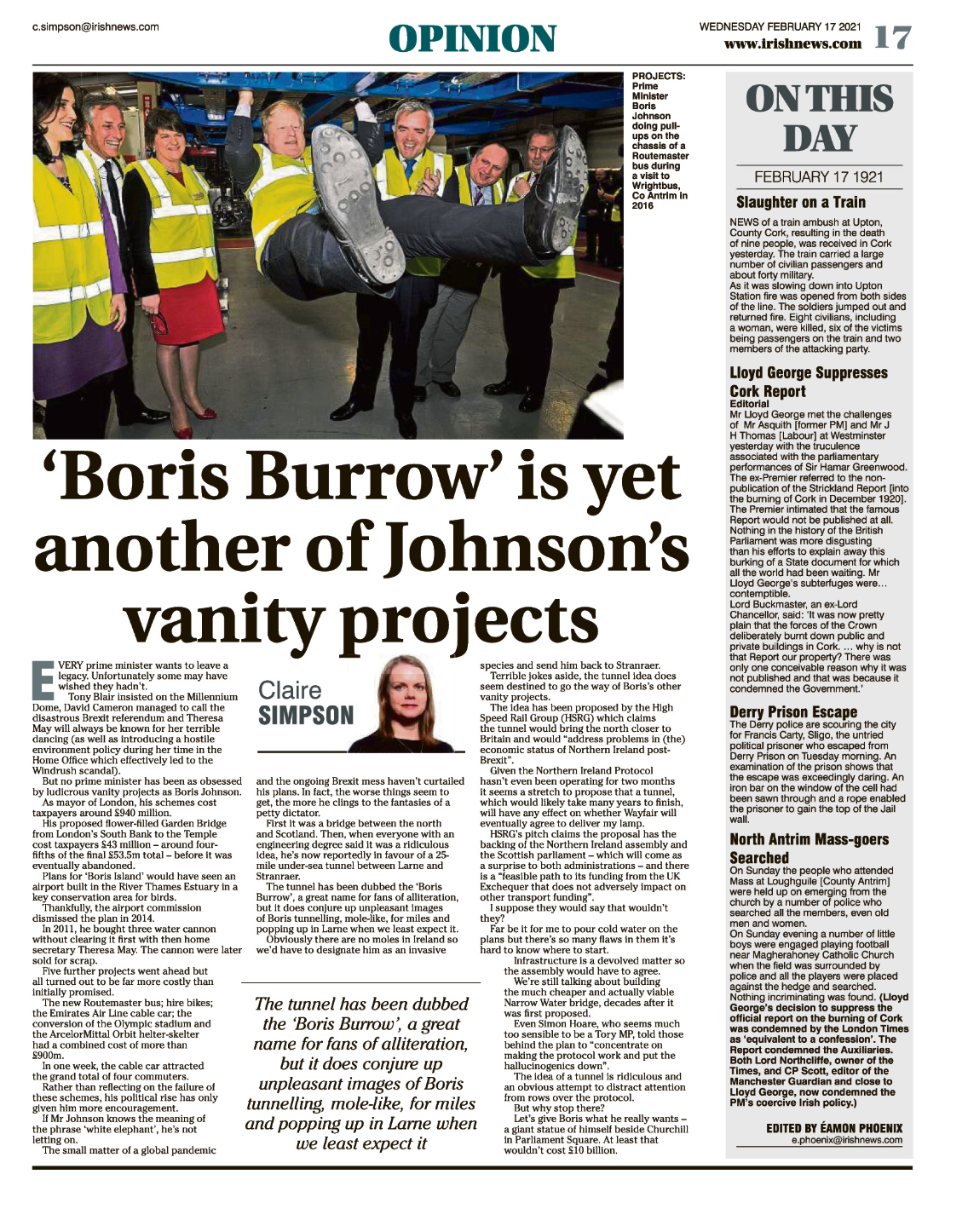
Thumbnail of PDF of Irish News page containing the Eamon Phoenix On This Day column dated 17th February 2021, detailing events reported on 17th February 1921

Summary: On This Day – 17th February 1921, a deadly ambush on a train at Upton, Cork, killed civilians and attackers alike, while Lloyd George moved to suppress the Cork city burning report, and police searches intensified in Antrim and Derry. Edited by Éamon Phoenix.

Slaughter on a Train | On This Day – 17th February 1921

NEWS of a train ambush at Upton, County Cork, resulting in the death of nine people, was received in Cork yesterday.

The train carried a large number of civilian passengers and about forty military.

As it was slowing down into Upton Station fire was opened from both sides of the line. The soldiers jumped out and returned fire.

Eight civilians, including a woman, were killed, six of the victims being passengers on the train and two members of the attacking party.

Lloyd George Suppresses Cork Report

Editorial

Mr Lloyd George met the challenges of Mr Asquith [former PM] and Mr J H Thomas [Labour] at Westminster yesterday with the truculence associated with the parliamentary performances of Sir Hamar Greenwood.

The ex-Premier referred to the non-publication of the Strickland Report [into the burning of Cork in December 1920].

The Premier intimated that the famous Report would not be published at all.

Nothing in the history of the British Parliament was more disgusting than his efforts to explain away this burking of a State document for which all the world had been waiting. Mr Lloyd George’s subterfuges were… contemptible.

Lord Buckmaster, an ex-Lord Chancellor, said: ‘It was now pretty plain that the forces of the Crown deliberately burnt down public and private buildings in Cork. … why is not that Report our property?

There was only one conceivable reason why it was not published and that was because it condemned the Government.’

Derry Prison Escape

The Derry police are scouring the city for Francis Carty, Sligo, the untried political prisoner who escaped from Derry Prison on Tuesday morning.

An examination of the prison shows that the escape was exceedingly daring.

An iron bar on the window of the cell had been sawn through and a rope enabled the prisoner to gain the top of the Jail wall.

North Antrim Mass-goers Searched

On Sunday the people who attended Mass at Loughguile [County Antrim] were held up on emerging from the church by a number of police who searched all the members, even old men and women.

On Sunday evening a number of little boys were engaged playing football near Magherahoney Catholic Church when the field was surrounded by police and all the players were placed against the hedge and searched. Nothing incriminating was found.

(Éamon Phoenix editor’s note: Lloyd George’s decision to suppress the official report on the burning of Cork was condemned by the London Times as ‘equivalent to a confession’. The Report condemned the Auxiliaries.

Both Lord Northcliffe, owner of the Times, and CP Scott, editor of the Manchester Guardian and close to Lloyd George, now condemned the PM’s coercive Irish policy.

On This Day – 17th February 1921

Further Reading on Irish History:

List of other On This Day columns

Other resources: National Library of Ireland Irish News CAIN Archive

About Eamon Phoenix

About the Eamon Phoenix Foundation

On This Day is a daily column in the Irish News looking back either 50 or 100 years. The column was compiled by Dr Éamon Phoenix from the mid 1980s until autumn, 2022. The Foundation is very grateful to the Irish News for giving permission to reproduce Eamon’s columns. Funding gratefully received from Ireland’s Department of Foreign Affairs and the Magill Trust.

Visit Irish News

* The Foundation has worked hard to recreate Eamon’s distinctive voice through AI. Since this is an emerging technology, occasional imperfections may be audible.