On This Day / October 16, 1920
Go BackReproduced with permission from The Irish News.
19201016
Reference Date
19201016
Publication Date
Summary: On This Day – 16th October 1920, Lisburn magistrates jailed rioters from the August ‘Swanzy Riots’, prompting 300 Specials to resign in protest. Edited by historian Dr Éamon Phoenix.
Lisburn ‘Specials’ Resign | On This Day – 16th October 1920
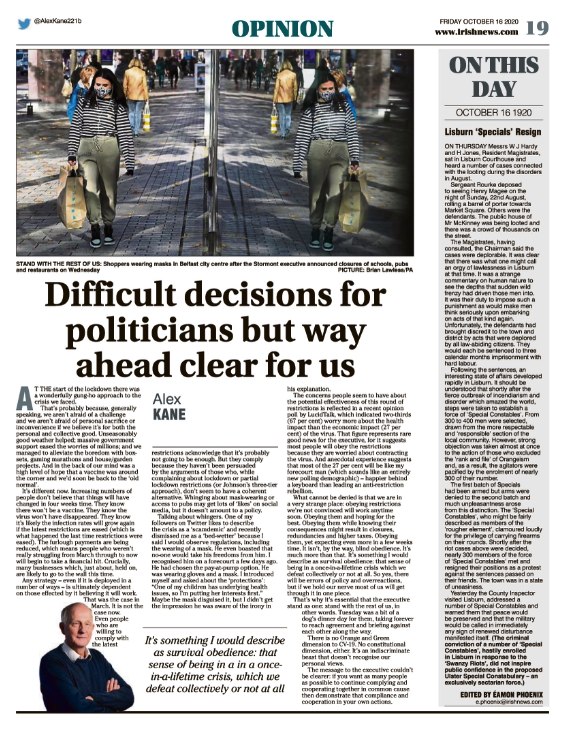
ON THURSDAY Messrs W J Hardy and H Jones, Resident Magistrates, sat in Lisburn Courthouse and heard a number of cases connected with the looting during the disorders in August.
Sergeant Rourke deposed to seeing Henry Magee on the night of Sunday, 22nd August, rolling a barrel of porter towards Market Square. Others were the defendants. The public house of Mr McKinney was being looted and there was a crowd of thousands on the street.
The Magistrates, having consulted, the Chairman said the cases were deplorable. It was clear that there was what one might call an orgy of lawlessness in Lisburn at that time. It was a strange commentary on human nature to see the depths that sudden wild frenzy had driven those men into.
It was their duty to impose such a punishment as would make men think seriously upon embarking on acts of that kind again. Unfortunately, the defendants had brought discredit to the town and district by acts that were deplored by all law-abiding citizens. They would each be sentenced to three calendar months imprisonment with hard labour.
Following the sentences, an interesting state of affairs developed rapidly in Lisburn. It should be understood that shortly after the fierce outbreak of incendiarism and disorder which amazed the world, steps were taken to establish a force of ‘Special Constables’. From 300 to 400 men were selected, drawn from the more respectable and ‘responsible’ section of the local community.
However, strong objection was taken almost at once to the action of those who excluded the ‘rank and file’ of Orangeism and, as a result, the agitators were pacified by the enrolment of nearly 300 of their number.
The first batch of Specials had been armed but arms were denied to the second batch and much unpleasantness arose from this distinction. The ‘Special Constables’, who might be fairly described as members of the ‘rougher element’, clamoured loudly for the privilege of carrying firearms on their rounds.
Shortly after the riot cases above were decided, nearly 300 members of the force of ‘Special Constables’ met and resigned their positions as a protest against the sentences passed on their friends. The town was in a state of uneasiness.
Yesterday the County Inspector visited Lisburn, addressed a number of Special Constables and warned them that peace would be preserved and that the military would be called in immediately any sign of renewed disturbance manifested itself.
(Editor’s note: The criminal conviction of a number of ‘Special Constables’, hastily enrolled in Lisburn in response to the ‘Swanzy Riots’, did not inspire public confidence in the proposed Ulster Special Constabulary – an exclusively sectarian force.)
On This Day – 16th October 1920
Further Reading on Irish History:
List of other On This Day columns
Other resources: National Library of Ireland Irish News CAIN Archive
19201016
Reference Date
19201016
Publication Date
Listen Along in Éamons Voice
Summary: On This Day – 16th October 1920, Lisburn magistrates jailed rioters from the August ‘Swanzy Riots’, prompting 300 Specials to resign in protest. Edited by historian Dr Éamon Phoenix.
Lisburn ‘Specials’ Resign | On This Day – 16th October 1920
ON THURSDAY Messrs W J Hardy and H Jones, Resident Magistrates, sat in Lisburn Courthouse and heard a number of cases connected with the looting during the disorders in August.
Sergeant Rourke deposed to seeing Henry Magee on the night of Sunday, 22nd August, rolling a barrel of porter towards Market Square. Others were the defendants. The public house of Mr McKinney was being looted and there was a crowd of thousands on the street.
The Magistrates, having consulted, the Chairman said the cases were deplorable. It was clear that there was what one might call an orgy of lawlessness in Lisburn at that time. It was a strange commentary on human nature to see the depths that sudden wild frenzy had driven those men into.
It was their duty to impose such a punishment as would make men think seriously upon embarking on acts of that kind again. Unfortunately, the defendants had brought discredit to the town and district by acts that were deplored by all law-abiding citizens. They would each be sentenced to three calendar months imprisonment with hard labour.
Following the sentences, an interesting state of affairs developed rapidly in Lisburn. It should be understood that shortly after the fierce outbreak of incendiarism and disorder which amazed the world, steps were taken to establish a force of ‘Special Constables’. From 300 to 400 men were selected, drawn from the more respectable and ‘responsible’ section of the local community.
However, strong objection was taken almost at once to the action of those who excluded the ‘rank and file’ of Orangeism and, as a result, the agitators were pacified by the enrolment of nearly 300 of their number.
The first batch of Specials had been armed but arms were denied to the second batch and much unpleasantness arose from this distinction. The ‘Special Constables’, who might be fairly described as members of the ‘rougher element’, clamoured loudly for the privilege of carrying firearms on their rounds.
Shortly after the riot cases above were decided, nearly 300 members of the force of ‘Special Constables’ met and resigned their positions as a protest against the sentences passed on their friends. The town was in a state of uneasiness.
Yesterday the County Inspector visited Lisburn, addressed a number of Special Constables and warned them that peace would be preserved and that the military would be called in immediately any sign of renewed disturbance manifested itself.
(Editor’s note: The criminal conviction of a number of ‘Special Constables’, hastily enrolled in Lisburn in response to the ‘Swanzy Riots’, did not inspire public confidence in the proposed Ulster Special Constabulary – an exclusively sectarian force.)
On This Day – 16th October 1920
Further Reading on Irish History:
List of other On This Day columns
Other resources: National Library of Ireland Irish News CAIN Archive
19201016
Reference Date
October 16, 2020
Publication Date
Listen Along in Éamons Voice *
Summary: On This Day – 16th October 1920, Lisburn magistrates jailed rioters from the August ‘Swanzy Riots’, prompting 300 Specials to resign in protest. Edited by historian Dr Éamon Phoenix.
Lisburn ‘Specials’ Resign | On This Day – 16th October 1920
ON THURSDAY Messrs W J Hardy and H Jones, Resident Magistrates, sat in Lisburn Courthouse and heard a number of cases connected with the looting during the disorders in August.
Sergeant Rourke deposed to seeing Henry Magee on the night of Sunday, 22nd August, rolling a barrel of porter towards Market Square. Others were the defendants. The public house of Mr McKinney was being looted and there was a crowd of thousands on the street.
The Magistrates, having consulted, the Chairman said the cases were deplorable. It was clear that there was what one might call an orgy of lawlessness in Lisburn at that time. It was a strange commentary on human nature to see the depths that sudden wild frenzy had driven those men into.
It was their duty to impose such a punishment as would make men think seriously upon embarking on acts of that kind again. Unfortunately, the defendants had brought discredit to the town and district by acts that were deplored by all law-abiding citizens. They would each be sentenced to three calendar months imprisonment with hard labour.
Following the sentences, an interesting state of affairs developed rapidly in Lisburn. It should be understood that shortly after the fierce outbreak of incendiarism and disorder which amazed the world, steps were taken to establish a force of ‘Special Constables’. From 300 to 400 men were selected, drawn from the more respectable and ‘responsible’ section of the local community.
However, strong objection was taken almost at once to the action of those who excluded the ‘rank and file’ of Orangeism and, as a result, the agitators were pacified by the enrolment of nearly 300 of their number.
The first batch of Specials had been armed but arms were denied to the second batch and much unpleasantness arose from this distinction. The ‘Special Constables’, who might be fairly described as members of the ‘rougher element’, clamoured loudly for the privilege of carrying firearms on their rounds.
Shortly after the riot cases above were decided, nearly 300 members of the force of ‘Special Constables’ met and resigned their positions as a protest against the sentences passed on their friends. The town was in a state of uneasiness.
Yesterday the County Inspector visited Lisburn, addressed a number of Special Constables and warned them that peace would be preserved and that the military would be called in immediately any sign of renewed disturbance manifested itself.
(Editor’s note: The criminal conviction of a number of ‘Special Constables’, hastily enrolled in Lisburn in response to the ‘Swanzy Riots’, did not inspire public confidence in the proposed Ulster Special Constabulary – an exclusively sectarian force.)
On This Day – 16th October 1920
Further Reading on Irish History:
List of other On This Day columns
Other resources: National Library of Ireland Irish News CAIN Archive
On This Day is a daily column in the Irish News looking back either 50 or 100 years. The column was compiled by Dr Éamon Phoenix from the mid 1980s until autumn, 2022. The Foundation is very grateful to the Irish News for giving permission to reproduce Eamon’s columns. Funding gratefully received from Ireland’s Department of Foreign Affairs and the Magill Trust.
* The Foundation has worked hard to recreate Eamon’s distinctive voice through AI. Since this is an emerging technology, occasional imperfections may be audible.